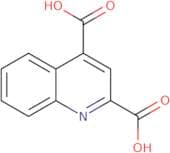
CAS 5323-57-9
:quinoline-2,4-dicarboxylic acid
Description:
Quinoline-2,4-dicarboxylic acid is an aromatic organic compound characterized by its quinoline structure, which consists of a fused benzene and pyridine ring. This compound features two carboxylic acid groups (-COOH) located at the 2 and 4 positions of the quinoline ring, contributing to its acidic properties and enhancing its solubility in polar solvents. It typically appears as a crystalline solid and is known for its potential applications in various fields, including pharmaceuticals, agrochemicals, and as a building block in organic synthesis. The presence of the carboxylic acid groups allows for the formation of salts and esters, making it versatile in chemical reactions. Quinoline derivatives are often studied for their biological activities, including antimicrobial and antitumor properties. Additionally, the compound's structure allows for potential coordination with metal ions, which can be useful in catalysis and materials science. Overall, quinoline-2,4-dicarboxylic acid is a significant compound in both synthetic and applied chemistry contexts.
Formula:C11H7NO4
InChI:InChI=1/C11H7NO4/c13-10(14)7-5-9(11(15)16)12-8-4-2-1-3-6(7)8/h1-5H,(H,13,14)(H,15,16)
SMILES:c1ccc2c(c1)c(cc(C(=O)O)n2)C(=O)O
Synonyms:- 2,4-Quinolinedicarboxylic Acid
Sort by
Purity (%)
0
100
|
0
|
50
|
90
|
95
|
100
Found 4 products.
Quinoline-2,4-dicarboxylic acid
CAS:Formula:C11H7NO4Purity:95%Color and Shape:SolidMolecular weight:217.1776Quinoline-2,4-dicarboxylic acid
CAS:<p>Quinoline-2,4-dicarboxylic acid</p>Purity:95%Molecular weight:217.18g/molQuinoline 2,4-dicarboxylic acid
CAS:<p>Quinoline 2,4-dicarboxylic acid (QDA) is a novel cytotoxic agent that targets cervical cancer cells. It inhibits the uptake of glucose and other nutrients by cervical cancer cells, leading to cell death through apoptosis. QDA also inhibits the expression of genes involved in cross-linking reactions, which are important for the structural integrity of proteins. This agent has been shown to inhibit the growth of aniline-induced breast cancer cells and glutamate-stimulated PC12 cells. QDA binds to DNA and forms covalent bonds with nucleotide bases, inhibiting DNA synthesis, as well as interfering with protein synthesis and cell division. The QDA mechanism is similar to that of benzoquinolines and estrone sulfate.</p>Formula:C11H7NO4Purity:Min. 95%Color and Shape:White PowderMolecular weight:217.18 g/mol