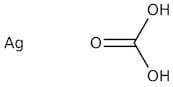
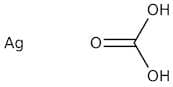
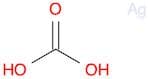
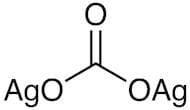
CAS 534-16-7
:Silver carbonate
Description:
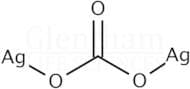
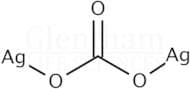
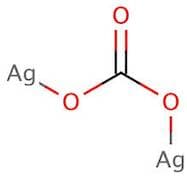
Silver carbonate, with the CAS number 534-16-7, is an inorganic compound characterized by its pale yellow to white crystalline appearance. It is composed of silver ions (Ag+) and carbonate ions (CO3^2-), forming a salt that is relatively insoluble in water. Silver carbonate is known for its thermal instability; upon heating, it decomposes to yield silver oxide and carbon dioxide. This compound is often used in organic synthesis, particularly in reactions involving the formation of silver salts or as a reagent in various chemical transformations. Additionally, it exhibits antibacterial properties, making it of interest in medicinal chemistry. Silver carbonate should be handled with care, as silver compounds can be toxic and may cause skin and eye irritation. Its applications extend to photography and as a catalyst in certain reactions, highlighting its versatility in both industrial and laboratory settings. Proper storage in a cool, dry place away from light is recommended to maintain its stability and effectiveness.
Formula:CH2O3·2Ag
InChI:InChI=1S/CH2O3.2Ag/c2-1(3)4;;/h(H2,2,3,4);;
InChI key:InChIKey=WIKQEUJFZPCFNJ-UHFFFAOYSA-N
SMILES:C(=O)(O)O.[Ag]
Synonyms:- Carbonic Acid - Silver (1:2)
- Carbonic acid, disilver(1+) salt
- Carbonic acid, silver(1+) salt (1:2)
- Disilver carbonate
- Fetizon's reagent
- Silver carbonate (2:1)
- Silver(I) carbonate
- Silvercarbonateyellowpowder
- Silver carbonate
Sort by
Purity (%)
0
100
|
0
|
50
|
90
|
95
|
100
Found 13 products.
Silver carbonate on Celite, ≈0.7 mmole Ag2CO3/g reagent
CAS:Oxidizing agent for alcohols, diols/triols, hydroquinones, and aminesFormula:CH2AgO3Molecular weight:169.89Silver carbonate, 99.5% (metals basis)
CAS:Silver carbonate is used in the production of silver powder in microelectronics, conducting polymers, and in tooth surface treatment to prevent cavities. It is also used as an antimicrobial agent for infection resistant surgical fabric materials. It is used in organic synthesis, and in biologicalFormula:CH2AgO3Purity:99.5%Molecular weight:169.89Silver carbonate (99+%-Ag)
CAS:Silver carbonate (99+%-Ag)
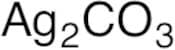
Formula:Ag2CO3Purity:(99+%-Ag)Color and Shape:yellow to pale green pwdr.Molecular weight:275.75Ref: IN-DA0037BE
1gTo inquire1kgTo inquire5gTo inquire10gTo inquire25gTo inquire50gTo inquire100gTo inquire250gTo inquire500gTo inquireSilver Carbonate
CAS:Silver CarbonateFormula:·CO3·2AgPurity:98%Color and Shape:Yellow SolidMolecular weight:275.7453Silver(I) Carbonate
CAS:Formula:Ag2CO3Purity:>98.0%(T)Color and Shape:Light yellow to Yellow powder to crystalMolecular weight:275.74Silver (I) carbonate, Trace metals grade 99.95%
CAS:Formula:CAg2O3Purity:99.95%Molecular weight:275.744Silver carbonate, 99.7%
CAS:Formula:Ag2CO3Purity:≥ 99.7%Color and Shape:Yellow to green or brown powderMolecular weight:275.75Silver Carbonate pure, 99%
CAS:Formula:Ag2CO3Purity:min. 99%Color and Shape:A greyish yellow, PowderMolecular weight:275.75Silver Carbonate
CAS:Applications Silver Carbonate is used in organic synthesis in the Koenigs-knorr glycosylation reaction. It is also known as Fetizon's reagent acting as an oxidising agent on celite forming lactones form diols.
Not a dangerous good if item is equal to or less than 1g/ml and there is less than 100g/ml in the package
References Fetizon, M., et al.: J. Chem. Soc. Chem. Comm., 19, 1118 (1969);Formula:Ag2CO3Color and Shape:NeatMolecular weight:275.75