Indoles
Indoles are heterocyclic compounds composed of a benzene ring fused to a pyrrole ring. These compounds are important in medicinal chemistry for their wide range of biological activities, including anti-inflammatory, anticancer, and antimicrobial properties. Indoles are used in synthesizing pharmaceuticals, agrochemicals, and dyes. At CymitQuimica, we provide a comprehensive range of high-quality indoles for your research and industrial applications.
Subcategories of "Indoles"
Found 3983 products of "Indoles"
Sort by
Purity (%)
0
100
|
0
|
50
|
90
|
95
|
100
Ethyl 2-[3-(1H-indol-2-yl)phenyl]-4-methyl-1,3-thiazole-5-carboxylate
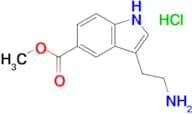
CAS:Molecular weight:362.45001220703125METHYL 3-(2-AMINOETHYL)-1H-INDOLE-5-CARBOXYLATE HYDROCHLORIDE
CAS:Formula:C12H15ClN2O2Purity:97%Color and Shape:No data available.Molecular weight:254.713-Methyl-1H-Indole-d8
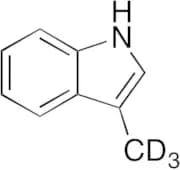
CAS:Controlled Product<p>Applications 3-(methyl-d3)-1H-Indole-2,4,5,6,7-d5 is the labeled analogue of 3-Methylindole (M313470), a naturally abundant pneumotoxin, found primarily in mammalian feces providing its strong fecal odor; however in lower concentrations the compound has a pleasent aroma, giving orange blossoms and jasmine their pleasing scent. It is often a component of commercial fragrances and perfumes.<br> Not a dangerous good if item is equal to or less than 1g/ml and there is less than 100g/ml in the package<br>References Nakashima, T., et al.: Biol. Pharm. Bull., 32, 832 (2009), Xu, H., et al.: Chem. Pharm. Bull., 57, 321 (2009), Bodoor, K., et al.: J. Med. Chem., 52, 3753 (2009), Naskar, S., et al.: J. Chem. Res., 3, 174 (2009), Sollner, K., et al.: J. Agric. Food Chem., 57, 4319 (2009),<br></p>Formula:C92H8HNColor and Shape:NeatMolecular weight:139.223-Methyl-d3-indole
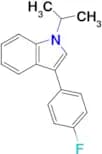
CAS:Controlled Product<p>Applications 3-Methyl-d3-indole has been used to prove that bioactivation of the pulmonary toxin 3-methylindole requires methyl carbon-hydrogen bond breakage in mice. 3-Methyl-d3-indole is the labeled analogue of 3-Methylindole (M313470), A naturally abundant pneumotoxin, found primarily in mammalian feces providing its strong fecal odor.<br> Not a dangerous good if item is equal to or less than 1g/ml and there is less than 100g/ml in the package<br>References Huijzer, J., et. al.: Toxicol. Appl. Pharm., 90, 60 (1987); Nakashima, T., et al.: Biol. Pharm. Bull., 32, 832 (2009); Xu, H., et al.: Chem. Pharm. Bull., 57, 321 (2009); Bodoor, K., et al.: J. Med. Chem., 52, 3753 (2009); Naskar, S., et al.: J. Chem. Res., 3, 174 (2009); Sollner, K., et al.: J. Agric. Food Chem., 57, 4319 (2009)<br></p>Formula:C92H3H6NColor and Shape:NeatMolecular weight:134.193-(4-Fluorophenyl)-1-isopropyl-1H-indole
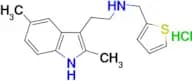
CAS:Purity:95.0%Color and Shape:SolidMolecular weight:253.320007324218752-(2,5-dimethyl-1H-indol-3-yl)-N-(thiophen-2-ylmethyl)ethan-1-amine hydrochloride
CAS:Purity:95.0%Molecular weight:320.8800048828125

![Ethyl 2-[3-(1H-indol-2-yl)phenyl]-4-methyl-1,3-thiazole-5-carboxylate](/_next/image/?url=https%3A%2Fstatic.cymitquimica.com%2Fproducts%2F10%2Fthumb-webp%2FF098030.webp&w=3840&q=75)