Synthetic Organic Chemistry
Synthetic organic chemistry is a branch of chemistry focused on the design and construction of organic molecules through controlled chemical reactions. This field plays a crucial role in the development of pharmaceuticals, agrochemicals, polymers, and advanced materials. At CymitQuimica, we offer a comprehensive range of high-purity reagents, catalysts, and building blocks essential for synthetic organic chemistry. Our catalog includes a variety of functionalized compounds, protecting groups, chiral auxiliaries, and coupling reagents, all meticulously tested for quality and consistency. By providing top-quality materials, we support researchers and industry professionals in achieving precise and efficient synthetic transformations, facilitating the discovery and development of innovative chemical entities and complex organic structures. Our products enable advancements in medicinal chemistry, material science, and chemical biology, driving progress in both research and industrial applications.
Subcategories of "Synthetic Organic Chemistry"
- Acids and Synthetic Reagents(15,008 products)
- Building Blocks(248,204 products)
- C-C Bond Forming Reactions(885 products)
- Protecting Groups(2,696 products)
- Reagents for Functional Group Introduction/Modification(1,021 products)
Found 207 products of "Synthetic Organic Chemistry"
Sort by
Purity (%)
0
100
|
0
|
50
|
90
|
95
|
100
1,9-Dicyanononane
CAS:<p>1,9-Dicyanonane is a reactive compound that is used in enzymatic reactions. It has an affinity for the carboxylate group of the enzyme and reacts with it to form products. 1,9-Dicyanonane can be used as an affinity label to identify enzymes in a reaction. This compound can also be labeled with stable isotopes of carbon, nitrogen, or hydrogen to make it more useful in NMR spectroscopy and mass spectrometry. The stable isotopes are usually 13C, 15N, or 2H. The use of these labels allows for calculation of the number of molecules in a sample by measuring the intensity of the peaks corresponding to the specific isotope.</p>Formula:C11H18N2Purity:Min. 95%Molecular weight:178.27 g/molMethyl 5-cyano-2-methoxybenzoate
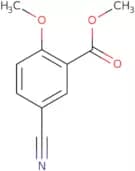
CAS:<p>Versatile small molecule scaffold</p>Formula:C10H9NO3Purity:Min. 95%Molecular weight:191.18 g/mol1-tert-Butyl 4-ethyl 4-cyanopiperidine-1,4-dicarboxylate
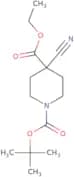
CAS:<p>Versatile small molecule scaffold</p>Formula:C14H22N2O4Purity:Min. 95%Molecular weight:282.34 g/molMethyl 1-cyanocyclopropanecarboxylate
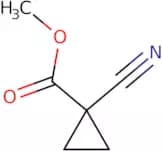
CAS:<p>Versatile small molecule scaffold</p>Formula:C6H7NO2Purity:Min. 95%Molecular weight:125.13 g/moltert-Butyl 3-cyanobenzoate
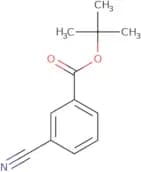
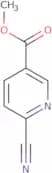
CAS:<p>Versatile small molecule scaffold</p>Formula:C12H13NO2Purity:Min. 95%Molecular weight:203.24 g/molMethyl 6-cyanonicotinate
CAS:<p>Versatile small molecule scaffold</p>Formula:C8H6N2O2Purity:Min. 95%Molecular weight:162.15 g/moltert-Butyl 3-cyano-3-(hydroxymethyl)azetidine-1-carboxylate
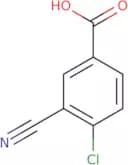
CAS:<p>Versatile small molecule scaffold</p>Formula:C10H16N2O3Purity:Min. 95%Molecular weight:212.25 g/mol4-Chloro-3-cyanobenzoic acid
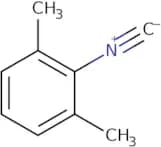
CAS:<p>Versatile small molecule scaffold</p>Formula:C8H4ClNO2Purity:Min. 95%Molecular weight:181.58 g/mol2-Isocyano-1,3-dimethyl-benzene
CAS:<p>2-Isocyano-1,3-dimethyl-benzene is an organic compound that is used to synthesize other compounds. It has a redox potential of -0.6 volts and a crystallography of orthorhombic with a space group of Pbca. It reacts with nitrogen atoms in the reaction solution to form stable complexes and can react with copper ions to form a copper complex. 2-Isocyano-1,3-dimethyl-benzene has been shown to undergo transfer reactions with molybdenum in the presence of xylene as solvent and ammonia gas as a catalyst. This chemical reaction mechanism leads to the formation of an isocyanide intermediate, which then reacts with water molecules to create an aminium ion and hydrogen cyanide. Titration calorimetry experiments have shown that 2-isocyano-1,3-dimethylbenzene has an enthalpy change of -2</p>Formula:C9H9NPurity:Min. 95%Molecular weight:131.17 g/molPotassiumhexacyanocobaltate(III)
CAS:Controlled Product<p>Potassiumhexacyanocobaltate(III) is a compound that is an optical material with a yellow colour. It has a high degree of anisotropy, and it can be used in magneto-optical devices. Potassiumhexacyanocobaltate(III) is bifunctional, meaning that it can have both magnetic and light emitting properties. The magnetic property arises from the spin-orbit coupling between the metal ions, while the light emission is due to radiative transitions involving the electrons in the metal ion. Potassiumhexacyanocobaltate(III) has been used to produce light emission in crystalline materials such as gallium arsenide and zinc selenide, as well as in devices such as LEDs.</p>Formula:C5CoK3N6Purity:Min. 95%Molecular weight:320.32 g/molMethyl 4-cyano-2-methoxybenzoate
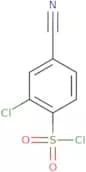
CAS:<p>Versatile small molecule scaffold</p>Formula:C10H9NO3Purity:Min. 95%Molecular weight:191.18 g/mol2-Chloro-4-cyanobenzenesulfonyl chloride
CAS:<p>Versatile small molecule scaffold</p>Formula:C7H3Cl2NO2SPurity:Min. 95%Molecular weight:236.08 g/molMethyl 6-chloro-5-cyanopicolinate
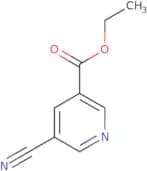
CAS:<p>Versatile small molecule scaffold</p>Formula:C8H5ClN2O2Purity:Min. 95%Molecular weight:196.59 g/molEthyl 5-cyanonicotinate
CAS:<p>Versatile small molecule scaffold</p>Formula:C9H8N2O2Purity:Min. 95%Molecular weight:176.17 g/mol5-cyano-2-methoxybenzoic acid
CAS:<p>Versatile small molecule scaffold</p>Formula:C9H7NO3Purity:Min. 95%Molecular weight:177.16 g/molSodium Pentacyanoammineferroate(II) Hydrate
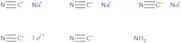
CAS:Controlled Product<p>Please enquire for more information about Sodium Pentacyanoammineferroate(II) Hydrate including the price, delivery time and more detailed product information at the technical inquiry form on this page</p>Formula:C5H3FeN6Na3·xH2OPurity:Min. 95%Molecular weight:271.94 g/moltert-Butyl 6-cyano-3,4-dihydroisoquinoline-2(1H)-carboxylate
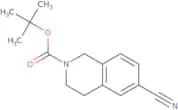
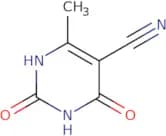
CAS:<p>Versatile small molecule scaffold</p>Formula:C15H18N2O2Purity:Min. 95%Molecular weight:258.32 g/mol6-Methyl-5-cyanouracil
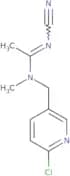
CAS:<p>Versatile small molecule scaffold</p>Formula:C6H5N3O2Purity:Min. 95%Molecular weight:151.12 g/molN-(6-Chloro-3-pyridylmethyl)-N-cyano-N-methylacetamidine
CAS:<p>N-(6-Chloro-3-pyridylmethyl)-N-cyano-N-methylacetamidine is a chemical pesticide that belongs to the class of chlorinated acetamides. It has been shown to be highly resistant to biological degradation, which means it can persist in the environment for a long time and accumulate in living organisms. This pesticide has been shown to have genotoxic effects in vivo and in vitro, and it has been shown to have an adverse effect on the kidney bean α subunit gene expression. In vitro assays have also shown that this compound is able to inhibit locomotor activity, as well as surface methodology optical sensor assays. N-(6-Chloro-3-pyridylmethyl)-N-cyano-N-methylacetamidine appears to be a promising candidate for wastewater treatment because it does not appear to be toxic at sublethal doses.</p>Formula:C10H11ClN4Purity:Min. 95%Molecular weight:222.67 g/mol4-Chloro-2-cyanophenylsulfonyl Chloride
CAS:<p>Versatile small molecule scaffold</p>Formula:C7H3NO2SCl2Purity:Min. 95%Molecular weight:236.07 g/mol