Cyano-, Nitrile-
Cyano and nitrile compounds are organic molecules that contain cyano (C≡N) or nitrile groups in their structure, characterized by the presence of nitrogen. These groups play important roles in various chemical reactions and industrial applications. In this category, you will find a wide range of cyano and nitrile compounds, ranging from simple to complex structures. At CymitQuimica, we offer high-quality cyano and nitrile compounds tailored to meet research and industrial needs. Our compounds are suitable for a variety of synthesis and analytical applications.
Found 9618 products of "Cyano-, Nitrile-"
Sort by
Purity (%)
0
100
|
0
|
50
|
90
|
95
|
100
6-Cyano-2-oxaspiro[3.3]heptane-6-carboxylic acid
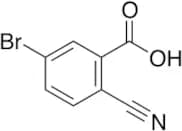
CAS:Controlled Product<p>Applications 6-cyano-2-oxaspiro[3.3]heptane-6-carboxylic acid (cas# 1934971-05-7) is a useful research chemical.<br></p>Formula:C8H9NO3Color and Shape:NeatMolecular weight:167.1625-Bromo-2-cyanobenzoic Acid
CAS:Controlled ProductFormula:C8H4BrNO2Color and Shape:NeatMolecular weight:226.027(3,5-Dimethoxyphenyl)acetonitrile
CAS:Controlled Product<p>Applications (3,5-Dimethoxyphenyl)acetonitrile (cas# 13388-75-5) is a compound useful in organic synthesis.<br></p>Formula:C10H11NO2Color and Shape:NeatMolecular weight:177.2N-[4-Cyano-3-(trifluoromethyl)phenyl]-2-hydroxy-5-nitrobenzamide
Controlled ProductFormula:C15H8F3N3O4Color and Shape:NeatMolecular weight:351.237(5-Benzyloxyindol-3-yl)acetonitrile
CAS:Controlled ProductFormula:C17H14N2OColor and Shape:NeatMolecular weight:262.3064-Cyano-N,N-dimethylbenzamide
CAS:Controlled Product<p>Applications 4-cyano-N,N-dimethylbenzamide (cas# 24167-50-8) is a useful research chemical.<br></p>Formula:C10H10N2OColor and Shape:NeatMolecular weight:174.19Aminoacetonitrile Hydrochloride
CAS:Controlled Product<p>Applications Aminoacetonitrile is a useful synthetic intermediate. It is a reagent used to synthesize dipeptide nitriles as reversible and potent cathepsin S inhibitors. It can also used to prepare substituted cyclic ureas as possible HIV protease inhibitors.<br>References Ward, Y., et al.: J. Med. Chem., 45, 5471 (2002); Wilkerson, W., et al.: J. Med. Chem., 40, 4079 (1997)<br></p>Formula:C2H5ClN2Color and Shape:White To Off-WhiteMolecular weight:92.53Benzoylacetonitrile
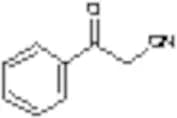
CAS:Controlled Product<p>Applications Used as a building block for the preparation of 4H-pyrans, 2-pyridones, furans and carbocyclics.<br>References Herschhorn, A., et al.: J. Med. Chem., 50, 3402 (2007),<br></p>Formula:C9H7NOColor and Shape:NeatMolecular weight:145.162-Fluoro-4-iodobenzonitrile
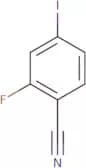
CAS:<p>2-fluoro-4-iodobenzonitrile is a potent inhibitor of the functions of VEGFR receptors. It inhibits the proliferation and migration of cancer cells by binding to VEGFR receptors, which are tyrosine kinases that regulate cell growth and differentiation. 2-Fluoro-4-iodobenzonitrile has been shown to inhibit angiogenesis, or the formation of new blood vessels, in vitro. This drug also has potent inhibitory activity against tumor growth in vivo. Clinical trials have shown that 2-fluoro-4-iodobenzonitrile can be used to treat various types of cancers, including breast cancer and colon cancer.</p>Formula:C7H3FINPurity:Min. 95%Color and Shape:PowderMolecular weight:247.01 g/mol3-Cyano-1-azetidinesulfonyl chloride
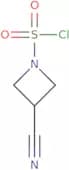
CAS:<p>Please enquire for more information about 3-Cyano-1-azetidinesulfonyl chloride including the price, delivery time and more detailed product information at the technical inquiry form on this page</p>Formula:C4H5ClN2O2SPurity:Min. 95%Molecular weight:180.61 g/molEthyl (ethoxymethylene) cyanoacetate
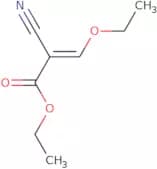
CAS:<p>Ethyl (Ethoxymethylene) cyanoacetate is a chemical compound that belongs to the family of aldehyde compounds. It is a colorless liquid at room temperature, with an odor similar to that of acetic acid. The compound has been used in the synthesis of epidermal growth factor and diazonium salts. It has also been used in the production of anti-cancer drugs such as malonic acid, which inhibits tumor growth by inhibiting protein synthesis. Ethyl (Ethoxymethylene) cyanoacetate reacts with quinoline derivatives to form carbon disulphide, which can be used as an antimicrobial agent and insecticide.</p>Formula:C8H11NO3Purity:Min. 95%Color and Shape:PowderMolecular weight:169.18 g/mol4-Cyano-2-methylphenylboronic acid, pinacol ester
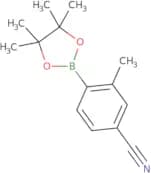
CAS:<p>Please enquire for more information about 4-Cyano-2-methylphenylboronic acid, pinacol ester including the price, delivery time and more detailed product information at the technical inquiry form on this page</p>Formula:C14H18BNO2Purity:Min. 95%Molecular weight:243.11 g/molDicyclohexylamine 2-cyanoacrylate
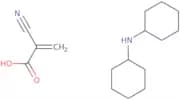
CAS:Controlled Product<p>Please enquire for more information about Dicyclohexylamine 2-cyanoacrylate including the price, delivery time and more detailed product information at the technical inquiry form on this page</p>Formula:C16H26N2O2Purity:Min. 95%Molecular weight:278.39 g/molN'-Cyanobenzenecarboximidamide hydrochloride
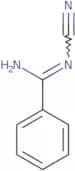
CAS:<p>N-Cyanobenzenecarboximidamide hydrochloride (NCBCH) is an intermediate for the synthesis of azomethine dyes. It can be used to produce azo dyes with a methoxy group at the 3 position and a hydrogen atom at the 4 position. NCBCH is also an excellent substrate for chemical reactions involving fragmentation, extraction, or elimination. NCBCH can be synthesized from methyl ether and benzonitrile in the presence of benzamidine. The product is then treated with methanol to give a tautomeric mixture of benzyl and methyl ether.</p>Formula:C8H7N3Purity:Min. 95%Molecular weight:145.16 g/mol5-Cyanopyridine-2-carboxylic acid
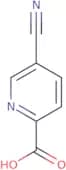
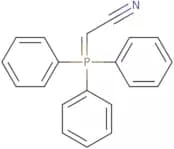
CAS:<p>5-Cyanopyridine-2-carboxylic acid is a small molecule that has been found to have significant biological activity in a number of different areas, including neurotherapeutics. It is the result of a scalable synthesis and is soluble in water. The molecule has two chiral centers and can exist as four different stereoisomers (enantiomers). In vitro studies show that 5-cyanopyridine-2-carboxylic acid inhibits fatty acid uptake by blocking the proton pump, which transports lipids into cells. This compound also binds to the cytosolic protein pyrazine 2-carboxylic acid receptor 1 (PYZR1), which may provide an explanation for its effects on fatty acid uptake.</p>Formula:C7H4N2O2Purity:Min. 95%Molecular weight:148.12 g/mol(Triphenylphosphoranylidene)acetonitrile
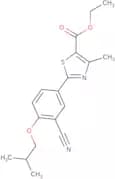
CAS:<p>(Triphenylphosphoranylidene)acetonitrile is a phosphorane that has been shown to have an inhibitory effect on the inflammatory response in animal models of bowel disease. It also has been shown to be effective in treating inflammatory diseases such as arthritis and multiple sclerosis. This drug binds to leukotriene D4, an inflammatory mediator, and inhibits its production by blocking the enzyme 5-lipoxygenase. The compound also has been shown to possess anti-inflammatory properties due to its inhibition of prostaglandin synthesis. (Triphenylphosphoranylidene)acetonitrile is used as a pharmaceutical preparation for the treatment of bowel disease, inflammatory diseases, and other conditions.</p>Formula:C20H16NPPurity:Min. 95%Molecular weight:301.32 g/molEthyl 2-(3-cyano-4-isobutoxyphenyl)-4-methyl-5-thiazolecarboxylate
CAS:<p>Ethyl 2-(3-cyano-4-isobutoxyphenyl)-4-methyl-5-thiazolecarboxylate (ECIT) is a derivative of formyl that has been used as a solvent for industrial and laboratory purposes. ECIT is an amorphous substance with the chemical formula CH3COC6H2CH2COCH=N(C=O)C6H4CN. The compound has been quantified in various solvents, such as n-butyl alcohol and acetonitrile. ECIT is a colorless liquid that boils at 140° C. It has a formyl group and an alkynyl group, which are both reactive groups that can be used to synthesize other compounds. ECIT also contains two stereoisomers: the erythro isomer and the threo isomer. The erythro isomer has the structural formula of CH3COC6H2CH</p>Purity:Min. 95%a-Acetylphenylacetonitrile
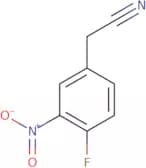
CAS:Controlled Product<p>a-Acetylphenylacetonitrile is a bifunctional molecule that can be used in the synthesis of new compounds, such as pharmaceuticals, dyes, and perfumes. It is an analytical technique for measuring the concentrations of cyanides in wastewater. The fluorescence properties of this compound are helpful in detecting the presence of phenylacetone by using a kinetic assay. This compound can also be used to synthesize other organic compounds with high enantiopurity.</p>Formula:C10H9NOPurity:Min. 95%Molecular weight:159.18 g/mol(4-Fluoro-3-Nitrophenyl)Acetonitrile
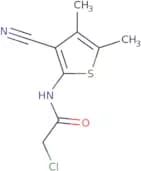
CAS:<p>4-Fluoro-3-nitrophenylacetonitrile is a monomer that can be synthesised from the reaction of carbamic acid and diphenyl ether. It is chiral, stereoselective and nucleophilic. 4-Fluoro-3-nitrophenylacetonitrile can also be synthesised by reacting fluoroacetamide with sodium cyanide in water, forming the corresponding amide, which reacts with acetonitrile to form the nitro compound. The anti-cancer properties of 4-fluoro-3 nitrophenylacetonitrile have been studied in vitro and in vivo. This substance has been shown to inhibit growth of cancer cells and induce apoptosis. In addition, this substance has been used as a synthetic strategy for dihydroisoquinolines, which are important for their anti-cancer properties.</p>Formula:C8H5FN2O2Purity:Min. 95%Molecular weight:180.14 g/mol2-Chloro-N-(3-cyano-4,5-dimethylthien-2-yl)acetamide
CAS:<p>Please enquire for more information about 2-Chloro-N-(3-cyano-4,5-dimethylthien-2-yl)acetamide including the price, delivery time and more detailed product information at the technical inquiry form on this page</p>Formula:C9H9ClN2OSPurity:Min. 95%Molecular weight:228.7 g/mol
![6-Cyano-2-oxaspiro[3.3]heptane-6-carboxylic acid](/_next/image/?url=https%3A%2Fstatic.cymitquimica.com%2Fproducts%2FTR%2Fthumb-webp%2FC277626.webp&w=3840&q=75)


![N-[4-Cyano-3-(trifluoromethyl)phenyl]-2-hydroxy-5-nitrobenzamide](/_next/image/?url=https%3A%2Fstatic.cymitquimica.com%2Fproducts%2FTR%2Fthumb-webp%2FC982240.webp&w=3840&q=75)