Cyano-, Nitrile-
Cyano and nitrile compounds are organic molecules that contain cyano (C≡N) or nitrile groups in their structure, characterized by the presence of nitrogen. These groups play important roles in various chemical reactions and industrial applications. In this category, you will find a wide range of cyano and nitrile compounds, ranging from simple to complex structures. At CymitQuimica, we offer high-quality cyano and nitrile compounds tailored to meet research and industrial needs. Our compounds are suitable for a variety of synthesis and analytical applications.
Found 9618 products of "Cyano-, Nitrile-"
Sort by
Purity (%)
0
100
|
0
|
50
|
90
|
95
|
100
Tert-butyl N-[(5-Cyanothiophen-2-yl)methyl]carbamate
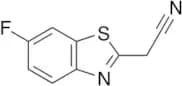
CAS:Controlled ProductFormula:C11H14N2O2SColor and Shape:NeatMolecular weight:238.3066-Fluoro-2-benzothiazoleacetonitrile
CAS:Controlled ProductFormula:C9H5FN2SColor and Shape:NeatMolecular weight:192.213Aminoacetonitrile Hydrochloride
CAS:Controlled Product<p>Applications Aminoacetonitrile is a useful synthetic intermediate. It is a reagent used to synthesize dipeptide nitriles as reversible and potent cathepsin S inhibitors. It can also used to prepare substituted cyclic ureas as possible HIV protease inhibitors.<br>References Ward, Y., et al.: J. Med. Chem., 45, 5471 (2002); Wilkerson, W., et al.: J. Med. Chem., 40, 4079 (1997)<br></p>Formula:C2H5ClN2Color and Shape:White To Off-WhiteMolecular weight:92.53Phenoxyacetonitrile
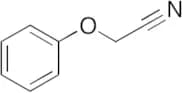
CAS:Controlled Product<p>Applications Phenoxyacetonitrile is a building block that has been used as a reactant for the preparation of [[(oxo)pyridazinyl]phenoxy]acetonitrile derivatives to be used as vasodilators.<br>References Bansal, R., et. al.: Drug Dev. Ind. Pharm., 74, 296 (2013)<br></p>Formula:C8H7NOColor and Shape:NeatMolecular weight:133.147p-Cyanobenzoic Acid Trimer
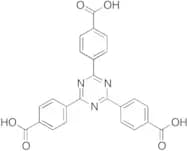
CAS:Controlled Product<p>Applications p-Cyanobenzoic Acid Trimer is used in the synthetic preparation of Terbium Triazinetribenzoate Formate Metal Organic Framework (MOF).<br>References Han, Y., et al.: J. Mater. Chem. A Mater. Energy Sustain., 3, 24525 (2015)<br></p>Formula:C24H15N3O6Color and Shape:NeatMolecular weight:441.392-Amino-4-cyano-phenol
CAS:Controlled Product<p>Stability Air Sensitive, Light Sensitive<br>Applications 2-Amino-4-cyano-phenol<br></p>Formula:C7H6N2OColor and Shape:NeatMolecular weight:134.14Diethyl (2-cyanoethyl)phosphonate
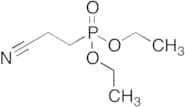
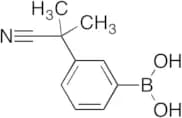
CAS:Controlled Product<p>Applications Diethyl (2-cyanoethyl)phosphonate, is a useful reactant used in various chemical synthesis such as in synthesis of lipophilic oxoamides with activity against phospholipase A2, Triose phosphate isomerase of muscle inhibitors, and also in base-catalyzed stereospecific anti-Markovnikov addition.<br></p>Formula:C7H14NO3PColor and Shape:NeatMolecular weight:191.163-(2-Cyanopropan-2-yl)phenylboronic acid
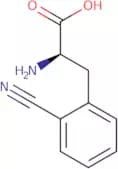
CAS:Controlled ProductFormula:C10H12BNO2Color and Shape:NeatMolecular weight:189.019D-2-Cyanophenylalanine
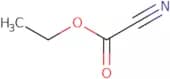
CAS:<p>Please enquire for more information about D-2-Cyanophenylalanine including the price, delivery time and more detailed product information at the technical inquiry form on this page</p>Formula:C10H10N2O2Purity:Min. 95%Molecular weight:190.2 g/molEthyl cyanoformate
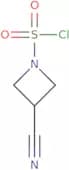
CAS:<p>Ethyl cyanoformate is a reactive compound that is used in organic synthesis. It has been shown to cause muscle cell proliferation and inhibit the production of gamma-aminobutyric acid, which is responsible for regulating neurotransmitter release. Ethyl cyanoformate also has antimicrobial properties due to its ability to form an oxygenated n-oxide tautomer. The reaction mechanism of ethyl cyanoformate involves the formation of a covalent bond with the sulfhydryl group on the enzyme gamma-aminobutyric acid receptor. This prevents the binding of GABA, inhibiting nerve impulses and reducing inflammation in the bowel.</p>Formula:C4H5NO2Purity:Min. 95%Color and Shape:Clear LiquidMolecular weight:99.09 g/mol3-Cyano-1-azetidinesulfonyl chloride
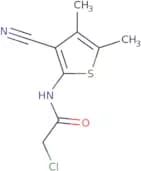
CAS:<p>Please enquire for more information about 3-Cyano-1-azetidinesulfonyl chloride including the price, delivery time and more detailed product information at the technical inquiry form on this page</p>Formula:C4H5ClN2O2SPurity:Min. 95%Molecular weight:180.61 g/mol2-Chloro-N-(3-cyano-4,5-dimethylthien-2-yl)acetamide
CAS:<p>Please enquire for more information about 2-Chloro-N-(3-cyano-4,5-dimethylthien-2-yl)acetamide including the price, delivery time and more detailed product information at the technical inquiry form on this page</p>Formula:C9H9ClN2OSPurity:Min. 95%Molecular weight:228.7 g/molDiethyl cyanophosphonate
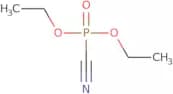
CAS:<p>Diethyl cyanophosphonate is a compound that is used as a fluorescence probe for amides and pyrazole rings. It binds to the ester form of the amide, which can then be detected with a fluorescence detector. The chemical reaction between diethyl cyanophosphonate and the ester form is reversible, so it can be used as a hypoglycemic agent. Diethyl cyanophosphonate has potent antitumor activity and binds to nerve cells, causing them to become electrically active.</p>Formula:C5H10NO3PPurity:Min. 95%Color and Shape:PowderMolecular weight:163.11 g/mol(1-Methyl-1H-benzoimidazol-2-yl)-acetonitrile
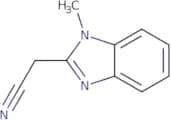
CAS:Controlled Product<p>(1-Methyl-1H-benzoimidazol-2-yl)-acetonitrile is a nucleophilic compound that reacts with carbanions to form alkyl benzoates. It can also act as an electrophile in the formation of nitroalkenes and amides, as well as an intermediate in the synthesis of phenazines. The potassium salt of this compound is used as a reagent in organic synthesis. (1-Methyl-1H-benzoimidazol-2-yl)-acetonitrile has been shown to react with methylene and aromatize to produce ethyl cyanoacetate, which can be used for the production of malononitrile. This reaction is catalyzed by potassium carbonate and esters.</p>Formula:C10H9N3Purity:Min. 95%Molecular weight:171.2 g/molEthyl 2-(3-cyano-4-isobutoxyphenyl)-4-methyl-5-thiazolecarboxylate
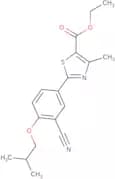
CAS:<p>Ethyl 2-(3-cyano-4-isobutoxyphenyl)-4-methyl-5-thiazolecarboxylate (ECIT) is a derivative of formyl that has been used as a solvent for industrial and laboratory purposes. ECIT is an amorphous substance with the chemical formula CH3COC6H2CH2COCH=N(C=O)C6H4CN. The compound has been quantified in various solvents, such as n-butyl alcohol and acetonitrile. ECIT is a colorless liquid that boils at 140° C. It has a formyl group and an alkynyl group, which are both reactive groups that can be used to synthesize other compounds. ECIT also contains two stereoisomers: the erythro isomer and the threo isomer. The erythro isomer has the structural formula of CH3COC6H2CH</p>Purity:Min. 95%a,a-Dimethyl-1-piperidineacetonitrile
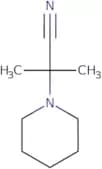
CAS:Controlled Product<p>Dimethylcyanamide is an organic compound that can be synthesized from cyanide or cyanic acid. Dimethylcyanamide is a colorless liquid with a strong odor. It has been used in the past as a precursor to other compounds, but it has since been replaced by cheaper and more convenient methods. Dimethylcyanamide reacts with primary amines to form nitriles, which are useful intermediates in organic synthesis. In addition, the reaction of dimethylcyanamide with secondary amines leads to the formation of primary amines. The transamination of dimethylamine-N-oxide yields a-dimethylaminopropionitrile as an intermediate product. The elimination reaction mechanism for this process involves the conversion of ammonia into hydroxide ions and hydrogen gas. This reaction produces high yields for both products and does not require high temperatures or pressures.</p>Formula:C9H16N2Purity:Min. 95%Molecular weight:152.24 g/molCyanoguanidine
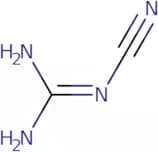
CAS:<p>Cyanoguanidine is an antimicrobial agent that inhibits the growth of bacteria by interfering with the synthesis of folic acid. This inhibits the production of DNA and protein, thereby leading to cell death. Cyanoguanidine has been shown to be effective in a model system for blood sampling and has been used as a pharmacological treatment for infectious diseases such as malaria. The optimum concentration for cyanoguanidine is between 5-20 mM, depending on the bacterial species. It can be synthesized from sulfamoyl chloride and dicyandiamide, which are commercially available chemicals. The analytical method for determining the inhibitory effects of cyanoguanidine on bacterial growth is plasma mass spectrometry.</p>Formula:C2H4N4Purity:Min. 95%Color and Shape:PowderMolecular weight:84.08 g/mol2-Cyano-N-cyclohexyl-N-methylacetamide
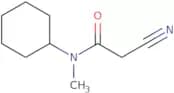
CAS:<p>Please enquire for more information about 2-Cyano-N-cyclohexyl-N-methylacetamide including the price, delivery time and more detailed product information at the technical inquiry form on this page</p>Formula:C10H16N2OPurity:Min. 95%Molecular weight:180.25 g/molDicyclohexylamine 2-cyanoacrylate
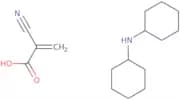
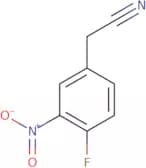
CAS:Controlled Product<p>Please enquire for more information about Dicyclohexylamine 2-cyanoacrylate including the price, delivery time and more detailed product information at the technical inquiry form on this page</p>Formula:C16H26N2O2Purity:Min. 95%Molecular weight:278.39 g/mol(4-Fluoro-3-Nitrophenyl)Acetonitrile
CAS:<p>4-Fluoro-3-nitrophenylacetonitrile is a monomer that can be synthesised from the reaction of carbamic acid and diphenyl ether. It is chiral, stereoselective and nucleophilic. 4-Fluoro-3-nitrophenylacetonitrile can also be synthesised by reacting fluoroacetamide with sodium cyanide in water, forming the corresponding amide, which reacts with acetonitrile to form the nitro compound. The anti-cancer properties of 4-fluoro-3 nitrophenylacetonitrile have been studied in vitro and in vivo. This substance has been shown to inhibit growth of cancer cells and induce apoptosis. In addition, this substance has been used as a synthetic strategy for dihydroisoquinolines, which are important for their anti-cancer properties.</p>Formula:C8H5FN2O2Purity:Min. 95%Molecular weight:180.14 g/mol
![Tert-butyl N-[(5-Cyanothiophen-2-yl)methyl]carbamate](/_next/image/?url=https%3A%2Fstatic.cymitquimica.com%2Fproducts%2FTR%2Fthumb-webp%2FB815518.webp&w=3840&q=75)