


Ethers
Ethers are organic compounds containing an ether functional group, characterized by an oxygen atom bonded to two hydrocarbon radicals. These compounds are valuable in synthesis and serve as solvents in various chemical reactions. At CymitQuimica, we offer a selection of high-quality ethers to support your research and industrial applications, ensuring reliable and effective results. Our range of ethers meets diverse laboratory requirements, from routine experiments to advanced research.
Found 40712 products of "Ethers"
Sort by
Purity (%)
0
100
|
0
|
50
|
90
|
95
|
100
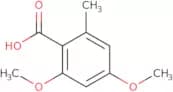
2,4-Dimethoxy-6-methylbenzoic acid
CAS:<p>2,4-Dimethoxy-6-methylbenzoic acid is a polyunsaturated compound that has been shown to have antioxidative properties. It has been shown to inhibit the formation of reactive oxygen species (ROS) and lipid peroxidation and reduce oxidative stress in mice. This molecule also has anticancer activities and is able to inhibit the growth of cancer cells. 2,4-Dimethoxy-6-methylbenzoic acid has been quantified in different food products such as vegetables, fruits, and grains. It can be found in dietary supplements, solvents, and cosmetics.</p>Formula:C10H12O4Purity:Min. 95%Color and Shape:White PowderMolecular weight:196.2 g/mol3-Methoxy-4-(4-nitrobenzyloxy)benzaldehyde
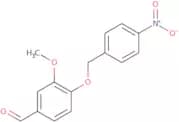
CAS:<p>3-Methoxy-4-(4-nitrobenzyloxy)benzaldehyde is a chemical intermediate that is used in the synthesis of complex compounds. It has been shown to be an effective reagent for the synthesis of various organic compounds, such as pharmaceuticals and pesticides. 3-Methoxy-4-(4-nitrobenzyloxy)benzaldehyde is also used as a research chemical or as a speciality chemical in laboratories. This compound can be used as a building block in the synthesis of other compounds with interesting properties, such as 3-methoxy-4-(2,5-dichlorobenzyloxy)benzaldehyde.</p>Formula:C15H13NO5Purity:Min. 95%Color and Shape:PowderMolecular weight:287.27 g/mol2,4-Dimethoxy-3-methylbenzyl alcohol
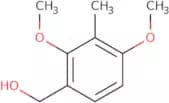
CAS:<p>2,4-Dimethoxy-3-methylbenzyl alcohol is a syntheses and deuterium analogue of orsellinic acid. It has been shown to inhibit bacterial growth in the presence of an oxygen atmosphere.</p>Formula:C10H14O3Purity:Min. 95%Molecular weight:182.22 g/mol4-(Trifluoromethoxy)phenylacetic acid
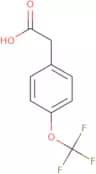
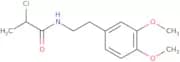
CAS:<p>4-(Trifluoromethoxy)phenylacetic acid is a useful scaffold, versatile building block, and useful intermediate in organic synthesis. It is a speciality chemical that is used as a reaction component in the preparation of complex compounds. 4-(Trifluoromethoxy)phenylacetic acid is also a reagent for the synthesis of high-quality pharmaceuticals, such as antibiotics and antiviral agents. This compound has CAS No. 4315-07-5 and can be found at Chemicals Online.</p>Formula:C9H7F3O3Purity:Min. 95%Color and Shape:PowderMolecular weight:220.15 g/molN-(2-(3,4-dimethoxyphenyl)ethyl)-2-chloropropanamide
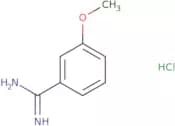
CAS:<p>Please enquire for more information about N-(2-(3,4-dimethoxyphenyl)ethyl)-2-chloropropanamide including the price, delivery time and more detailed product information at the technical inquiry form on this page</p>Purity:Min. 95%3-Methoxybenzamidine hydrochloride
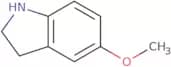
CAS:<p>3-Methoxybenzamidine hydrochloride is a chemical that belongs to the group of acid chlorides. It is used in organic synthesis as an intermediate for the production of triazines, which are used as herbicides and insecticides. 3-Methoxybenzamidine hydrochloride is usually prepared by reacting methylamine with nitrous acid. The use of 3-methoxybenzamidine hydrochloride in organic synthesis has been shown to be highly efficient, with yields up to 95%. This chemical also exhibits fluorescence at low temperatures.</p>Formula:C8H10N2O·HClPurity:Min. 95%Color and Shape:PowderMolecular weight:186.64 g/mol5-Methoxy-2,3-dihydroindoline
CAS:<p>5-Methoxy-2,3-dihydroindoline is a methoxy compound that is substituted with a methyl group. It has been shown to be an effective hydrogen transfer agent in cyclopentenone reactions, and can also be used as a sensor for nitroaromatic compounds. 5-Methoxy-2,3-dihydroindoline can be synthesized by the reaction of methoxylated aniline with sodium ethoxide in acetonitrile. This reaction produces the desired product in high yield (70%), and it can also be used for the methylation of secondary amines in good yield (80%). 5-Methoxy-2,3-dihydroindoline is potently active when titrated against benzo[a]pyrene.</p>Formula:C9H11NOPurity:Min. 95%Color and Shape:PowderMolecular weight:149.19 g/molTris[3-(trimethoxysilyl)propyl] isocyanurate
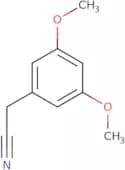
CAS:<p>Tris(trimethoxysilyl)propyl isocyanurate (TTIPi) is an efficient method for the synthesis of conjugates. TTIPi can be used to prepare a variety of conjugates, such as those containing biomolecules such as proteins, peptides, nucleotides, and small molecules. The resulting conjugates can be visualized by microscopy and analyzed using the Anova statistical package. TTIPi has been shown to form covalent bonds with DNA bases and other substrates. It has also been shown to form coordination bonds with ethylene oxide or tetraethyl silane which are worthwhile for dispersive polymerization in organic solvents. The mesoporous silica support used in this process has been shown to be acidic or basic depending on the pH of the solution. This versatile technique is useful for preparing a wide range of conjugates.</p>Formula:C21H45N3O12Si3Purity:Min. 95%Color and Shape:Colorless Clear LiquidMolecular weight:615.85 g/mol(3,5-Dimethoxyphenyl)acetonitrile
CAS:<p>3,5-Dimethoxyphenylacetonitrile is a synthetic compound that has been shown to be an inhibitor of the demethylation reaction. It is postulated to have anticancer activity and inhibits the biosynthesis of octaketides in vitro. This compound has also been shown to have antibacterial activity and is structurally related to cannabinoids. The mechanism by which 3,5-dimethoxyphenylacetonitrile inhibits cancer cells is not known. However, it may be due to its ability to bind cannabinoid receptors.</p>Formula:C10H11NO2Purity:Min. 95%Color and Shape:PowderMolecular weight:177.2 g/mol5-Bromo-2,3-dimethoxybenzoic acid
CAS:<p>2,3-Dimethoxybenzoic acid is a metabolite of 2,3-dimethoxybenzaldehyde, which is produced by the condensation of acetaldehyde and benzoic acid. It has been used as an intermediate in organic synthesis. The enzyme dopamine D3 receptor ligand binding assays have been used to study the ability of 5-bromo-2,3-dimethoxybenzoic acid to inhibit dopamine uptake in rat striatal membranes. The compound has also been shown to be a specific ligand for the dopamine D3 receptor and bind with a high affinity.</p>Formula:C9H9BrO4Purity:Min. 95%Color and Shape:PowderMolecular weight:261.07 g/molN-Ethyl-N-(3-sulfopropyl)-3-methoxyaniline sodium
CAS:<p>N-Ethyl-N-(3-sulfopropyl)-3-methoxyaniline sodium (ESP) is a selective agonist of the CB2 receptor. It is structurally unrelated to other CB2 receptor ligands, and has been shown to act as a selective, low affinity antagonist of the epidermal growth factor receptor. ESP has also been shown to be an ATP binding cassette transporter substrate and acts as a voltage sensor in whole cell recordings. ESP has potential therapeutic applications in diabetic neuropathy and chronic pain.</p>Formula:C12H19NO4S•NaPurity:Min. 95%Color and Shape:PowderMolecular weight:296.34 g/mol5-Methoxyuracil
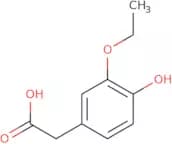
CAS:<p>5-Methoxyuracil is a labile, colorless and crystalline compound that occurs spontaneously in the presence of oxygen. It has a chemical structure similar to thiourea, with one methyl group substituted for the amino group on the heterocycle. 5-Methoxyuracil is used as a precursor for synthesis of thymine and uracil. It also acts as an antioxidant, preventing reactive oxygen species from causing cellular damage. 5-Methoxyuracil can be used in regenerative medicine to increase the production of messenger RNA (mRNA) and ribosomal RNA (rRNA). This drug is used as a prebiotic agent and can be synthetically produced by dimethylation of uridine followed by ethyl formate oxidation.</p>Formula:C5H6N2O3Purity:Min. 95%Color and Shape:PowderMolecular weight:142.11 g/mol3-Ethoxy-4-hydroxyphenylacetic acid
CAS:<p>3-Ethoxy-4-hydroxyphenylacetic acid is a chemical compound that functions as an anaesthetic. It has been shown to produce sedation and anesthesia in animals, but not in humans. 3-Ethoxy-4-hydroxyphenylacetic acid is also a metabolite of the drug propofol, which is used as a general anesthetic.</p>Formula:C10H12O4Purity:Min. 95%Color and Shape:PowderMolecular weight:196.2 g/mol3-Methoxybenzylamine
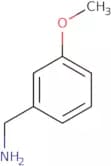
CAS:<p>3-Methoxybenzylamine is a fatty acid amide that is synthesized from benzylamine derivatives. The compound is a viscosity enhancer and antioxidant, and has been shown to inhibit the reaction of 3-hydroxybutyric acid with hydrochloric acid. 3-Methoxybenzylamine has also been used as a dietary supplement in tissue samples to reduce the effects of oxidation on the fatty acid chains. This compound has an asymmetric synthesis, which can be achieved by reacting an amine with an acyl chain.</p>Formula:C8H11NOPurity:Min. 95%Color and Shape:Clear LiquidMolecular weight:137.18 g/mol2-Methoxy-5-nitropyridine
CAS:<p>2-Methoxy-5-nitropyridine is an experimental model for the study of nucleophilic substitution reactions. It has been shown to catalyze a variety of nucleophilic substitutions, such as the reaction between dimethylformamide and methoxide. The uptake of 2-methoxy-5-nitropyridine in human cells has been studied using the mitochondrial cytochrome P450 (mt2) receptors, where it has been found that this compound binds to mt2 receptors with high affinity. The optical properties of 2-methoxy-5-nitropyridine have been determined by spectroscopic analysis and found to be similar to those of nitro compounds. Toxicity studies have also demonstrated that 2-methoxy-5-nitropyridine can cause liver damage at high doses, but there is no evidence that it causes cancer or causes reproductive toxicity.</p>Formula:C6H6N2O3Purity:Min. 95%Color and Shape:PowderMolecular weight:154.12 g/mol3-Aminopropyldiisopropylethoxysilane
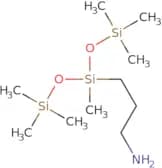
CAS:<p>3-Aminopropyldiisopropylethoxysilane (APDS) is a monolayer chemical that is used to modify the surface properties of a variety of substrates. This chemical can be used for patterning, functionalization, and immobilization of biomolecules. APDS has been shown to have a protective effect on cells in culture by preventing oxidation and denaturation of proteins. APDS also has been used for detection methods such as electron microscopy and photoelectron spectroscopy.</p>Formula:C10H29NO2Si3Purity:Min. 95%Color and Shape:Clear LiquidMolecular weight:279.6 g/mol4-Chloro-4'-methoxychalcone
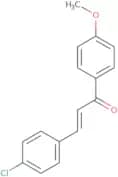
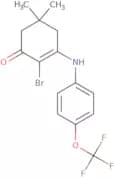
CAS:<p>4-Chloro-4'-methoxychalcone (4MC) is a chalcone with an antibacterial activity. It is synthesized from 4,4'-dimethoxychalcone by substitution of one or two methoxy groups on the aromatic ring with chlorine atoms. 4MC has shown to be active against a number of different bacterial strains, including Staphylococcus aureus and Pseudomonas aeruginosa.<br>The dilution method is used for the determination of the minimal inhibitory concentrations (MICs). This method involves serial dilutions in which bacteria are grown in liquid media containing increasing concentrations of the test compound. The lowest concentration of the test compound that inhibits bacterial growth is determined and recorded as MIC. <br>Plutella xylostella larvae were found to be resistant to 4MC because they lack esterase enzymes that hydrolyze 4MC. Irradiation can be used to produce esters that are more reactive towards</p>Formula:C16H13ClO2Purity:Min. 95%Color and Shape:PowderMolecular weight:272.73 g/mol2-bromo-5,5-dimethyl-3-((4-(trifluoromethoxy)phenyl)amino)cyclohex-2-en-1-one
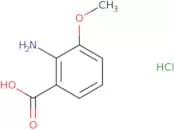
CAS:<p>Please enquire for more information about 2-bromo-5,5-dimethyl-3-((4-(trifluoromethoxy)phenyl)amino)cyclohex-2-en-1-one including the price, delivery time and more detailed product information at the technical inquiry form on this page</p>Purity:Min. 95%3-Methoxyanthranilic acid hydrochloride
CAS:<p>3-Methoxyanthranilic acid hydrochloride is a synthetic, monosubstituted, hydrochloric acid salt of 3-methoxyanthranilic acid and the hydrochloride. It is a colorless crystalline solid that melts at 166 degrees Celsius. 3-Methoxyanthranilic acid hydrochloride is used as an intermediate in the synthesis of caprolactam, which is then used to produce polyamide fibers. The melting point of 3-Methoxyanthranilic acid hydrochloride can be used to identify other compounds with similar structures. This compound has been shown to have antihistamine effects and may be useful for treating allergies or asthma.</p>Formula:C8H9NO3•HClPurity:Min. 95%Color and Shape:PowderMolecular weight:203.62 g/mol2-(R)-[1-(R)-(3,5-Bis(trifluoromethyl)phenyl)ethoxy]-3-(S)-fluorophenylmorpholine
CAS:<p>2-(R)-[1-(R)-(3,5-Bis(trifluoromethyl)phenyl)ethoxy]-3-(S)-fluorophenylmorpholine is a fine chemical with high quality. It has been used as a versatile building block in organic synthesis. 2-(R)-[1-(R)-(3,5-Bis(trifluoromethyl)phenyl)ethoxy]-3-(S)-fluorophenylmorpholine is a useful scaffold and can be used as a reaction component in the synthesis of other compounds. This compound is also an intermediate for the preparation of more complex compounds. CAS No. 171338-27-5</p>Formula:C20H18F7NO2Purity:Min. 95%Color and Shape:Yellow PowderMolecular weight:437.35 g/mol

![Tris[3-(trimethoxysilyl)propyl] isocyanurate](/_next/image/?url=https%3A%2Fstatic.cymitquimica.com%2Fproducts%2F3D%2Fthumb-webp%2FFT168667.webp&w=3840&q=75)



![2-(R)-[1-(R)-(3,5-Bis(trifluoromethyl)phenyl)ethoxy]-3-(S)-fluorophenylmorpholine](/_next/image/?url=https%3A%2Fstatic.cymitquimica.com%2Fproducts%2F3D%2Fthumb-webp%2FFB18758.webp&w=3840&q=75)