Organoboranes
Organoboranes are organic compounds characterized by the presence of boron atoms bonded to carbon. These compounds are derivatives of the BH3 molecule and play animportant role in various chemical reactions, including as intermediates in organic synthesis. At CymitQuimica, we offer a wide range of organoboranes to support your research and industrial needs. Our products are designed to deliver high performance and reliability in your synthetic processes.
Found 6101 products of "Organoboranes"
Sort by
Purity (%)
0
100
|
0
|
50
|
90
|
95
|
100
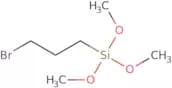
(3-Bromopropyl)trimethoxysilane
CAS:<p>3-Bromopropyltrimethoxysilane is a divalent hydrocarbon that has been used as a model compound for the study of detection methods. It has been shown to have biocompatible properties and can be used as an immobilization template molecule. 3-Bromopropyltrimethoxysilane also reacts with pyridinium ions to form complexes that are highly stable. The stability of these complexes can be attributed to the functional groups on the pyridine ring, which are more susceptible to hydrolysis than those on the silica surface. 3-Bromopropyltrimethoxysilane is a substrate for nitrate reductase enzymes, resulting in inhibition of growth at concentrations low enough not to cause cytotoxicity.</p>Formula:C6H15BrO3SiPurity:Min. 95%Molecular weight:243.17 g/mol4-Mercaptophenylboronic acid
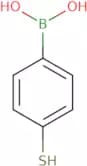
CAS:<p>4-Mercaptophenylboronicacid is a boronic acid that has been used to synthesize gold nanoparticles with antimicrobial properties. Boronic acids are able to form hydrogen bonds with biological molecules such as proteins and DNA, which allows them to be used for immobilization of biomolecules. This compound is also used as a reagent for the synthesis of disulfide bonds in proteins and peptides. 4-Mercaptophenylboronicacid can be used to prepare samples for electrochemical impedance spectroscopy (EIS) and colorimetric analysis.</p>Formula:C6H7BO2SPurity:Min. 95%Molecular weight:154 g/mol3-Formylfuran-2-boronic acid
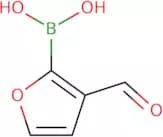
CAS:<p>3-Formylfuran-2-boronic acid is a molecule that can reversibly form an imine with primary amines. 3-Formyl group and fluorophore are the main features of this molecule. The fluorescent properties of 3-formyl group have been extensively studied by functional theory, structural studies and kinetic experiments. The study of these properties has led to the discovery of new fluorescent probes for use in biochemical studies. 3-Formyl furan also interacts with anthracene and other heterocycles by binding constants. These interactions were studied using quantum chemical calculations.</p>Formula:C5H5BO4Purity:Min. 95%Color and Shape:PowderMolecular weight:139.9 g/molDi-tert-butyldichlorosilane
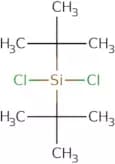
CAS:<p>Di-tert-butyldichlorosilane is a silicon compound that has been used to silylate amines and primary alcohols. It is a sterically hindered molecule with two chloro groups at the same position on one of the silicon atoms, which prevents or limits steric interactions with other molecules. Covid-19 Pandemic is the name given to a new strain of influenza virus that was discovered in 2009. The new strain contains some genetic material from bird flu, which makes it resistant to oseltamivir and zanamivir, drugs commonly used to fight against influenza infection.</p>Formula:C8H18Cl2SiPurity:Min. 95%Color and Shape:Clear LiquidMolecular weight:213.22 g/mol1-Phenyl-4-[4-(4,4,5,5-tetramethyl-[1,3,2]dioxaborolan-2-yl)-benzyl]piperazine
CAS:<p>Please enquire for more information about 1-Phenyl-4-[4-(4,4,5,5-tetramethyl-[1,3,2]dioxaborolan-2-yl)-benzyl]piperazine including the price, delivery time and more detailed product information at the technical inquiry form on this page</p>Formula:C23H31BN2O2Purity:Min. 95%Color and Shape:PowderMolecular weight:378.32 g/mol2,6-Dimethyl-4-phenylpyronium tetrafluoroborate
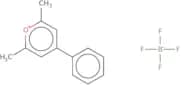
CAS:<p>2,6-Dimethyl-4-phenylpyronium tetrafluoroborate is a high quality reagent that is useful for the preparation of complex compounds. It is also a useful intermediate and building block. The CAS No. 97606-13-8, 2,6-Dimethyl-4-phenylpyronium tetrafluoroborate has been used in research chemicals and as a versatile building block for the synthesis of speciality chemicals. This reagent can be used in reactions to form many organic molecules that are not commercially available or difficult to synthesize.</p>Formula:C13H13O·BF4Purity:Min. 95%Color and Shape:PowderMolecular weight:272.05 g/molTriethyloxonium tetrafluoroborate
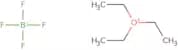
CAS:<p>Triethyloxonium tetrafluoroborate is an antimicrobial agent that inhibits the transfer of electrons from one molecule to another. It has been shown to be effective against methicillin-resistant Staphylococcus aureus and Mycobacterium tuberculosis. Triethyloxonium tetrafluoroborate binds to the bacterial enzyme, Jak1, which is involved in the formation of cytokines and interleukins. This binding inhibits the production of these molecules, leading to cell death by apoptosis. The use of triethyloxonium tetrafluoroborate as a research tool has facilitated its discovery as a potential anti-inflammatory drug for autoimmune diseases such as type 1 diabetes mellitus and rheumatoid arthritis. Triethyloxonium tetrafluoroborate can be used to inhibit amide synthesis, which may have applications in the study of carbohydrate chemistry and nitrogen atoms in biological systems. This compound has also been used</p>Formula:C6H15BF4OPurity:Min. 95%Color and Shape:PowderMolecular weight:189.99 g/molBoronic acid, B-2-furanyl-
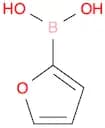
CAS:Formula:C4H5BO3Purity:97%Color and Shape:SolidMolecular weight:111.8917Ref: 4Z-B-164012
Discontinued productPoly ε L-lysine HCl - Average MW 2000~4700Da
CAS:<p>Antimicrobial cationic peptide; used for microscopy glass slides coating</p>Formula:(C6H12N2O•HCl)nPurity:Min. 95 Area-%Color and Shape:White Yellow PowderRef: 3D-FP159079
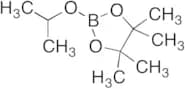
Discontinued product2-Isopropoxy-4,4,5,5-tetramethyl-1,3,2-dioxaborolane
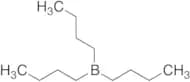
CAS:Controlled Product<p>Applications 2-Isopropoxy-4,4,5,5-tetramethyl-1,3,2-dioxaborolane was used in the synthesis of Alternariol [A575760] which is an alternaria mycotoxin and genotoxin, found in common edible crops. Also used in synthesis of highly efficient nanostructured organosilicon luminophore with fast photoluminescence.<br> Not a dangerous good if item is equal to or less than 1g/ml and there is less than 100g/ml in the package<br>References Won, M., et al.: J. Korean. Chem. Soc., 59, 471 (2015); Starikova, T., et al.: J. Mater. Chem., 4, 4699 (2016);<br></p>Formula:C9H19BO3Color and Shape:NeatMolecular weight:186.06Tributylborane (1.0 M in THF)
CAS:Controlled Product<p>Applications Tributylborane is a reducing agent used in the controlled radical polymerization of alkyl acrylates.<br>References Ludin, D. et al.: Russ. Chem. Bill., 65, 1859 (2016); Semenycheva, L. et al.: Russ. J. App. Chem., 89, 1667 (2016);<br></p>Formula:C12H27BColor and Shape:Single SolutionMolecular weight:182.15Potassium dihydrogen arsenate
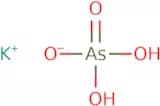
CAS:<p>Potassium dihydrogen arsenate is an inorganic chemical that is used as a pesticide. It prevents the synthesis of proteins by inhibiting soybean trypsin. The optimum concentration for chrysoperla is 1.6 mg/L, which has been shown to be sublethal at levels below 5 mg/L. This chemical has also been shown to have effects on light exposure and thermal expansion. Potassium dihydrogen arsenate belongs to the ferroelectric class of compounds and has a hydrogen bond with water, which may explain its uptake into plants.</p>Formula:H2AsKO4Purity:Min. 95%Molecular weight:180.04 g/mol1,2-Bis(hydroxymethyl)-O-carborane
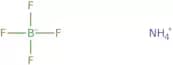
CAS:Controlled Product<p>1,2-Bis(hydroxymethyl)-O-carborane is a cyclic molecule that can be used in the synthesis of organic compounds. It can be prepared by reacting anhydrous sodium chloride with propiolic acid. It has been shown to produce decaborane and anion when reacted with chlorine. The chlorides are catalytic for the formation of methyl alcohol and methacrylates. 1,2-Bis(hydroxymethyl)-O-carborane has been used as a starting material for the synthesis of triflates and methyl alcohols. This compound has also been found to produce diffraction patterns that can be used for structural analysis.</p>Formula:C4H16B10O2Purity:Min. 95%Molecular weight:204.28 g/molAmmonium tetrafluoroborate
CAS:<p>Ammonium tetrafluoroborate is a salt of the organic compound tetrafluoroborate and ammonium. It is a colorless solid that can be used as a chemical reagent. Ammonium tetrafluoroborate has a higher chemical stability than other salts of tetrafluoroborate, such as ammonium hexafluorophosphate and ammonium hexafluoroarsenate. Ammonium tetrafluoroborate is used to make the dinucleotide phosphate, which is an important component in DNA synthesis. In a redox potential test, ammonium tetrafluoroborate showed no electrochemical activity in water vapor at pH 7. Ammonium tetrafluoroborate reacts with trifluoroacetic acid to produce hydrogen fluoride and ammonium chloride. This reaction is reversible, which means that it can be used for the synthesis of ammonia gas from hydrogen and nitrogen gases or for the</p>Formula:NH4BF4Purity:Min. 98%Color and Shape:White PowderMolecular weight:104.84 g/molRef: 3D-FA55588
Discontinued product

![1-Phenyl-4-[4-(4,4,5,5-tetramethyl-[1,3,2]dioxaborolan-2-yl)-benzyl]piperazine](/_next/image/?url=https%3A%2Fstatic.cymitquimica.com%2Fproducts%2F3D%2Fthumb-webp%2FFP33228.webp&w=3840&q=75)