Carboxylic Acids
Carboxylic acids are organic molecules characterized by having a carboxyl-type functional group (-COOH). These acids are fundamental in various chemical reactions, including esterification, amidation, and decarboxylation. Carboxylic acids are widely used in the production of pharmaceuticals, polymers, and agrochemicals. In this section, you can find a large number of carboxylic acids ready to be used. At CymitQuimica, we provide a broad range of high-quality carboxylic acids to support your research and industrial applications.
Found 12453 products of "Carboxylic Acids"
Sort by
Purity (%)
0
100
|
0
|
50
|
90
|
95
|
100
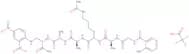
Abz-Gly-Ala-Lys(Ac)-Ala-Ala-Dap (Dnp)-NH2 trifluoroacetate salt
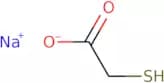
CAS:<p>Please enquire for more information about Abz-Gly-Ala-Lys(Ac)-Ala-Ala-Dap (Dnp)-NH2 trifluoroacetate salt including the price, delivery time and more detailed product information at the technical inquiry form on this page</p>Formula:C35H48N12O12Purity:Min. 95%Molecular weight:828.83 g/molMercaptoacetic acid sodium salt
CAS:<p>Mercaptoacetic acid sodium salt (MAS) is an oxidation catalyst that is used to convert ethyl alcohol into acetic acid. It has been shown to be a good catalyst for the oxidation of hydroxyl groups in the presence of metal hydroxides or inorganic acids, such as sodium carbonate. MAS has also been shown to be toxic to human serum and is not recommended for use in humans. The toxicity of MAS may be due to its ability to react with fatty acids and form mercaptans, which are volatile compounds that can cause irritation. Mercaptoacetic acid sodium salt reacts with potassium dichromate and forms mercaptans and other products, which may contribute to its toxicity.</p>Formula:C2H3NaO2SPurity:(Titration) Min. 90%Color and Shape:PowderMolecular weight:114.1 g/mol2-[(3,5,6-Trichloro-2-pyridinyl)oxy]acetic acid
CAS:<p>Carbaryl is a broad-spectrum insecticide that has been used to control pests in homes, gardens, and agricultural fields. It can be found in many products for use around the home, including flea collars and ant traps. Carbaryl is absorbed by plants through their leaves and roots and can affect photosynthetic activity. Carbaryl also affects plant metabolism by inhibiting proximal tubule function, which leads to an increase in urea nitrogen and urine production. Carbaryl can be toxic to humans when ingested or inhaled. The toxicity of carbaryl depends on its route of exposure (oral, inhalation, or skin). Carbaryl is metabolized through a number of metabolic reactions that include oxidation by cytochrome P450 enzymes, reduction by glutathione reductase, or conjugation with glucuronic acid.</p>Formula:C7H4Cl3NO3Purity:Min. 95%Color and Shape:PowderMolecular weight:256.47 g/molAngiotensin A trifluoroacetate salt
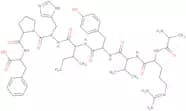
CAS:<p>Angiotensin A trifluoroacetate salt H-Ala-Arg-Val-Tyr-Ile-His-Pro-Phe-OH is a drug that has been shown to be effective in treating chronic kidney disease and heart failure. It is a synthetic peptide that mimics the activity of angiotensin II, an important regulator of blood pressure. Angiotensin A trifluoroacetate salt H-Ala-Arg-Val-Tyr-Ile-His-Pro-Phe-OH binds to the angiotensin receptor, which causes vasoconstriction and increases the release of soluble guanylate cyclase. This drug also inhibits the production of matrix metalloproteinases, which break down collagen and other extracellular proteins.</p>Formula:C49H71N13O10Purity:Min. 95%Molecular weight:1,002.17 g/mol(R,S)-α-Amino-3-hydroxy-5-methyl-4-isoxazolepropionic acid hydrobromide
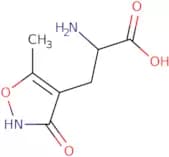
CAS:<p>(R,S)-AMPA is a synthetic analog of the excitatory neurotransmitter glutamate, specifically designed to activate AMPA receptors, a subtype of ionotropic glutamate receptors. These receptors are pivotal in mediating fast synaptic transmission in the central nervous system. (R,S)-AMPA serves as a prototypical agonist for AMPA receptors, facilitating the study of receptor function and synaptic plasticity.</p>Formula:C7H10N2O4•HBrPurity:Min. 95%Molecular weight:267.08 g/molD-Lactic acid benzyl ester
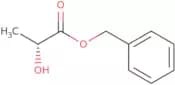
CAS:<p>D-Lactic acid benzyl ester is a chiral molecule that can be used as a feedstock for the production of D-lactic acid. It has been shown to catalyze hydrogenation reactions with an enhanced reaction rate and high selectivity when compared to other methods. The catalytic activity of D-lactic acid benzyl ester can be increased by using zeolites or iron catalyst, which are more expensive than the ligand used in this study. In addition, D-lactic acid benzyl ester was found to be more effective at catalysing the reaction between alkenes and hydrogen gas than other known catalysts. These findings indicate that it may be possible to use D-lactic acid benzyl ester as a cost-effective alternative to other catalysts in industrial processes.</p>Formula:C10H12O3Purity:Min. 95%Molecular weight:180.2 g/mol(Asn7)-Amyloid b-Protein (1-40) trifluoroacetate salt
CAS:<p>(Asn7)-Amyloid b-Protein (1-40) trifluoroacetate salt H-Asp-Ala-Glu-Phe-Arg-His-Asn-Ser-Gly-Tyr-Glu-Val-His-His-Gln-Lys<br>The product is a compound that has been shown to inhibit the formation of beta amyloid peptides in the brain. It binds to the beta amyloid peptide and prevents its aggregation, thereby preventing the formation of plaques and inhibiting neuronal cell death. The product contains no detectable levels of trehalose, which makes it ideal for use in brain imaging studies. This product may also be used as a predictive biomarker for Alzheimer's disease because it can be detected in cerebrospinal fluid and plasma.</p>Formula:C194H296N54O57SPurity:Min. 95%Molecular weight:4,328.82 g/molTyr-α-CGRP (human) trifluoroacetate salt
CAS:<p>Please enquire for more information about Tyr-alpha-CGRP (human) trifluoroacetate salt including the price, delivery time and more detailed product information at the technical inquiry form on this page</p>Formula:C172H276N52O51S2Purity:Min. 95%Molecular weight:3,952.48 g/mol(His(3-Me)2)-LHRH trifluoroacetate salt
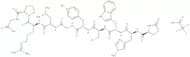
CAS:<p>Please enquire for more information about (His(3-Me)2)-LHRH trifluoroacetate salt including the price, delivery time and more detailed product information at the technical inquiry form on this page</p>Formula:C56H77N17O13·C2HF3O2Purity:Min. 95%Molecular weight:1,310.34 g/molMca-Lys-Pro-Leu-Gly-Leu-Dap (Dnp)-Ala-Arg-NH2 trifluoroacetate salt
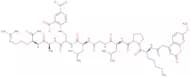
CAS:<p>Please enquire for more information about Mca-Lys-Pro-Leu-Gly-Leu-Dap (Dnp)-Ala-Arg-NH2 trifluoroacetate salt including the price, delivery time and more detailed product information at the technical inquiry form on this page</p>Formula:C55H80N16O16Purity:Min. 95%Molecular weight:1,221.32 g/mol(Cys(Et)2·7)-a-CGRP (human) trifluoroacetate salt
CAS:<p>Please enquire for more information about (Cys(Et)2·7)-a-CGRP (human) trifluoroacetate salt including the price, delivery time and more detailed product information at the technical inquiry form on this page</p>Formula:C167H277N51O49S2Purity:Min. 95%Molecular weight:3,847.43 g/molAc-Arg-Leu-Arg-AMC trifluoroacetate salt
CAS:<p>Ac-Arg-Leu-Arg-AMC trifluoroacetate salt is a mitochondrial biogenesis activator that has been shown to increase the levels of proteins in the mitochondria. These proteins are required for mitochondrial membrane potential, ATP production, and protein homeostasis. Ac-Arg-Leu-Arg-AMC trifluoroacetate salt has been shown to increase the number of pluripotency markers in human liver cells and to reduce insulin resistance in animals. The drug also increases the expression of ubiquitin ligases and proteasomes, which are enzymes that degrade damaged proteins. Ac-Arg-Leu-Arg-AMC trifluoroacetate salt may be used for treating liver diseases or disorders as well as obesity.</p>Formula:C30H46N10O6•C2HF3O2Purity:Min. 96 Area-%Color and Shape:PowderMolecular weight:756.77 g/molBoc-(±)-trans-4-(3-trifluoromethylphenyl)pyrrolidine-3-carboxylic acid
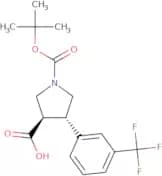
CAS:<p>Please enquire for more information about Boc-(±)-trans-4-(3-trifluoromethylphenyl)pyrrolidine-3-carboxylic acid including the price, delivery time and more detailed product information at the technical inquiry form on this page</p>Formula:C17H20F3NO4Purity:Min. 95%Molecular weight:359.34 g/mol3-Methoxyphenylboronic acid
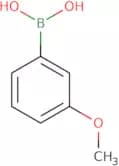
CAS:<p>3-Methoxyphenylboronic acid is a photophysical molecule that can be used as an analytical reagent in plant physiology and analytical chemistry. 3-Methoxyphenylboronic acid reacts reversibly with copper ions to form a complex. The binding constants of the copper complex depend on the pH of the solution, which can be altered by adding a phosphate derivative to the solution. This reaction was investigated using cross-coupling techniques and showed that the binding constants for this complex are dependent on the type of solvent used. 3-Methoxyphenylboronic acid has also been used to measure glucose levels in blood samples.</p>Formula:C7H9BO3Purity:Min. 95%Color and Shape:White PowderMolecular weight:151.96 g/mol(Asp76)-pTH (39-84) (human) trifluoroacetate salt
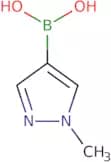
CAS:<p>Please enquire for more information about (Asp76)-pTH (39-84) (human) trifluoroacetate salt including the price, delivery time and more detailed product information at the technical inquiry form on this page</p>Formula:C211H356N66O73Purity:Min. 95%Molecular weight:4,985.49 g/mol(1-Methyl-1H-pyrazol-4-yl)boronic acid
CAS:<p>(1-Methyl-1H-pyrazol-4-yl)boronic acid is a boronic acid that has been used for the synthesis of a number of heterocyclic compounds. Boronic acids are commonly used to synthesize phosphine ligands, which are reactive and can be used in cross-coupling reactions with organic halides, triflates, and tosylates. The efficiency of the reaction depends on the functional group present on the boron atom. (1-Methyl-1H-pyrazol-4-yl)boronic acid can inhibit the activity of many types of enzymes, including those involved in bacterial DNA synthesis and protein synthesis. (1-Methyl-1H-pyrazol-4-yl)boronic acid has been shown to have pharmacokinetic properties that depend on its ionization state.</p>Formula:C4H7BN2O2Purity:Min. 95%Molecular weight:125.92 g/molDynorphin A (1-8) acetate salt
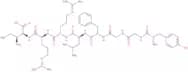
CAS:<p>Dynorphin A (1-8) acetate salt H-Tyr-Gly-Gly-Phe-Leu-Arg-Arg-Ile-OH acetate salt is a synthetic, nonpeptide opioid agonist. It binds to the delta receptor and inhibits nociception in the central nervous system. This compound has been shown to produce acute phase and subchronic toxicity in rats and has been shown to possess antinociceptive effects in mice. Dynorphin A (1-8) acetate salt H-Tyr-Gly-Gly-Phe-Leu-Arg-Arg-Ile-OH acetate salt has also been shown to antagonize the enzyme inhibitors of phospholipase A2, cyclooxygenase, and lipoxygenase.<br>MECHANISM OF ACTION: Dynorphin A (1–8) is an endogenous peptide that modulates neurotransmission at the</p>Formula:C46H72N14O10Purity:Min. 95%Molecular weight:981.15 g/molHIV (gp120) Fragment (421-438) trifluoroacetate salt
CAS:<p>Please enquire for more information about HIV (gp120) Fragment (421-438) trifluoroacetate salt including the price, delivery time and more detailed product information at the technical inquiry form on this page</p>Formula:C99H148N24O25S2Purity:Min. 95%Molecular weight:2,138.51 g/molpTH-Related Protein Splice Isoform 3 (140-173) (human) trifluoroacetate salt
CAS:<p>Please enquire for more information about pTH-Related Protein Splice Isoform 3 (140-173) (human) trifluoroacetate salt including the price, delivery time and more detailed product information at the technical inquiry form on this page</p>Formula:C186H313N53O44S2Purity:Min. 95%Molecular weight:4,059.94 g/molUrocortin III (mouse) trifluoroacetate salt
CAS:<p>Trifluoroacetate salt</p>Formula:C186H312N52O52S2Purity:Min. 95%Molecular weight:4,172.92 g/mol

![2-[(3,5,6-Trichloro-2-pyridinyl)oxy]acetic acid](/_next/image/?url=https%3A%2Fstatic.cymitquimica.com%2Fproducts%2F3D%2Fthumb-webp%2FFT28420.webp&w=3840&q=75)