Glycoscience
Glycoscience is the study of carbohydrates and their derivatives, as well as the interactions and biological functions they participate in. This field of research is crucial for understanding a wide variety of biological processes, including cell recognition, signaling, immune response, and disease development. Glycoscience has important applications in biotechnology, medicine, and the development of new drugs and therapies. At CymitQuimica, we offer a wide selection of high-quality, high-purity products for glycoscience research. Our catalog includes monosaccharides, oligosaccharides, polysaccharides, glycoconjugates, and specific reagents, designed to support researchers in their studies on the structure, function, and applications of carbohydrates in biological systems. These resources are intended to facilitate scientific discoveries and practical applications in various areas of bioscience and medicine.
Subcategories of "Glycoscience"
- Aminosugars(108 products)
- Glyco-Related Antibodies(282 products)
- Glycolipids(46 products)
- Glycosaminoglycans (GAGs)(55 products)
- Glycosides(419 products)
- Monosaccharides(6,621 products)
- Oligosaccharides(3,681 products)
- Polysaccharides(503 products)
Found 11041 products of "Glycoscience"
Sort by
Purity (%)
0
100
|
0
|
50
|
90
|
95
|
100
(2E) -2, 3- Dideoxy- 3- methyl- 4, 5- O- isopropylidene - D- erythro- Hex- 2- enonic acid methyl ester
<p>(2E) -2, 3- Dideoxy- 3- methyl- 4, 5- O- isopropylidene - D- erythro- Hex- 2- enonic acid methyl ester is a custom synthesis sugar that can be fluorinated and glycosylated. It is a monosaccharide or saccharide carbohydrate that has the CAS No. of 91428-07-3. This sugar can be modified with methylation, modification, and Click modification to create new sugars for use in biotechnology and pharmaceuticals.</p>Purity:Min. 95%2-Acetamido-2-deoxy-3-O-(b-D-galactopyranosyl)-a-D-galactopyranosyl-1-O-L-threonine
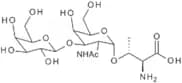
CAS:<p>2-Acetamido-2-deoxy-3-O-(b-D-galactopyranosyl)-a-D-galactopyranosyl-1-O-L-threonine is a fluorinated monosaccharide that is used as a building block for the synthesis of complex carbohydrates. This compound can be used to synthesize glycoproteins, glycolipids, and other glycoconjugates. 2-Acetamido-2-deoxy -3 -O-(b -D -galactopyranosyl) -a -D -galactopyranosyl 1 O L threonine has been modified with methylation and click chemistry reactions.</p>Formula:C18H32N2O13Purity:Min. 95%Color and Shape:White to light yellow solid.Molecular weight:484.45 g/molADP-D-glucose disodium salt
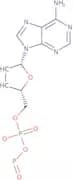
CAS:<p>ADP-D-glucose disodium salt is a synthetic saccharide with the chemical formula C6H14N2O8. It is used as a building block for the synthesis of complex carbohydrates, such as polysaccharides and oligosaccharides. ADP-D-glucose disodium salt can be modified to create methylated, glycosylated, and fluorinated derivatives. These modifications allow ADP-D-glucose disodium salt to be used in Click chemistry and other advanced applications.br>br>ADP-D-glucose disodium salt is also known by its CAS number 102129-65-7.br>br> br>br></p>Formula:C16H23N5O15P2·2NaPurity:Min. 95%Color and Shape:PowderMolecular weight:633.31 g/molN-Acetyl-2,3-dehydro-2-deoxyneuraminic acid sodium
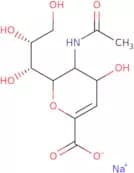
CAS:<p>Inhibitor of viral, bacterial and animal sialidase</p>Formula:C11H16NNaO8Purity:Min. 95%Color and Shape:White PowderMolecular weight:313.24 g/molN-Cbz-D-glucosamine
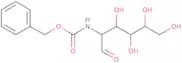
CAS:<p>N-Cbz-D-glucosamine is a synthetic molecule that is used in the synthesis of oligosaccharides. It is an acceptor for choline hydroxylase and participates in the biosynthesis of glycoproteins. N-Cbz-D-glucosamine inhibits virus RNA synthesis and has been shown to be effective against uninfected cells. The ring opening of the molecule leads to the formation of a cyclic amide, which can inhibit protein synthesis by binding to ribosomes.</p>Formula:C14H19NO7Purity:Min. 95%Color and Shape:PowderMolecular weight:313.3 g/mol1,2,3,4-Tetra-O-acetyl-6-O-trityl-b-D-mannopyranose
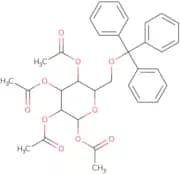
CAS:<p>1,2,3,4-Tetra-O-acetyl-6-O-trityl-b-D-mannopyranose is a synthetic sugar that can be used as a building block for the synthesis of oligosaccharides. It is also used to alter the properties of sugars and polysaccharides by modifying their glycosidic linkages. The product is insoluble in water and organic solvents. It is stable under acidic conditions and can be hydrolyzed with acids or alkalis. It is also soluble in methanol and methylene chloride. The CAS number for this product is 92621-31-3.End></p>Purity:Min. 95%Blood group B trisaccharide
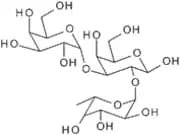
CAS:<p>Core antigen fragment in ABO blood group system</p>Formula:C18H32O15Purity:Min. 95%Color and Shape:White PowderMolecular weight:488.44 g/molMethyl a-D-fucopyranoside
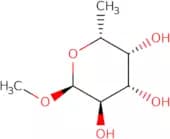
CAS:<p>Methyl a-D-fucopyranoside is a monoclonal antibody that binds to the O-antigen of the polysaccharide chain. It is a synthetic trisaccharide consisting of an o-antigen, an α-linked D-fucose residue, and an α-linked galactose residue. This antibody interacts with the serologic subtypes of Group A Streptococcus, but not with other serogroups. Methyl a-D-fucopyranoside utilizes conformational epitopes and disaccharides which are not accessible to other antibodies in order to bind to the o-antigen. The o-antigen is composed of two serologically distinct regions: one region for binding by anti-A antibodies, and another for binding by anti-B antibodies.</p>Formula:C7H14O5Purity:Min. 98 Area-%Color and Shape:White Off-White PowderMolecular weight:178.18 g/molN-Acetyl-heparin
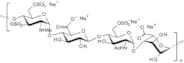
CAS:<p>N-Acetyl heparin is a glycosaminoglycan, which occurs in many mammalian tissues and has important anticoagulant and thrombolytic properties. The chemical structure is composed mainly of two disaccharide repeating units A and B. A is L-iduronic acid 2-suplhate linked α-(1,4) to 2-deoxy-2-sulfamido-D-galactose 6-sulphate, while B is D-glucuronic acid β-(1,4) linked to 2-deoxy-2-sulfamido-D-glucose 6-sulphate.</p>Purity:Min. 95%Color and Shape:PowderGD1a-Oligosaccharide
CAS:<p>GD1a oligosaccharide is the carbohydrate moiety from the disialylated glycosphingolipid GD1a of the a-series (shown in the sodium form), a major ganglioside found in neuronal and glial membranes. GD1a oligosaccharide has a core tetrasaccharide structure (Galβ1,3GalNAcβ1,4Galβ1,4Glc) with sialic acids linked α2,3/α2,8 to the inner galactose residue, α2,3 to the outer galactose residue (Ledeen, 2009). GD1a ganglioside interacts with myelin-associated glycoprotein (MAG) and is essential for long-term axon-myelin stability. GD1a ganglioside plays a role in viral infection as it is a receptor for viral glycoproteins in rotavirus and paramyxovirus 1. The hexasaccharide GD1a moiety was also found on a glycoprotein that acts as a receptor for adenovirus type 37. Additionally, GD1a ganglioside interacts with botulinum neurotoxin (BoNT) and is crucial for its entry into cells (Kolter, 2012).</p>Formula:C48H79N3O37Purity:Min. 95%Color and Shape:PowderMolecular weight:1,290.14 g/molEthyl cellulose viscosity 20cP
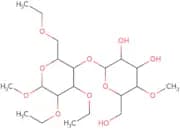
CAS:<p>Ethyl cellulose is an organic compound that is soluble in alcohols, acetone and ethers. It is a viscous liquid that can be dissolved in water to form a gel. Ethyl cellulose can be modified with oligosaccharides, carbohydrates, complex carbohydrates, and other substances. Ethyl cellulose has been used for the production of edible films, as well as capsules and tablets. The viscosity of ethyl cellulose can be changed by adding different substances to it. This modification allows ethyl cellulose to be customized for various purposes such as creating high purity products or glycosylation.</p>Purity:Min. 95%Color and Shape:PowderPrednisolone succinate b-cyclodextrin conjugate
<p>The prednisolone succinate cyclodextrin beta conjugate represents a specific class of cyclodextrin derivatives where the drug molecule (prednisolone succinate) is covalently bound to β-cyclodextrin. The conjugate is designed to combine the beneficial properties of cyclodextrins with the therapeutic effects of prednisolone. Prednisolone succinate cyclodextrin beta conjugate aims to improve the solubility, stability, and bioavailability of prednisolone while potentially offering controlled release properties.</p>Purity:Min. 95%L-Idonic acid sodium
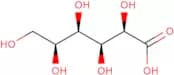
CAS:<p>L-Idonic acid sodium is a plant hormone that regulates carbohydrate metabolism. It has been shown to regulate the synthesis of galacturonic acid and malic acid, which are important for the production of glucose. L-Idonic acid sodium also regulates the synthesis of fatty acids, which are important for cell membrane formation. L-Idonic acid sodium is an intermediate in the biosynthesis of l-tartaric acid, which is an enzyme substrate. The gene product that encodes this molecule has been characterized as a protein with a molecular weight of approximately 9,000 daltons and a hydroxyl group on C-3.</p>Formula:C6H11O7NaPurity:Min. 95%Color and Shape:PowderMolecular weight:218.15 g/molHyaluronic acid sodium salt - Average MW 1.5 - 2.5 million Da
CAS:<p>The sodium salt of hyaluronic acid is a glycosaminoglycan found in many organs, where it functions as a joint lubricant and shock absorber. It is obtained principally from synovial fluid, vitreous humor of the eye, umbilical tissue and cocks comb. The chemical structure of hyaluronic is a disaccharide repeat of β-(1,3) glucuronic acid and β-(1,4) N-acetyl glucosamine.</p>Formula:(C14H20NO11Na)nPurity:Min. 95%Color and Shape:PowderN,N',N'',N''',N''''-Pentaacetyl chitopentaose
CAS:<p>Chitopentaose is a pentaacetyl derivative of the sugar chitohexaose. It is an oligosaccharide that has been shown to inhibit the activity of glycosidases and lectins, which may be due to its high affinity to these enzymes. Chitopentaose has also been found to bind to insulin receptors in the human tumor cell line A-20, leading to a reduction in tumor growth. The molecule also inhibits the transcriptional regulation of genes encoding for penicillin-binding protein, mouse tumor necrosis factor, and α1-acid glycoprotein.</p>Formula:C40H67N5O26Purity:Min. 95 Area-%Color and Shape:PowderMolecular weight:1,033.98 g/molEthyl b-D-fructopyranoside
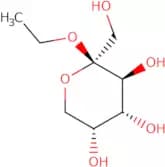
CAS:<p>Salidroside is a phenylpropanoid, a type of secondary metabolite. It is found in the plant family Ranunculaceae and can be extracted from the roots of Rhodiola rosea (golden root) and other plants in this family. Salidroside has been shown to have anti-inflammatory properties, which may be due to its inhibition of prostaglandin synthesis. Salidroside also has strong antioxidant properties, which may be due to its ability to scavenge free radicals. Salidroside can be used as an additive for foods such as breads and pastries because it inhibits the formation of phthalic acid that is produced by baking.</p>Formula:C8H16O6Purity:Min. 95%Molecular weight:208.21 g/molMethyl 6-amino-6-deoxy-a-D-glucopyranoside
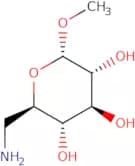
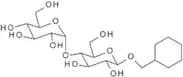
CAS:<p>Methyl 6-amino-6-deoxy-a-D-glucopyranoside is a saccharide with a molecular weight of 362.4 g/mol. This carbohydrate is fluorinated and modified with an amine group on the C1 position, which makes it a complex carbohydrate. It can be custom synthesized to order and has high purity. CAS No. 5155-47-5</p>Formula:C7H15NO5Purity:Min. 98 Area-%Color and Shape:Clear LiquidMolecular weight:193.2 g/molCyclohexylmethyl-4-O-(a-D-glucopyranosyl)-b-D-glucopyranoside
CAS:<p>Detergent used for the solubilization of membrane proteins. Important for the solubilization is the detergent-to-protein ratio. At low ratios (1:10) the membranes are lysed and large complexes of are formed containing protein, detergent, and membrane lipids. With progressively larger ratios smaller complexes are obtained. Finally, at ratios of 10:1 to 20:1 individual detergent-protein complexes are formed free of membrane lipids. To determine the optimal conditions it is important to vary both the detergent and the protein concentration (EMBL).</p>Formula:C19H34O11Purity:Min. 95%Color and Shape:PowderMolecular weight:438.47 g/mol6-O-(b-D-Galactopyranosyl)-D-glucopyranose
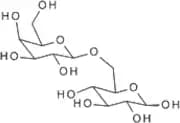
CAS:<p>6-O-(b -D-Galactopyranosyl)-D-glucopyranose, also called allolactose, is a glucose disaccharide with β1-6 glycosidic link, similar to lactose (glucose β1-4 linked). Allolactose is an inducer of the lac operon in E. coli and many other enteric bacteria.</p>Formula:C12H22O11Purity:Min. 90 Area-%Color and Shape:White PowderMolecular weight:342.3 g/molCanagliflozin hemihydrate
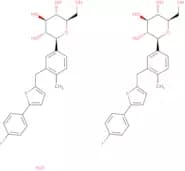
CAS:<p>Canagliflozin is an oral diabetes drug that belongs to the class of sodium-glucose cotransporter 2 (SGLT2) inhibitors. It works by blocking reabsorption of glucose in the kidney, thereby lowering blood sugar levels. Canagliflozin has been shown to be a potent inhibitor of insulin resistance and has been used clinically in combination with metformin hydrochloride. The chemical stability of canagliflozin is dependent on its particle size, which can range from 10 micrometres to 100 micrometres. A number of analytical methods have been developed for canagliflozin, including high performance liquid chromatography with ultraviolet detection, gas chromatography with mass spectrometry detection, and dihedral angle analysis. Canagliflozin is an example of a polymorphic compound: it exists as two enantiomers due to chiral symmetry.</p>Formula:(C24H25FO5S)2•H2OPurity:Min. 95%Color and Shape:PowderMolecular weight:907.05 g/mol