


Carbohydrates and glycoconjugates
Carbohydrates are organic compounds composed of carbon, hydrogen, and oxygen, with a basic structure formed by monosaccharides. These can combine to form disaccharides, oligosaccharides, or polysaccharides, depending on the number of monomeric units. Carbohydrates play a fundamental role in energy storage, cell structure, and cellular communication. Their derivatives are used in pharmaceutical products, such as sweeteners and excipients.
At CymitQuimica, we offer a wide range of carbohydrates and their derivatives for research and industrial applications.
Found 5010 products of "Carbohydrates and glycoconjugates"
Sort by
Purity (%)
0
100
|
0
|
50
|
90
|
95
|
100
Benzyl 4-O-(β-D-galactopyranosyl)-β-D-glucopyranoside
CAS:<p>Benzyl 4-O-(b-D-galactopyranosyl)-b-D-glucopyranoside is a Glycosylation product that is custom synthesized to order. It is an oligosaccharide, which is synthesized by the modification of monosaccharides with other saccharides. This product has been fluorinated and acetylated at its C4 position and methylated at its C6 position. This compound has CAS No. 18404-72-3 and can be used as a sugar in the synthesis of complex carbohydrates or as a component of polysaccharides.</p>Formula:C19H28O11Purity:Min. 95%Color and Shape:PowderMolecular weight:432.42 g/molSucrose palmitate
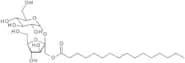
CAS:<p>The ‘tallowate’ esters are probably the best known derivatives of sucrose and many attempts have been made to commercialise them in order to exploit their excellent surfactant functionalities. The most functional products are the mono- and diesters of the tallow acids (stearic, palmitic, oleic) with hydrophile-lipophile balance (HLB) values that lend themselves to surfactant applications in foods and cosmetics. They also have other uses, for example in coating fruits with a semipermeable membrane that acts as a preservative. Manufacturing economics have prevented these products from mass production and they remain in niche applications.</p>Formula:C28H52O12Purity:(%) Min. 90.0%Color and Shape:White PowderMolecular weight:508.72 g/mol1,2,3,6-Tetra-O-acetyl-4-O-(2,3,4,6-tetra-O-acetyl-b-D-galactopyranosyl)-b-D-thioglucopyranose
CAS:<p>This is a synthetic, high purity and custom-synthesized carbohydrate. The chemical name is 1,2,3,6-Tetra-O-acetyl-4-O-(2,3,4,6-tetra-O-acetyl-b-D-galactopyranosyl)-b-D-thioglucopyranose. It has been modified with the Click reaction to allow for chemical modification. This product is a complex carbohydrate that has been fluorinated to create an organic fluorine compound.</p>Formula:C28H38O18SPurity:Min. 95%Molecular weight:694.66 g/mol4-Methoxyphenyl 2,6-di-O-acetyl-4-O-[2,4,6-tri-O-acetyl-3-O-allyl-β-D-galactopyranosyl]-3-O-allyl-β-D-glucopyranoside
<p>The chemical structure of this compound is composed of a custom synthesis, modification, and fluorination. The molecular weight is 572.6 g/mol and the CAS No. is 1027152-06-6. The molecular formula is C50H76O24. This compound has a molecular weight of 572.6 g/mol and an empirical formula of C50H76O24. It appears as a white crystalline powder that can be dissolved in water or ethanol.=END>></p>Formula:C35H46O17Purity:Min. 95%Molecular weight:738.73 g/molChitobiose octaacetate
CAS:<p>Octacetylated chitobiose derivative</p>Formula:C28H40N2O17Purity:Min. 95%Color and Shape:White PowderMolecular weight:676.62 g/molIsomaltotriose
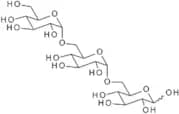
CAS:<p>Produced from high maltose syrup by treatment with transglucosidase</p>Formula:C18H32O16Purity:Min. 97 Area-%Color and Shape:White Off-White PowderMolecular weight:504.44 g/molMycothione
<p>Please enquire for more information about Mycothione including the price, delivery time and more detailed product information at the technical inquiry form on this page</p>Formula:C34H58N4O24S2Purity:Min. 95%Molecular weight:970.97 g/mol4-Aminobutyl 3-O-(a-D-mannopyranosyl)-a-D-mannopyranoside
<p>4-Aminobutyl 3-O-(a-D-mannopyranosyl)-a-D-mannopyranoside is a fluorescent, water soluble, and hydrophilic glycoside. This compound is synthesized through the condensation of 4-aminobutyric acid with 3-(2,3,4,6-tetraacetyl glucosamine) to form an aminobutyl ester. The aminobutyl ester is then reacted with a D-mannose derived from 2,3,4,6-tetraacetyl glucosamine. This product is used in glycoprotein analysis and can be modified for various purposes.</p>Purity:Min. 95%2,3,6,2',3',4',6'-Hepta-O-acetyl-b-lactosyl azide
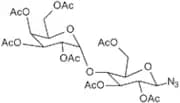
CAS:<p>2,3,6,2',3',4',6'-Hepta-O-acetyl-b-lactosyl azide is a custom synthesis of a carbohydrate that has been modified by the addition of acetyl groups to one end and the attachment of an azide group to the other. The synthesis of this compound has been completed in high purity and is available for purchase. This compound is a complex carbohydrate that is a sugar that can be modified by fluorination. It is also an oligosaccharide or polysaccharide with saccharide units.</p>Formula:C26H35N3O17Purity:Min. 95%Color and Shape:PowderMolecular weight:661.57 g/mol[UL-¹³C₁₂]Sucrose
CAS:<p>Sucrose is a sugar that is used as a food additive. It is the disaccharide of glucose and fructose, which are two monosaccharides. Sucrose can be synthesized by the glycosylation of glucose and fructose in an α-1,2 linkage. Sucrose can also be synthesized by the fluorination of sucrose followed by methylation with methylamine. The synthesis of sucrose starts with the reaction of acrylonitrile with formaldehyde to produce acrylonitrile trimer, which is then reacted with methanol to produce methyl 3-hydroxybutyrate. This product undergoes a series of reactions to form sucrose.</p>Formula:C12H22O11Purity:Min. 98 Area-%Color and Shape:PowderMolecular weight:354.21 g/molZymosan A (from Saccharomyces cerevisiae)
CAS:<p>Zymosan is prepared from the cell walls of baker's yeast (Saccharomyces cerevisiae) and consists of polysaccharide chains of various molecular weights, containing approximately 73% polysaccharide, 15% protein, 7% lipid and other inorganic components. When injected into animals, it induces inflammation and has been used for many years in inflammation and immunology research. The conditions activated include components of the complement system, prostaglandins and leukotrienes, platelet aggregation factor, and lysosomal enzymes. Zymosan preparations are often insoluble but can be made soluble for separation on DE cellulose or Sepharose to produce more active fractions.</p>N,N',N'',N''',N''''-Pentaacetyl chitopentaose
CAS:<p>Chitopentaose is a pentaacetyl derivative of the sugar chitohexaose. It is an oligosaccharide that has been shown to inhibit the activity of glycosidases and lectins, which may be due to its high affinity to these enzymes. Chitopentaose has also been found to bind to insulin receptors in the human tumor cell line A-20, leading to a reduction in tumor growth. The molecule also inhibits the transcriptional regulation of genes encoding for penicillin-binding protein, mouse tumor necrosis factor, and α1-acid glycoprotein.</p>Formula:C40H67N5O26Purity:Min. 95 Area-%Color and Shape:PowderMolecular weight:1,033.98 g/molNeoagarodecaose
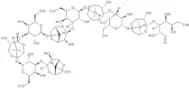
CAS:<p>Agarose is a polysaccharide found in red algae, typically Gelidium and Gracilaria. It is a strictly alternating polysaccharide of α-1,3 linked D-galactose and β-1,4 linked L-3,6 anhydrogalactose with occasional sulfation at position 6 of the anhydrogalactose residue. Agaro-oligosaccharides result from cleavage at galactose residues and neoagaro-oligosaccharides from cleavage at 3,6-anhydro residues. Neoagarodecaose is reported to have potential for novel cosmeceuticals.</p>Formula:C60H92O46Purity:Min. 95%Color and Shape:PowderMolecular weight:1,549.34 g/mol3'-(N-Glycolyl-a-neuraminosyl)lactose
CAS:<p>3'-(N-Glycolyl-a-neuraminosyl)lactose is a carbohydrate that is synthesized from lactose, which is a disaccharide composed of glucose and galactose. It is synthesized by the modification of the terminal hydroxyl group on the galactose moiety with glycolyl chloride. 3'-(N-Glycolyl-a-neuraminosyl)lactose has been shown to inhibit the growth of bacteria and fungi. It also has the potential to be used as an anti-cancer drug candidate due to its ability to inhibit protein synthesis in cells. This carbohydrate can also be modified by methylation, glycosylation, or click chemistry.</p>Formula:C23H39NO20Purity:Min. 95%Molecular weight:649.55 g/molBlood group A type 4 linear trisaccharide-NGL
<p>Useful oligosaccharide-lipid conjugate for raising antibodies.</p>Purity:Min. 95%3-O-(a-L-Fucopyranosyl)-4-O-(3-sialyl-b-D-galactopyranosyl)-D-glucose
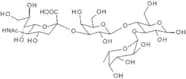
<p>3-O-(a-L-Fucopyranosyl)-4-O-(3-sialyl-b-D-galactopyranosyl)-D-glucose is a modification of the complex carbohydrate, oligosaccharide, monosaccharide, and polysaccharide. It is synthesized by methylation of glucose and glycosylation with sialic acid. The product has a CAS number and a high purity level. This product is an example of a synthetic oligosaccharide that has been fluorinated. The product can be used as an additive or preservative in food products.</p>Formula:C29H49NO23Purity:Min. 95%Molecular weight:779.71 g/mol6-O-(b-D-Mannopyranosyl)-D-mannose
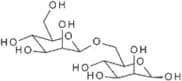
CAS:<p>Isolated from the products of the acid reversion of D-mannose</p>Formula:C12H22O11Purity:Min. 98 Area-%Color and Shape:PowderMolecular weight:342.3 g/molGD1a-Ganglioside sodium
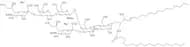
CAS:<p>GD1a (shown as sodium salt) is one of the major gangliosides in neuronal and glial membranes. It has a core tetrasaccharide structure (Galβ1,3GalNAcβ1,4Galβ1,4Glc) with sialic acids linked α2,3/α2,8 to the inner galactose residue, α2,3 to the outer galactose residue and ceramide linked β to position 1 on the reducing terminal glucose residue (Ledeen, 2009). It interacts with myelin-associated glycoprotein (MAG) and is essential for long-term axon-myelin stability. It plays a role in viral infection as it is a receptor for viral glycoproteins in rotavirus and paramyxovirus 1. The hexasaccharide GD1a moiety was also found on a glycoprotein that acts as a receptor for adenovirus type 37. GD1a ganglioside also interacts with botulinum neurotoxin and is crucial for its entry into cells (Kolter, 2012).</p>Formula:C84H148N4O39·xNaPurity:Min. 95%Color and Shape:White PowderMolecular weight:1,838.08 g/molLactose 6'-sulfate
CAS:<p>Lactose 6'-sulfate is a custom synthesis of a complex carbohydrate and an oligosaccharide. It is modified by methylation and glycosylation, which can be altered to create other saccharides such as galactose. Lactose 6'-sulfate has been fluorinated in the alpha position and contains a sulfate group that is attached with a click chemistry reaction. Lactose 6'-sulfate has CAS number 1015758-24-3 and is high purity.</p>Formula:C12H22O14SPurity:Min. 95%Color and Shape:PowderMolecular weight:422.36 g/mol2-Methyl-(4-O-β-D-glucopyranosyl)-1,2-dideoxy-α-D-glucopyrano)-[2,1-d]-2-oxazoline
CAS:<p>2-Methyl-(4-O-b-D-glucopyranosyl)-1,2-dideoxy-a-D-glucopyrano)-[2,1-d]-2-oxazoline is a custom synthesis of a carbohydrate. It can be modified by fluorination, methylation, and monosaccharide modification. It has been synthesized from a saccharide with a molecular weight of 803. This molecule has the CAS number 91433-96-7.</p>Formula:C14H23NO10Purity:Min. 95%Color and Shape:PowderMolecular weight:365.33 g/mol



![4-Methoxyphenyl 2,6-di-O-acetyl-4-O-[2,4,6-tri-O-acetyl-3-O-allyl-β-D-galactopyranosyl]-3-O-allyl-…](/_next/image/?url=https%3A%2Fstatic.cymitquimica.com%2Fproducts%2F3D%2Fthumb-webp%2FOM10984.webp&w=3840&q=75)

![[UL-¹³C₁₂]Sucrose](/_next/image/?url=https%3A%2Fstatic.cymitquimica.com%2Fproducts%2F3D%2Fthumb-webp%2FOS29120.webp&w=3840&q=75)




![2-Methyl-(4-O-β-D-glucopyranosyl)-1,2-dideoxy-α-D-glucopyrano)-[2,1-d]-2-oxazoline](/_next/image/?url=https%3A%2Fstatic.cymitquimica.com%2Fproducts%2F3D%2Fthumb-webp%2FOM10959.webp&w=3840&q=75)