Chromogenic Substrates
Chromogenic substrates are compounds that produce a visible color change when acted upon by specific enzymes. These substrates are widely used in diagnostic assays, biochemical research, and enzyme-linked immunosorbent assays (ELISAs) to detect and quantify enzyme activity. The color change allows for easy and rapid visual identification of enzyme reactions, making chromogenic substrates essential tools in laboratory analysis. At CymitQuimica, we provide a diverse selection of high-quality chromogenic substrates to support your research and diagnostic applications.
Found 712 products of "Chromogenic Substrates"
Sort by
Purity (%)
0
100
|
0
|
50
|
90
|
95
|
100
4-Nitrophenyl 4,6-benzylidene-2-O-(2,3,4,6-tetra-O-[4-methoxybenzyl]-a-D-glucopyranosyl)-a-D-glucopyranoside
<p>4-Nitrophenyl 4,6-benzylidene-2-O-(2,3,4,6-tetra-O-[4-methoxybenzyl]-a-D-glucopyranosyl)-a-D-glucopyranoside is a fluorogenic substrate that is used in diagnostic assays to measure the activity of enzymes such as β–galactosidase and β–glucuronidase. It is also an enzyme substrate for culture media and chemiluminescence. This product has a CAS number of 57316-92-8.</p>Purity:Min. 95%Molecular weight:1,088.02 g/molOstazin brilliant red H-3B hydroxyethylcellulose
<p>Ostazin brilliant red H-3B hydroxyethylcellulose is a chromogenic enzyme substrate that produces a bright red color upon reaction with specific enzymes. This substrate is particularly useful for the detection and visualization of enzyme activity in histochemical and cytochemical staining techniques. The vibrant red color produced by the reaction allows for easy observation and analysis of enzyme distribution and localization in cells and tissues. Ostazin brilliant red H-3B hydroxyethylcellulose is often used in combination with other substrates to study the presence and activity of multiple enzymes simultaneously, providing valuable insights into the complex interactions and functions of enzymes in biological systems.</p>Purity:Min. 95%2-Nitrophenyl b-D-glucuronide
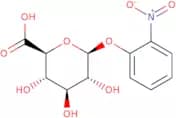
CAS:<p>2-Nitrophenyl-b-D-glucuronide is a chromogenic substrate used to detect the activity of beta-glucuronidase in various biological samples. Upon hydrolysis by the enzyme, the substrate releases 2-nitrophenol, which can be spectrophotometrically measured at 405 nm. The substrate is commonly used in clinical assays to evaluate liver and kidney function, as well as in drug metabolism studies. It is also used in environmental monitoring to assess the presence of microbial activity in soil and water samples. Overall, 2-Nitrophenyl-b-D-glucuronide is a widely used substrate with excellent sensitivity and specificity, making it a valuable tool in enzymology research and diagnostic testing.</p>Purity:Min. 95%Color and Shape:Off-white solid.Molecular weight:315.23 g/mol2-Chloro-4-nitrophenyl β-D-xylopyranoside
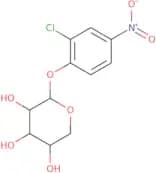
CAS:<p>2-Chloro-4-nitrophenyl β-D-xylopyranoside is a fluorogenic substrate that can be used for the detection of β-glucuronidase activity in food testing, environmental testing, and diagnostics. It has been shown to be an effective substrate for detecting β-glucuronidase activity with a high degree of sensitivity and specificity. 2CNPX can also be used as a chromogenic substrate for the detection of β-glucuronidase activity in food testing and environmental testing. The conjugate form of this substrate is useful for immunochemical assays, such as enzyme linked immunosorbent assay (ELISA) or radioimmunoassay (RIA). This product is also used as a ligand in fluorescence resonance energy transfer (FRET) assays.<br>2CNPX can be used to detect β-glucuronidase activity by chemiluminescence</p>Formula:C11H12ClNO7Purity:Min. 95%Molecular weight:305.67 g/mol2-Nitrophenyl 2-acetamido-3,4,6-tri-O-acetyl-2-deoxy-b-D-galactopyranoside
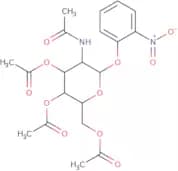
CAS:<p>2-Nitrophenyl 2-acetamido-3,4,6-tri-O-acetyl-2-deoxy-b-D-galactopyranoside is a chemiluminescent substrate for the detection of beta galactosidase. It is a white to light yellow powder with a molecular weight of 564.87 and an assay of ≥ 98% by HPLC. This product has been shown to be stable when stored at 4°C for up to three months.</p>Purity:Min. 95%Molecular weight:468.41 g/mol2-Nitrophenyl 2,3-di-O-acetyl-4-O-triethylsilyl-b-D-xylopyranoside
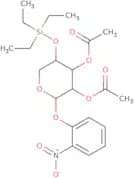
CAS:<p>2-Nitrophenyl 2,3-di-O-acetyl-4-O-triethylsilyl-b-D-xylopyranoside is a chromogenic substrate for enzmatic assays to measure xylosidase activity. It is a derivative of xylose that can be hydrolyzed by xylosidase to release the yellow-colored 2-nitrophenyl group, which can be detected spectrophotometrically. By modifying the xylose molecule with acetyl and triethylsilyl groups, the enzyme substrate becomes more stable and resistant to degradation. This substrate is commonly used in the study of plant biomass degradation and in the detection of xylosidase activity in microorganisms.</p>Purity:Min. 95%Molecular weight:469.56 g/mol4-Nitrophenyl 3,4,6-tri-O-acetyl-b-D-galactopyranoside
CAS:<p>4-Nitrophenyl 3,4,6-tri-O-acetyl-b-D-galactopyranoside is a nucleic acid molecule that has been synthesized by recombinant expression in Corynebacterium glutamicum. It is a photosynthetic molecule and can be used to study the molecular basis of photosynthesis. The 4-nitrophenyl group on the sugar moiety confers resistance to degradation by nucleases. 4NP3,4,6GalAc has been shown to be capable of binding to proteins and polypeptides that are important for photosynthesis. This compound also has marginalizing effects on C. glutamicum strains that are used as expression vectors for recombinant protein production.</p>Purity:Min. 95%Molecular weight:427.36 g/mol4-Nitrophenyl 2,3-di-O-(b-D-glucopyranosyl)-b-D-glucopyranoside
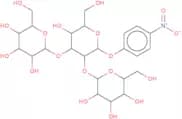
<p>4-Nitrophenyl 2,3-di-O-(b-D-glucopyranosyl)-b-D-glucopyranoside is a chromogenic substrate that can be used to detect the presence of β-glucuronidase in human and animal tissue. The compound is also a fluoroquinolone substrate for the detection of β-lactamase activity. 4NPBG is used in diagnostics as well as food testing, due to its ability to detect bacteria in both food and water samples. 4NPBG is a chemiluminescent substrate that emits light upon hydrolysis by β-glucuronidase or β-lactamase. The compound has been shown to be an excellent ligand for binding to protein A or protein G and can be used for immunoassays such as ELISA or Western blotting.</p>Purity:Min. 95%Molecular weight:625.53 g/mol4-Aminoantipyrine
CAS:<p>4-Aminoantipyrine has been used as an analgesic and anti-inflammatory agent. It can also target peroxidase enzymes to produce a red color</p>Formula:C11H13N3OColor and Shape:Off-White To Yellow SolidMolecular weight:203.24 g/mol4-Nitrophenyl 2-acetamido-2-deoxy-4-O-(β-D-galactopyranosyl)-α-D-glucopyranoside
CAS:<p>4-Nitrophenyl 2-acetamido-2-deoxy-4-O-(β-D-galactopyranosyl)-α-D-glucopyranoside is a high-quality chromogenic pNP enzyme substrate specifically designed to enable effective and accurate detection of enzyme activity. By utilizing this advanced substrate, researchers and professionals can perform a range of applications, including activity assays, enzyme inhibition studies, and substrate specificity profiling. This substrate's unique properties result in exceptional sensitivity and throughput, ensuring effective results for a wide variety of enzyme assays.</p>Formula:C20H28N2O13Purity:Min. 90%Color and Shape:White PowderMolecular weight:504.44 g/mol2,4-Dinitrophenyl)-L-lysine hydrochloride monohydrate
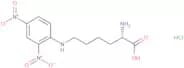
CAS:<p>2,4-Dinitrophenyl)-L-lysine hydrochloride monohydrate is a lysine derivative that has been modified with a 2,4-dinitrophenyl group. It could be used as an enzyme substrate to monitor enzymes that recognize and modify lysine residues, such as lysine methyltransferases and demethylases, lysine acylases and lysine oxidases.</p>Purity:Min. 95%Color and Shape:PowderMolecular weight:348.74 g/molNaphthol AS sulphate potassium
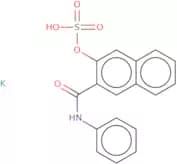
CAS:<p>Modified naphtol AS substrate used in histochemical and cytochemical staining</p>Formula:C17H13NO5S•KPurity:Min. 95%Color and Shape:PowderMolecular weight:382.45 g/molNaphthol AS-CL phosphate
CAS:<p>Modified naphtol AS substrate used in histochemical and cytochemical staining</p>Purity:Min. 95%Molecular weight:407.74 g/molRemazol brilliant blue R D-xylan
<p>Remazol Brilliant Blue R D-xylan is a chromogenic substrate used for the detection and quantification of xylanase enzyme activity. This substrate consists of a xylan polymer backbone covalently linked to the Remazol Brilliant Blue R dye. Upon cleavage by xylanase enzymes, the dye is released, producing a vibrant blue color that can be easily measured spectrophotometrically. This substrate is widely used in various applications, including the study of xylanase-producing microorganisms, optimization of enzyme production, and evaluation of enzyme kinetics.</p>Purity:Min. 95%Color and Shape:Powder6-Benzoyl-2-naphthylphosphate disodium salt
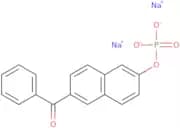
CAS:<p>6-Benzoyl-2-naphthylphosphate disodium salt is a chromogenic substrate used to detect and quantify alkaline phosphatase activity. After enzymatic hydrolysis, 6-benzoyl-2-naphthol is released, which can be detect or even further react with other reagents (e.g. Fast Red) to increase the intensity of the colorimetric signal. It is used in common applications such as ELISA, immunohistochemistry and Western Blotting.</p>Purity:Min. 95%Molecular weight:374.24 g/mol4-Nitrophenyl a-D-maltotetraoside
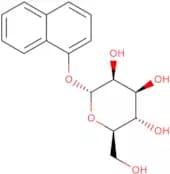
CAS:<p>4-Nitrophenyl alpha-D-maltotetraoside is a chromogenic substrate used for the detection of alpha-glucosidase and alpha-amylase activity. The four glucose units in the molecule are hydrolyzed by the enzyme, releasing 4-nitrophenol and allowing for easy colorimetric measurement of enzymatic activity</p>Purity:Min. 95%Molecular weight:787.67 g/mol1-Naphthyl-α-D-mannopyranoside
CAS:<p>1-Naphthyl-alpha-D-mannopyranoside is a chromogenic substrate. It is used in diagnostics and as a reagent for enzymatic analysis of alpha-mannosidase activity in culture media, food testing, and environmental testing.</p>Formula:C16H18O6Purity:Min. 95%Color and Shape:PowderMolecular weight:306.31 g/mol4-Nitrophenyl b-D-cellopentaoside
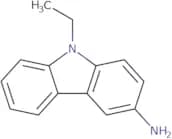
CAS:<p>Substrates for endoglucanase and beta-cellobiohydrolase activity in the study of digestive system in Zygentoma as an insect model for high cellulase activity</p>Formula:C36H55NO28Purity:Min. 95%Color and Shape:PowderMolecular weight:949.81 g/mol3-Amino-9-ethylcarbazole
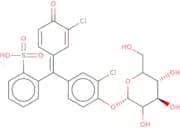
CAS:<p>3-Amino-9-ethylcarbazole is a peroxidase substrate suitable for use in immunoblotting and immunohistochemical staining procedures. This substrate produces an insoluble end product that is red in color and can be observed visually.</p>Formula:C14H14N2Purity:Min. 95%Color and Shape:Beige PowderMolecular weight:210.27 g/molChlorophenol red b-D-galactopyranoside
CAS:<p>Used in biological studies as a chromogenic substrate for β-galactosidase; red color.Chlorophenol red indicates changes of pH in the range of 4.8 to 6.7 by turning the solution from yellow (at pH 4.8) to violet (at pH 6.7). Converted as signalogenic moiety of an enzyme substrate, chlorophenol red beta-D-galactopyranoside has a good proven sensitivity in the detection of beta-galactosidase activity in transfected mammalian cells, when compared to ONPG (o-nitrophenyl-beta-D-galactopyranoside) (Eustice, 1991)</p>Formula:C25H22Cl2O10SPurity:Min. 95%Color and Shape:Orange Red PowderMolecular weight:585.41 g/mol
![4-Nitrophenyl 4,6-benzylidene-2-O-(2,3,4,6-tetra-O-[4-methoxybenzyl]-a-D-glucopyranosyl)-a-D-gluco…](/_next/image/?url=https%3A%2Fstatic.cymitquimica.com%2Fproducts%2F3D%2Fthumb-webp%2FEN04828.webp&w=3840&q=75)