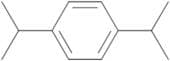
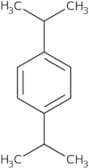
CAS 100-18-5
:1,4-Diisopropylbenzol
Beschreibung:
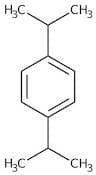
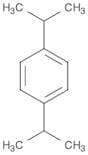
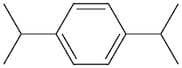
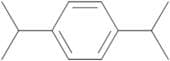
1,4-Diisopropylbenzol, auch bekannt als p-Diisopropylbenzol, ist eine organische Verbindung, die durch ihre aromatische Struktur gekennzeichnet ist, die zwei Isopropylgruppen enthält, die an den Positionen 1 und 4 des Benzolrings angebracht sind. Diese Verbindung ist bei Raumtemperatur eine farblose Flüssigkeit und bekannt für ihren charakteristischen süßen Geruch. Sie ist relativ unpolar, was sie in organischen Lösungsmitteln löslich, aber weniger in Wasser macht. Die Anwesenheit der Isopropylgruppen trägt zu ihrer hydrophoben Natur bei und beeinflusst ihre Reaktivität, insbesondere bei elektrophilen aromatischen Substitutionsreaktionen. 1,4-Diisopropylbenzol wird in verschiedenen Anwendungen eingesetzt, unter anderem als Lösungsmittel und in der Synthese anderer organischer Verbindungen. Es ist wichtig, diese Substanz mit Vorsicht zu behandeln, da sie gesundheitliche Risiken darstellen kann, wenn sie eingeatmet oder verschluckt wird, und geeignete Sicherheitsmaßnahmen getroffen werden sollten, um die Exposition zu minimieren. Darüber hinaus wird sie als flüchtige organische Verbindung (VOC) klassifiziert, die zur Luftverschmutzung beitragen kann und in industriellen Umgebungen entsprechend verwaltet werden sollte.
Formel:C12H18
InChl:InChI=1/C12H18/c1-9(2)11-5-7-12(8-6-11)10(3)4/h5-10H,1-4H3
InChI Key:InChIKey=SPPWGCYEYAMHDT-UHFFFAOYSA-N
SMILES:C(C)(C)C1=CC=C(C(C)C)C=C1
Synonyme:- 1,4-Bis(1-methylethyl)benzene
- 1,4-Bis(isopropyl)benzene
- 1,4-Bis(propan-2-yl)benzene
- 1,4-Di(Propan-2-Yl)Benzene
- Benzene, 1,4-bis(1-methylethyl)-
- Benzene, p-diisopropyl-
- Brn 1854739
- Hsdb 5331
- Nsc 84198
- p-Di-iso-propylbenzene
- p-Diisopropylbenzene
- p-Diisopropylbenzol
- para-Diisopropylbenzene
- 1,4-DIISOPROPYLBENZENE
- 4-05-00-01126 (Beilstein Handbook Reference)
- 1,4-Diisopropylbenzene
- Bis(1-methylethyl)benzene, 1-4: (p-or 1,4-Diisopropylbenzene)
- 1,4-Diisopropylbenzene97%
- 1,4-bis(1-methylethyl)-benzen
- p-bis(1-methylethyl)benzene
- 1,4-DIISOPROPYLBENZENE 98+%
- 1,4-DIISOPROPYLBENZENE, STANDARD FOR GC
- p-diisopropyl-benzen
- Benzene,1,4-bis(1-methylet
- Benzene, 1,4-di-(1-methylethyl)
- Weitere Synonyme anzeigen
Sortieren nach
Reinheit (%)
0
100
|
0
|
50
|
90
|
95
|
100
10 Produkte.
1,4-Diisopropylbenzene, 98%
CAS:1,4-Diisopropylbenzene is used as an intermediate for the synthesis of stabilizers, polymers, synthetic lubricants and hydroperoxides. It is also used in the trivalent actinide-lanthanide separation by phosphorus reagent extraction from aqueous komplexes (TALSPEAK) process for separating trivalent lFormel:C12H18Reinheit:98%Farbe und Form:Clear colorless, LiquidMolekulargewicht:162.28Ref: 54-OR79870
1kgNachfragen5mlNachfragen100gNachfragen2.5lNachfragen25mlNachfragen500gNachfragen100mlNachfragen500mlNachfragen1,4-Diisopropylbenzene
CAS:1,4-Diisopropylbenzene is a benzene derivative widely used in biochemical experiments and drug synthesis research.Formel:C12H18Reinheit:98.64%Farbe und Form:SolidMolekulargewicht:162.271,4-Diisopropylbenzene
CAS:Formel:C12H18Reinheit:>98.0%(GC)Farbe und Form:Colorless to Almost colorless clear liquidMolekulargewicht:162.281,4-Diisopropylbenzene
CAS:Kontrolliertes ProduktFormel:C12H18Farbe und Form:NeatMolekulargewicht:162.271,4-Diisopropylbenzene
CAS:1,4-Diisopropylbenzene is an aromatic hydrocarbon that can be used in the production of nylon. It is a reactive compound that reacts with hydrogen chloride to form 1,4-dichlorobenzene. It undergoes nucleophilic attack by the addition of hydrogen fluoride to produce a dihydrochloride salt. The reaction of 1,4-diisopropylbenzene with hydrochloric acid yields 1,2-dichlorobenzene and hydrogen chloride gas. The reaction mechanism for this chemical reaction is shown below:
Formel:C12H18Reinheit:Min. 95%Molekulargewicht:162.27 g/mol