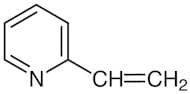
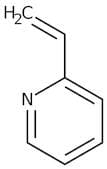
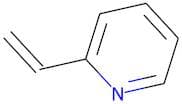
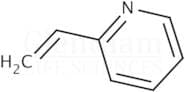
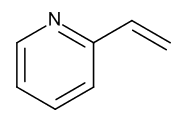
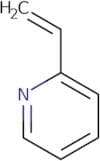
CAS 100-69-6
:2-Vinylpyridin
- 2-Ethenylpyridine
- 2-Pyridylethylene
- 2-Vinilpiridina
- 2-Vinylpiridine
- 2-Vinylpyridin
- 2-Vinylpyridine Monomer
- Nsc 18255
- Pyridine, 2-ethenyl-
- Pyridine, 2-vinyl-
- ethenyl-Pyridine
- α-Vinylpyridine
- Weitere Synonyme anzeigen
2-Vinylpyridine (stabilized with TBC)
CAS:Formel:C7H7NReinheit:>97.0%(GC)Farbe und Form:Colorless to Brown clear liquidMolekulargewicht:105.142-Vinylpyridine, 97%, stab. with 0.1% 4-tert-butylcatechol
CAS:2-Vinylpyridine is a pyridine derivative used in the preparation of poly(2-vinylpyridine) via radical polymerization. 2-Vinylpyridine is used to improve effectiveness of protective polymer coatings on metals. It is a reagent for pyridylethylation for new protection method for active hydrogen compounFormel:C7H7NReinheit:0.1%Farbe und Form:Liquid, Clear, colorless or pale yellow to brownMolekulargewicht:105.142-Vinylpyridine (2-Ethenylpyridine)
CAS:Compounds containing an unfused pyridine ring in the structure, nesoiFormel:C7H7NFarbe und Form:Light Brown LiquidMolekulargewicht:105.057852-Vinylpyridine
CAS:Formel:C7H7NReinheit:(GC) ≥ 97.0%Farbe und Form:Clear, colourless to pale yellow or pale brown liquidMolekulargewicht:105.14Betahistine EP Impurity A (2-Vinylpyridine)
CAS:Formel:C7H7NFarbe und Form:Pale Brown LiquidMolekulargewicht:105.142-Ethenylpyridine (2-Vinylpyridine)
CAS:Kontrolliertes ProduktFormel:C7H7NFarbe und Form:NeatMolekulargewicht:105.142-Vinylpyridine (stabilised with tert-Butylcatechol)
CAS:Formel:C7H7NReinheit:95.0%Farbe und Form:LiquidMolekulargewicht:105.142-Vinylpyridine (stabilized with 0.1% 4-tert-butylcatechol)
CAS:Stability Light Sensitive, Volatile
Applications 2-Vinylpyridine is a pyridine deriviative used in the preparation of poly(2-vinylpyridine) via radical polymerization. 2-Vinylpyridine is used to improve effectiveness of protective polymer coatings on metals. 2-Vinylpyridine is an impurity of Betahistine (B324000).
Not a dangerous good if item is equal to or less than 1g/ml and there is less than 100g/ml in the package
References Shibaev, L.A. et al.: Vysokomolek. Soedin. Ser. A Ser. B, 37, 1874 (1995); Zavrazhina, V.I. et al.: Korr. Mat. Zash., 9, 33 (2004);Formel:C7H7NFarbe und Form:Light Yellow To Light BrownMolekulargewicht:105.142-Vinylpyridine, stabilized with TBC
CAS:2-Vinylpyridine is a reactive, organic compound that can form hydrogen bonds with other molecules. It has been used in the synthesis of detergent compositions and as a reactant to produce polymers. 2-Vinylpyridine is also used in the treatment of autoimmune diseases, such as hepatitis C. 2-Vinylpyridine has been shown to bind to proteins by forming hydrogen bonds with amino acid residues that have an amine group or a hydroxyl group. The binding of 2-vinyl pyridine to these sites leads to conformational changes and enzyme inhibition. 2-Vinylpyridine can be synthesized from pyridine and hydrochloric acid in a two step process involving condensation followed by cyclization. 2-Vinylpyridine was first synthesized by Kolbe and Woodward in 1883 using x-ray crystallography, which involved exposing crystals of pyridine to x-rays, thereby providing structural
Formel:C7H7NReinheit:Min. 95%Farbe und Form:Clear LiquidMolekulargewicht:105.14 g/mol