CAS 100-71-0
:2-Ethylpyridin
Beschreibung:
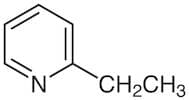
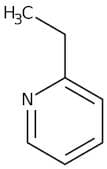
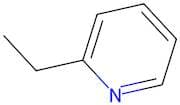
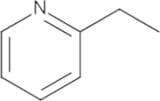
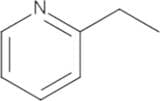
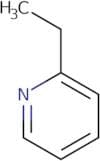
2-Ethylpyridin ist eine organische Verbindung mit der chemischen Formel C9H11N, die zur Klasse der Pyridinderivate gehört. Sie weist einen sechsgliedrigen aromatischen Ring auf, der ein Stickstoffatom enthält, mit einer Ethylgruppe, die am zweiten Kohlenstoff des Rings angebracht ist. Diese Verbindung ist bei Raumtemperatur eine farblose bis blassgelbe Flüssigkeit mit einem charakteristischen aromatischen Geruch. Sie ist mäßig in Wasser und hoch in organischen Lösungsmitteln wie Ethanol und Ether löslich. 2-Ethylpyridin ist bekannt für seine Verwendung als Baustein in der organischen Synthese und als Lösungsmittel in verschiedenen chemischen Reaktionen. Sie kann auch als Ligand in der Koordinationschemie dienen. Die Verbindung hat ein relativ niedriges Toxizitätsprofil, sollte jedoch wie viele organische Lösungsmittel mit Vorsicht behandelt werden, um Inhalation oder Hautkontakt zu vermeiden. Ihre chemischen Eigenschaften umfassen Basizität aufgrund des Stickstoffatoms, was es ihr ermöglicht, an verschiedenen chemischen Reaktionen, einschließlich Alkylierung und Acylierung, teilzunehmen. Insgesamt ist 2-Ethylpyridin eine vielseitige Verbindung mit Anwendungen sowohl in industriellen als auch in Forschungskontexten.
Formel:C7H9N
InChl:InChI=1S/C7H9N/c1-2-7-5-3-4-6-8-7/h3-6H,2H2,1H3
InChI Key:InChIKey=NRGGMCIBEHEAIL-UHFFFAOYSA-N
SMILES:C(C)C1=CC=CC=N1
Synonyme:- Nsc 964
- Pyridine, 2-ethyl-
- alpha-Ethylpyridine
- α-Ethylpyridine
- 2-Ethylpyridine
Sortieren nach
Reinheit (%)
0
100
|
0
|
50
|
90
|
95
|
100
10 Produkte.
2-Ethylpyridine
CAS:Formel:C7H9NReinheit:>98.0%(GC)(T)Farbe und Form:Colorless to Almost colorless clear liquidMolekulargewicht:107.162-Ethylpyridine, 98%
CAS:2-Ethylpyridine is used to study its effect on the proliferation and survival of human umbilical vein endothelial cells (HUVECs), HMVECs from lung, and NIH 3T3 cells. 2-Ethylpyridine linked with silica is a popular stationary phase for chiral and achiral separations in supercritical fluid chromatogrFormel:C7H9NReinheit:98%Farbe und Form:Clear colorless to pale yellow, LiquidMolekulargewicht:107.162-Ethylpyridine
CAS:Kontrolliertes ProduktApplications 2-Ethylpyridine can be used to prepare Dimethindene Maleate (D460460). It is also used to study its effect on the proliferation and survival of human umbilical vein endothelial cells (HUVECs), HMVECs from lung, and NIH 3T3 cells.2-Ethylpyridine linked with silica is a popular stationary phase for chiral and achiral separations in supercritical fluid chromatography.
Not a dangerous good if item is equal to or less than 1g/ml and there is less than 100g/ml in the package
References Richard, Y., et al.: Toxicol. Sci., 93, 82 (2006); Speybrouck, D., et a.: Curr. Topics in Med. Chem., 12, 1250(2012)Formel:C7H9NFarbe und Form:ColourlessMolekulargewicht:107.152-Ethylpyridine
CAS:2-Ethylpyridine is a chemical compound that can be derived from sodium succinate, 2-ethylpyridine, and trifluoroacetic acid. It has been shown to have biological properties such as the inhibition of mitochondrial membrane potential, which is the driving force for ATP synthesis in mitochondria. This drug also inhibits the production of hydrogen peroxide and nitric oxide by reacting with hydrochloric acid or nitrogen atoms. 2-Ethylpyridine can be used as a solid catalyst for reactions involving hydrogen bond formation or intermolecular hydrogen bond formation. 2-Ethylpyridine reacts with protocatechuic acid to form an intramolecular hydrogen bond and a group p2 type of reaction mechanism.Formel:C7H9NReinheit:Min. 95%Farbe und Form:Colorless Clear LiquidMolekulargewicht:107.15 g/mol