CAS 10025-91-9
:Antimontrichlorid
Beschreibung:
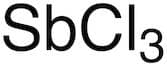
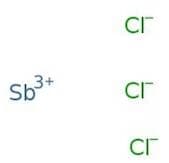
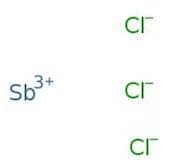
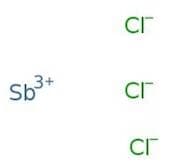
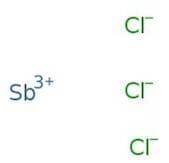
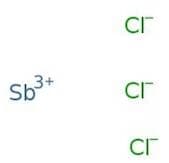
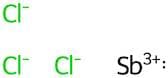
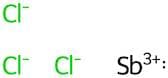
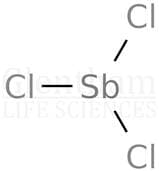
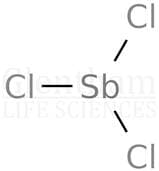
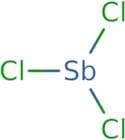
Antimontrichlorid, mit der chemischen Formel SbCl3 und der CAS-Nummer 10025-91-9, ist eine anorganische Verbindung, die durch ihr kristallines Aussehen von weiß bis gelblich gekennzeichnet ist. Es handelt sich um eine kovalente Verbindung, die eine trigonal-pyramidale Molekülgeometrie aufweist. Antimontrichlorid ist hochlöslich in organischen Lösungsmitteln wie Chloroform und Ether, hat jedoch eine begrenzte Löslichkeit in Wasser. Es ist bekannt für seine Lewis-Säure-Eigenschaften, was es zu einem nützlichen Katalysator in verschiedenen organischen Reaktionen macht, insbesondere in Friedel-Crafts-Acylierungs- und Alkylierungsprozessen. Die Verbindung kann bei der Hydrolyse Salzsäure freisetzen, was zur Bildung von Antimonoxiden führen kann. Antimontrichlorid wird auch in der Herstellung von Flammschutzmitteln und als Reagenz in der analytischen Chemie verwendet. Es ist jedoch wichtig, diese Substanz mit Vorsicht zu behandeln, da sie giftig und reizend für Haut, Augen und Atemwege sein kann. Angemessene Sicherheitsmaßnahmen, einschließlich der Verwendung von persönlicher Schutzausrüstung, sind unerlässlich, wenn man mit diesem Chemikalien arbeitet.
Formel:Cl3Sb
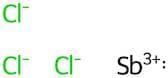
InChl:InChI=1S/3ClH.Sb/h3*1H;/q;;;+3/p-3
InChI Key:InChIKey=FAPDDOBMIUGHIN-UHFFFAOYSA-K
SMILES:[Sb](Cl)(Cl)Cl
Synonyme:- (2E,4S,4aS,5aS,6S,12aS)-2-[amino(hydroxy)methylidene]-7-chloro-4-(dimethylamino)-6,10,11,12a-tetrahydroxy-6-methyl-4a,5a,6,12a-tetrahydrotetracene-1,3,12(2H,4H,5H)-trione - trichlorostibane (1:1)
- Antimon(Iii)-Chlorid
- Antimonous chloride
- Antimontrichlorid
- Antimony Butter
- Antimony chloride (Sb2Cl6)
- Antimony chloride (Sb<sub>2</sub>Cl<sub>6</sub>)
- Antimony chloride (SbCl3)
- Antimony chloride (SbCl<sub>3</sub>)
- Antimony standard concentrate
- Antimony(+3) Trihydride Cation Trichloride
- Antimony(III) chloride
- Antimony(III) trichloride
- Antimonychloride
- Antimonychlorideelecgroffwhitextl
- Butter of antimony
- Stibine, trichloro-
- Trichloroantimony
- Trichlorostibane
- Trichlorostibine
- Trichlorure d'antimoine
- Tricloruro De Antimonio
- Weitere Synonyme anzeigen
Sortieren nach
Reinheit (%)
0
100
|
0
|
50
|
90
|
95
|
100
19 Produkte.
Antimony(III) Chloride
CAS:Formel:SbCl3Reinheit:>98.0%(T)Farbe und Form:White to Almost white powder to crystalMolekulargewicht:228.11Antimony(III) chloride, 99+%
CAS:This Thermo Scientific Chemicals brand product was originally part of the Alfa Aesar product portfolio. Some documentation and label information may refer to the legacy brand. The original Alfa Aesar product / item code or SKU reference has not changed as a part of the brand transition to Thermo SciFormel:Cl3SbReinheit:99+%Farbe und Form:Crystals or powder or crystalline powder or lumps, White to brownMolekulargewicht:228.11Antimony(III) chloride, Puratronic™, 99.999% (metals basis)
CAS:Antimony(III) chloride is used as a chlorinating agent, as a fireproofing agent in textiles; in bronzing steel and as a mordant in dyeing as well as a caustic in medicine. It is also used as an apoptosis agent that is used to detect cholesterols and carotenoids. It is also employed to detect certain
Formel:Cl3SbReinheit:99.999%Molekulargewicht:228.11Antimony(III) chloride, ultra dry, 99.999% (metals basis)
CAS:Antimony Trichloride is used as a chlorinating agent, as a fireproofing agent in textiles; in bronzing steel and as a mordant in dyeing as well as a caustic in medicine. It is also used as an apoptosis agent that is used to detect cholesterols and carotenoids. This Thermo Scientific Chemicals brandFormel:Cl3SbReinheit:99.999%Molekulargewicht:228.11Antimony(III) chloride, ACS, 99.0% min
CAS:Antimony(III) chloride is engaged to detect certain compounds, such as cholesterols and carotenoids. It is likewise employed as a dye mordant and a fabric flame retardant. It is used as inorganic and organic chlorination catalyst. It is used to coat the steel to make bronze, used as a cutting materiFormel:Cl3SbReinheit:99.0%Molekulargewicht:228.11Antimony(III) chloride, 99.9% (metals basis)
CAS:Antimony(III) chloride is engaged to detect certain compounds, such as cholesterols. It is a complexing agent used in the colorimetric Carr-Price test for detecting carotenoids including vitamin A. It is employed as a mordant and a fabric flame retardant. It is used as a catalyst for chlorinationFormel:Cl3SbReinheit:99.9%Molekulargewicht:228.11Antimony(III) chloride, elec. gr. (99.999%-Sb) PURATREM
CAS:Antimony(III) chloride, elec. gr. (99.999%-Sb) PURATREM
Formel:SbCl3Reinheit:(99.999%-Sb)Farbe und Form:off-white xtl.Molekulargewicht:228.11Antimony(III) chloride
CAS:Antimony(III) chlorideFormel:Cl·SbReinheit:99.9%Farbe und Form: off white adhering crystalsMolekulargewicht:228.12g/molAntimony(III) chloride (99%-Sb)
CAS:Antimony(III) chloride (99%-Sb)
Formel:SbCl3Reinheit:(99%-Sb)Farbe und Form:off-white xtl.Molekulargewicht:228.11Antimony(III) chloride
CAS:Antimony(III) chlorideReinheit:99%Farbe und Form:SolidMolekulargewicht:228.12g/molAntimony(III) chloride
CAS:Formel:SbCl3Reinheit:≥ 99.5%Farbe und Form:White crystalline powder or crystalsMolekulargewicht:228.11Antimony(III) chloride
CAS:Antimony(III) chlorideReinheit:99.99%Farbe und Form:PowderMolekulargewicht:228.12g/molAntimony(III) chloride, 99%
CAS:Formel:SbCl3Reinheit:(Titration) ≥ 99.0%Farbe und Form:White to off-white crystals or chunksMolekulargewicht:228.11Antimony(III) chloride, 99.99+%
CAS:Formel:SbCl3Reinheit:≥ 99.99%Farbe und Form:White to pale brown crystalline powder or crystalsMolekulargewicht:228.11Antimony(III) chloride
CAS:Antimony(III) chloride is an inorganic chemical compound that is used as a catalyst in wastewater treatment. It is a solid at room temperature and soluble in water. This compound has been shown to have genotoxic effects, which are changes to the genetic material that can lead to cancer. Antimony(III) chloride has also been shown to have oxidative properties when it reacts with sodium carbonate, an acid, or nitrogen atoms. The reaction mechanism of this compound includes the formation of an antimony-carbonate intermediate that decomposes into carbon dioxide and antimony oxides. This process leads to the formation of sodium salts. The oxidation catalyst can be sodium hydroxide or potassium hydroxide, which are strong bases. X-ray diffraction data show that antimony(III) chloride has a trigonal bipyramidal structure with bond angles of 120° and 180° between atoms.Formel:SbCl3Reinheit:Min. 95%Molekulargewicht:228.11 g/molAntimony Trichloride extrapure AR, 99%
CAS:Formel:SbCl3Reinheit:min. 99%Farbe und Form:White, Crystalline compoundMolekulargewicht:228.11Antimony Trichloride pure, 98%
CAS:Formel:SbCl3Reinheit:min. 98%Farbe und Form:White, Crystalline compoundMolekulargewicht:228.11Antimony Trichloride extrapure AR, ACS, ExiPlus, Multi-Compendial, 99%
CAS:Formel:SbCl3Reinheit:min. 99%Farbe und Form:White, Crystalline compoundMolekulargewicht:228.11