CAS 10049-83-9
:Pyrithinolhydrochlorid
Beschreibung:
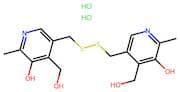
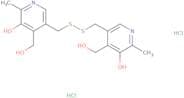
Pyrithinolhydrochlorid, mit der CAS-Nummer 10049-83-9, ist eine synthetische Verbindung, die aus Vitamin B6 abgeleitet ist und für ihre nootropischen Eigenschaften bekannt ist. Es handelt sich um ein wasserlösliches, gelbliches Kristallpulver, das häufig zur Behandlung von kognitiven Störungen und zur Verbesserung von Gedächtnis und Lernfähigkeiten eingesetzt wird. Pyritinol wirkt als Antioxidans und soll den Blutfluss im Gehirn verbessern, wodurch möglicherweise die neuronale Funktion gesteigert wird. Die Verbindung wird typischerweise in Form ihres Hydrochloridsalzes verabreicht, was ihre Löslichkeit und Bioverfügbarkeit erhöht. In Bezug auf die Sicherheit wird Pyritinol im Allgemeinen gut vertragen, kann jedoch wie jedes pharmazeutische Mittel Nebenwirkungen haben, einschließlich gastrointestinaler Störungen oder allergischer Reaktionen bei einigen Personen. Sein Wirkmechanismus umfasst die Modulation von Neurotransmittersystemen, insbesondere derjenigen, die mit Acetylcholin in Verbindung stehen, das eine entscheidende Rolle bei Gedächtnis- und Lernprozessen spielt. Insgesamt ist Pyrithinolhydrochlorid sowohl in klinischen als auch in Forschungsumgebungen aufgrund seiner kognitionsfördernden Wirkungen von Interesse.
Formel:C16H20N2O4S2·2ClH
InChl:InChI=1S/C16H20N2O4S2.2ClH/c1-9-15(21)13(5-19)11(3-17-9)7-23-24-8-12-4-18-10(2)16(22)14(12)6-20;;/h3-4,19-22H,5-8H2,1-2H3;2*1H
InChI Key:InChIKey=HRZWYHGGJOWGRI-UHFFFAOYSA-N
SMILES:C(SSCC=1C(CO)=C(O)C(C)=NC1)C=2C(CO)=C(O)C(C)=NC2.Cl
Synonyme:- 4-Pyridinemethanol, 3,3′-(dithiodimethylene)bis[5-hydroxy-6-methyl-, dihydrochloride
- 4-Pyridinemethanol, 3,3′-[dithiobis(methylene)]bis[5-hydroxy-6-methyl-, dihydrochloride
- 4-Pyridinemethanol, 3,3′-[dithiobis(methylene)]bis[5-hydroxy-6-methyl-, hydrochloride (1:2)
- 5,5'-(Disulfanediyldimethanediyl)Bis[4-(Hydroxymethyl)-2-Methylpyridin-3-Ol]
- 5,5'-(Disulfanediyldimethanediyl)Bis[4-(Hydroxymethyl)-2-Methylpyridin-3-Ol] Dihydrochloride
- Biocefalin
- Enbol
- Encephabol
- Enerbol
- Pyriditol
- Pyrithioxin hydrochloride
- Pyrithioxine hcl
- Pyrithioxine hydrochloride
- Pyritinol Dihydrochloride
- Pyritinol HCl
- Pyritinol hydrochloride
- Weitere Synonyme anzeigen
Sortieren nach
Reinheit (%)
0
100
|
0
|
50
|
90
|
95
|
100
5 Produkte.
4-Pyridinemethanol, 3,3'-[dithiobis(methylene)]bis[5-hydroxy-6-methyl-, hydrochloride (1:2)
CAS:Formel:C16H22Cl2N2O4S2Reinheit:95%Farbe und Form:SolidMolekulargewicht:441.3929Pyrithioxin dihydrochloride
CAS:Pyrithioxin dihydrochloride (Pyrithioxine HCl) has anti-nociceptive and anti-allodynic effects and can be used to study neurological diseases.Formel:C16H22Cl2N2O4S2Reinheit:98%Farbe und Form:SolidMolekulargewicht:441.39Pyrithioxin DiHCl
CAS:Formel:C16H20N2O4S2·2HClFarbe und Form:White To Off-White SolidMolekulargewicht:368.48 2 36.46Pyrithioxin dihydrochloride
CAS:Pyrithioxin dihydrochloride is a pharmaceutical dosage form used to treat degenerative diseases. It has been shown to have an inhibitory effect on the activity of cholinergic neurons, and can be used to treat symptoms such as muscle weakness, muscle atrophy, and difficulty with movement. Pyrithioxin dihydrochloride may also be used in long-term treatment for Alzheimer's disease or Parkinson's disease. Pyrithioxin dihydrochloride inhibits the synthesis of acetylcholine by binding to the enzyme choline acetyltransferase and blocking the transfer of acetyl-coenzyme A from the coenzyme A pool. This drug also inhibits brain infarction in animal models by preventing accumulation of fatty acids in the blood vessels.Formel:C16H20N2O4S2·2HClReinheit:Min. 95%Farbe und Form:White To Off-White To Light (Or Pale) Yellow SolidMolekulargewicht:441.39 g/mol
![4-Pyridinemethanol, 3,3'-[dithiobis(methylene)]bis[5-hydroxy-6-methyl-, hydrochloride (1:2)](/_next/image/?url=https%3A%2Fstatic.cymitquimica.com%2Fproducts%2FIN%2Fthumb%2FDA000245.jpg&w=3840&q=75)