CAS 101012-12-8
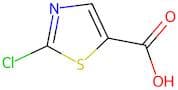
:2-Chlor-1,3-thiazol-5-carbonsäure
Beschreibung:
2-Chlor-1,3-thiazol-5-carbonsäure ist eine heterocyclische Verbindung, die durch das Vorhandensein eines Thiazolrings gekennzeichnet ist, der ein fünfgliedriger Ring ist, der sowohl Schwefel- als auch Stickstoffatome enthält. Die Verbindung weist eine Carbonsäurefunktion (-COOH) und ein Chlor-Substituent an der zweiten Position des Thiazolrings auf. Diese Struktur verleiht einzigartige chemische Eigenschaften, einschließlich potenzieller Säure aufgrund der Carbonsäuregruppe und Reaktivität, die mit dem Chloratom verbunden ist. Die Thiazolgruppe trägt zu seiner biologischen Aktivität bei, was es in der pharmazeutischen und agrochemischen Forschung von Interesse macht. Die Verbindung ist typischerweise ein Feststoff bei Raumtemperatur und kann eine moderate Löslichkeit in polaren Lösungsmitteln aufweisen. Ihre Synthese umfasst oft die Reaktion von Thiazolderivaten mit chlorierenden Agenzien und anschließender Carboxylierung. Aufgrund ihrer funktionellen Gruppen kann 2-Chlor-1,3-thiazol-5-carbonsäure an verschiedenen chemischen Reaktionen teilnehmen, einschließlich nucleophiler Substitutionen und Kupplungsreaktionen, was sie zu einem vielseitigen Zwischenprodukt in der organischen Synthese macht.
Formel:C4H2ClNO2S
InChl:InChI=1/C4H2ClNO2S/c5-4-6-1-2(9-4)3(7)8/h1H,(H,7,8)
InChI Key:InChIKey=HNJOKQPEJIWTRF-UHFFFAOYSA-N
SMILES:C(O)(=O)C=1SC(Cl)=NC1
Synonyme:- 2-Chloro-5-thiazolecarboxylic acid
- 2-Chlorothiazole-5-Carboxylic Acid
- 2-Chlorothiazole-5-Carboxylicacid
- 5-Thiazolecarboxylic acid, 2-chloro-
- 2-Chloro-1,3-thiazole-5-carboxylic acid
- 5-Carboxy-2-chloro-1,3-thiazole
- 2-chloro-thiazol-5-carboxylic acid
- 5-Thiazolecarboxylicacid, 2-chloro-
- 2-Chloro-1,3-thiazole-5-carboxylic acid 97%
- 2-Chloro-5-carboxy-1,3-thiazole
- 2-Chloro-1,3-thiazole-5-carboxylic acid, >=98%
Sortieren nach
Reinheit (%)
0
100
|
0
|
50
|
90
|
95
|
100
6 Produkte.
5-Thiazolecarboxylic acid, 2-chloro-
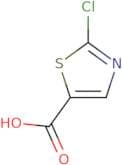
CAS:Formel:C4H2ClNO2SReinheit:95%Farbe und Form:SolidMolekulargewicht:163.58222-Chloro-1,3-thiazole-5-carboxylic acid
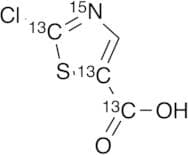
CAS:2-Chloro-1,3-thiazole-5-carboxylic acidFormel:C4H2ClNO2SReinheit:97%Farbe und Form: off-white crystalline solidMolekulargewicht:163.58g/mol2-Chloro-5-thiazolecarboxylic Acid-13C3,15N
CAS:Kontrolliertes ProduktFormel:CC3H2ClNO2SFarbe und Form:NeatMolekulargewicht:167.552-Chloro-1,3-thiazole-5-carboxylic Acid
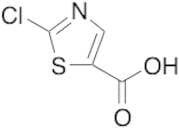
CAS:Applications 2-Chloro-5-thiazolecarboxylic Acid (C411465) was studied as one of the metabolites of thiamethoxam, clothianidin, and dinotefuran in mice.
References Ford, K., et al.: Chem. Res. Toxicol., 19, 1549 (2006);Formel:C4H2ClNO2SFarbe und Form:NeatMolekulargewicht:163.5822-Chloro-1,3-thiazole-5-carboxylic acid
CAS:Formel:C4H2ClNO2SReinheit:95%Farbe und Form:SolidMolekulargewicht:163.582-Chloro-5-thiazolecarboxylic Acid-13C3,15N
CAS:2-Chloro-5-thiazolecarboxylic Acid-13C3,15N is a neonicotinoid pesticide that inhibits the function of acetylcholinesterase. It has been used as an analytical method for detecting neonicotinoids in human urine and has been shown to interact with glutamate in the body. 2-Chloro-5-thiazolecarboxylic Acid-13C3,15N is also used to control pests on plants. This compound has been found to be effective against a number of insects, including aphids, leafhoppers, thrips, and whiteflies. 2-Chloro-5-thiazolecarboxylic Acid-13C3,15N can be applied to plant tissue or seedlings orally or by spraying onto leaves or stems. This compound can also be applied as a soil drench or seed treatment. The compound can then be recovered from plant tissues using elFormel:C4H2ClNO2SReinheit:Min. 95%Molekulargewicht:167.55 g/mol