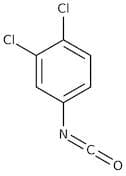
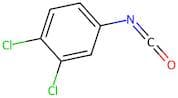
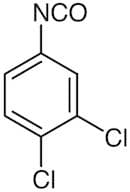
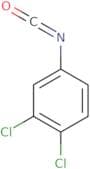
CAS 102-36-3
:3,4-Dichlorphenylisocyanat
Beschreibung:
3,4-Dichlorphenylisocyanat, mit der CAS-Nummer 102-36-3, ist eine organische Verbindung, die durch das Vorhandensein von sowohl Isocyanat- als auch Dichlorphenyl-Funktionsgruppen gekennzeichnet ist. Sie erscheint als farblose bis blassgelbe Flüssigkeit mit einem stechenden Geruch. Diese Verbindung ist bekannt für ihre Reaktivität, insbesondere bei der Bildung von Urethanen und anderen Derivaten durch Reaktionen mit Alkoholen und Aminen. Sie ist mäßig in organischen Lösungsmitteln löslich, hat jedoch eine begrenzte Löslichkeit in Wasser. Aufgrund der Anwesenheit der Isocyanatgruppe kann sie gefährlich sein und zeigt potenzielle Toxizität sowie reizende Eigenschaften, insbesondere für die Haut, die Augen und das Atmungssystem. Ein ordnungsgemäßer Umgang und Sicherheitsvorkehrungen sind beim Arbeiten mit dieser Substanz unerlässlich, da sie auch in Gegenwart von Feuchtigkeit hydrolysiert werden kann, was zur Bildung von 3,4-Dichlorphenylcarbamat führt. Ihre Anwendungen finden sich hauptsächlich in der Synthese verschiedener chemischer Zwischenprodukte und in der Herstellung von Pestiziden und Arzneimitteln.
Formel:C7H3Cl2NO
InChl:InChI=1/C7H3Cl2NO/c8-6-2-1-5(10-4-11)3-7(6)9/h1-3H
InChI Key:InChIKey=MFUVCHZWGSJKEQ-UHFFFAOYSA-N
SMILES:N(=C=O)C1=CC(Cl)=C(Cl)C=C1
Synonyme:- 1,2-Dichloro-4-Isocyanato-Benzen
- 1,2-Dichloro-4-isocyanatobenzene
- 1,2-Dichloro-4-phenyl isocyanate
- 3,4-Dichlorfenylisokyanat
- 3,4-Dichloro phenyl isocyanate
- 3,4-Dichlorobenzene isocyanate
- 3,4-Dichloroisocyanatobenzene
- 3,4-Dichlorphenylisocyanate
- Benzene,1,2-Dichloro-4-Isocyanato
- Benzene,1,2-Dichloro-4Isocyanato-
- Dcpi
- Dichlorophenyl-3,4-isocyanate
- Isocyanic acid 3,4-dichlorophenyl ester
- NSC 76605
- 3,4-Dichlorophenyl isocyanate
- 3,4-Dichlorophenyl #niso-cyanate
- 3,4-DICHLOROPHENYLCARBIMIDE
- 3,4-DCPI
- 3,4-DichloroPhenylIsocynate
- Dichloroisocyanatobenzene
- dichlorophenylisocyanate(non-specificname)
- Isocyanicacid-3,4-dichtorophenyl ester
- Phenylisocyanate,dichloro-
- Weitere Synonyme anzeigen
Sortieren nach
Reinheit (%)
0
100
|
0
|
50
|
90
|
95
|
100
4 Produkte.
3,4-Dichlorophenyl isocyanate, 97%
CAS:Methyl-labeled diuron was prepared by the reaction of 3,4-dichlorophenyl- isocyanate with C 'labeled dimethylamine.Substituted urea derivatives were prepared by reacting 3,4-dichlorophenyl isocyanate with amino acids, dipeptides, histamine. The R- and S-isomers and RS-racemate of MBPU were synthesiz
Formel:C7H3Cl2NOReinheit:97%Farbe und Form:Crystals or fused solid, White to pale creamMolekulargewicht:188.013,4-Dichlorophenyl isocyanate
CAS:3,4-Dichlorophenyl isocyanateFormel:C7H3Cl2NOReinheit:97%Farbe und Form: hazy. white liquid/ white low-melting solid fused solidMolekulargewicht:188.01082g/mol3,4-Dichlorophenyl Isocyanate
CAS:Formel:C7H3Cl2NOReinheit:>98.0%(GC)(T)Farbe und Form:White to Almost white powder to lumpMolekulargewicht:188.013,4-Dichlorophenyl isocyanate
CAS:3,4-Dichlorophenyl isocyanate is a reactive intermediate that features a hydroxyl group. 3,4-Dichlorophenyl isocyanate has been found to cause neurotoxicity in rats and mice by inhibiting the enzyme acetylcholinesterase (AChE) and causing an accumulation of acetylcholine (ACh). The activity of this molecule has been demonstrated using monoclonal antibodies against AChE. 3,4-Dichlorophenyl isocyanate reacts with lysine residues on proteins to form acrylate esters. This allows for the formation of crosslinks between proteins and DNA, which can lead to cancer.Formel:C7H3Cl2NOReinheit:Min. 95%Farbe und Form:PowderMolekulargewicht:188.01 g/mol