CAS 102-38-5
:N-(3-Nitrophenyl)formamid
Beschreibung:
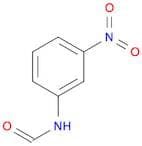
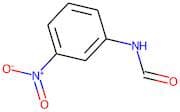
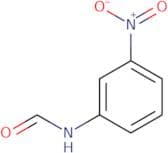
N-(3-Nitrophenyl)formamid, mit der CAS-Nummer 102-38-5, ist eine organische Verbindung, die durch ihre funktionellen Gruppen, einschließlich einer Amide und einer Nitrogruppe, gekennzeichnet ist. Sie weist eine Formamidstruktur auf, bei der das Stickstoffatom an eine 3-Nitrophenylgruppe gebunden ist, was zu ihrer chemischen Reaktivität und ihren Eigenschaften beiträgt. Diese Verbindung erscheint typischerweise als Feststoff bei Raumtemperatur und ist bekannt für ihre blassgelbe bis hellbraune Farbe. Sie ist in organischen Lösungsmitteln wie Ethanol und Aceton löslich, hat jedoch eine begrenzte Löslichkeit in Wasser. N-(3-Nitrophenyl)formamid wird häufig in der organischen Synthese verwendet und kann als Zwischenprodukt in der Herstellung verschiedener Arzneimittel und Agrochemikalien dienen. Ihre Nitrogruppe kann an elektrophilen aromatischen Substitutionsreaktionen teilnehmen, was sie zu einem wertvollen Baustein in der synthetischen Chemie macht. Darüber hinaus sollten beim Umgang mit dieser Verbindung Sicherheitsvorkehrungen getroffen werden, da nitro-substituierte Verbindungen gefährlich sein können und Umweltgefahren darstellen können.
Formel:C7H6N2O3
InChl:InChI=1S/C7H6N2O3/c10-5-8-6-2-1-3-7(4-6)9(11)12/h1-5H,(H,8,10)
InChI Key:InChIKey=QCDUUALALDXTAD-UHFFFAOYSA-N
SMILES:N(C=O)C1=CC(N(=O)=O)=CC=C1
Synonyme:- Formamide, N-(3-nitrophenyl)-
- Formanilide, 3′-nitro-
- N-(3-nitrophenyl)formamide
- N-(m-Nitrophenyl)formamide
- m-Nitroformanilide
Sortieren nach
Reinheit (%)
0
100
|
0
|
50
|
90
|
95
|
100
4 Produkte.
3-Nitroformanilide
CAS:3-Nitroformanilide is an organic molecule that is synthesized by the reaction of formamide and nitroethane. It can be used as a precursor for the synthesis of other molecules with pharmaceutical properties, such as imines, sulfoxides, and nucleophilic anions. 3-Nitroformanilide has shown high reactivity with sulfoxide and nucleophilic anions in organic solvents. The reaction yield of the reaction between 3-nitroformanilide and sulfoxide increases when it is carried out in inorganic solvents. This reaction produces a nucleophilic anion, which can then be used to synthesize other molecules with pharmaceutical properties.
Formel:C7H6N2O3Reinheit:Min. 95%Farbe und Form:PowderMolekulargewicht:166.13 g/molRef: 3D-FN169224
Ausgelaufenes produkt