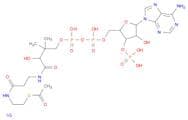
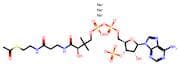
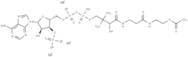
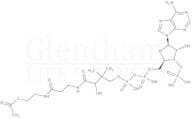
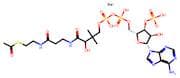
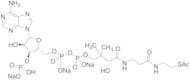
CAS 102029-73-2
:Acetyl-Coenzym A (C2:0) Natrium*enzymatisch hergestellt
Beschreibung:
Acetyl-Coenzym A (C2:0) Natrium, mit der CAS-Nummer 102029-73-2, ist eine biochemische Verbindung, die eine entscheidende Rolle in verschiedenen Stoffwechselwegen spielt, insbesondere bei der Synthese und Oxidation von Fettsäuren sowie im Zitronensäurezyklus. Diese Verbindung ist ein Derivat von Coenzym A, das für den Transfer von Acetylgruppen in Stoffwechselreaktionen unerlässlich ist. Die Natriumsalzform verbessert die Löslichkeit in wässrigen Lösungen und macht es bioverfügbarer für enzymatische Reaktionen. Acetyl-CoA zeichnet sich durch seine hohe Reaktivität aufgrund der Anwesenheit einer Thioesterbindung aus, die leicht hydrolysiert werden kann, um Energie freizusetzen. Es ist an der Regulierung von Stoffwechselprozessen beteiligt und dient als Schlüsselsubstrat für die Synthese von Lipiden und Neurotransmittern. Darüber hinaus zeigt seine enzymatische Vorbereitung, dass es durch biologische Prozesse hergestellt wird, was seine Reinheit und Funktionalität in biochemischen Anwendungen gewährleistet. Insgesamt ist Acetyl-Coenzym A entscheidend für den Zellstoffwechsel und die Energieproduktion.
Formel:C23H35N7Na3O17P3S
InChl:InChI=1/C23H38N7O17P3S.3Na/c1-12(31)51-7-6-25-14(32)4-5-26-21(35)18(34)23(2,3)9-44-50(41,42)47-49(39,40)43-8-13-17(46-48(36,37)38)16(33)22(45-13)30-11-29-15-19(24)27-10-28-20(15)30;;;/h10-11,13,16-18,22,33-34H,4-9H2,1-3H3,(H,25,32)(H,26,35)(H,39,40)(H,41,42)(H2,24,27,28)(H2,36,37,38);;;/q;3*+1/p-3/t13-,16-,17-,18+,22-;;;/m1.../s1
SMILES:CC(=O)SCCN=C(CCN=C(C(C(C)(C)COP(=O)(O)OP(=O)(O)OCC1C(C(C(n2cnc3c(N)ncnc23)O1)O)OP(=O)(O)O)O)O)O.[Na].[Na].[Na]
Synonyme:- Acetyl coenzyme A trisodium salt
- adenosine, 5'-O-[[[[[(3R)-4-[[3-[[2-(acetylthio)ethyl]amino]-3-oxopropyl]amino]-3-hydroxy-2,2-dimethyl-4-oxobutyl]oxy]hydroxyphosphinyl]oxy]hydroxyphosphinyl]-, 3'-(dihydrogen phosphate), trisodium salt
- Acetyl coenzyme A sodium salt
Sortieren nach
Reinheit (%)
0
100
|
0
|
50
|
90
|
95
|
100
8 Produkte.
Coenzyme A, S-acetate, trisodium salt (9CI)
CAS:Formel:C23H35N7Na3O17P3SReinheit:90%Farbe und Form:SolidMolekulargewicht:875.5163Acetyl Coenzyme A trisodium
CAS:Acetyl Coenzyme A trisodium (Acetyl-CoA trisodium) is a compound in glucose metabolism and lipid metabolism, and is involved in the tricarboxylic acid cycle.Formel:C23H35N7Na3O17P3SReinheit:95% - 98.55%Farbe und Form:SolidMolekulargewicht:875.52Acetyl coenzyme A sodium salt
CAS:Formel:C23H38N7O17P3SReinheit:≥ 95%Farbe und Form:White powderMolekulargewicht:809.57 (free acid)Acetyl Coenzyme A, Sodium Salt
CAS:Acetyl Coenzyme A, Sodium SaltReinheit:≥ 95%Molekulargewicht:831.555g/molAcetyl coenzyme A sodium salt
CAS:Acetyl-coenzyme A is an important intermediate in the metabolism of carbohydrates, fats, and proteins. It is a cytosolic molecule that is synthesized from Acetyl-CoA and ATP. The Michaelis–Menten kinetics describe the relationship between the concentration of acetyl-coenzyme A and the rate of its consumption. Acetyl co-enzyme A is found in many different tissues, including plants, animals, and humans. It has an important role in regulating cellular growth and differentiation by activating various enzymes involved in metabolic pathways. Acetyl CoA can be acetylated to form acetyl CoA carboxylic acid (ACC) which then turns into malonyl CoA through a series of reactions. Malonyl CoA then enters the Krebs cycle as a key intermediate for generating energy from fatty acids.Formel:C23H38N7O17P3S·xNaReinheit:Min. 95%Farbe und Form:PowderMolekulargewicht:809.57 g/molAcetyl Coenzyme A Trisodium Salt
CAS:Applications Acetyl Coenzyme A Trisodium Salt is used in skin-lightening cosmetics.
Formel:C23H38N7O17P3S·3NaFarbe und Form:NeatMolekulargewicht:878.54