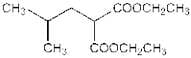
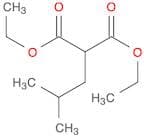
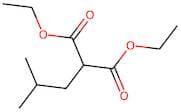
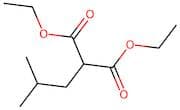
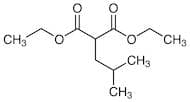
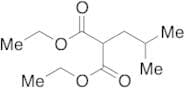
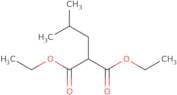
CAS 10203-58-4
:Propandisäure, 2-(2-methylpropyl)-, 1,3-diethylester
- (2-Methylpropyl)propanedioic acid diethyl ester
- 1,3-Diethyl 2-(2-methylpropyl)propanedioate
- 2-Isobutylmalonic acid diethyl ester
- Ai3-05627
- Diethyl (2-Methylpropyl)Propanedioate
- Diethyl 2-isobutylmalonate
- Ethyl 2-ethoxycarbonyl-4-methylvalerate
- Isobutylmalonic Acid Diethyl Ester
- Malonic acid, isobutyl-, diethyl ester
- Nsc 68522
- Propanedioic acid, (2-methylpropyl)-, diethyl ester
- Propanedioic acid, 2-(2-methylpropyl)-, 1,3-diethyl ester
- Diethyl isobutylmalonate
- Ethyl 2-carbethoxy-4-methyl pentanoate
- Ethyl isobutyl malonate
- DIETHYL (2-METHYLPROPYL)MALONATE
- Weitere Synonyme anzeigen
Diethyl isobutylmalonate, 98%
CAS:This Thermo Scientific Chemicals brand product was originally part of the Alfa Aesar product portfolio. Some documentation and label information may refer to the legacy brand. The original Alfa Aesar product / item code or SKU reference has not changed as a part of the brand transition to Thermo SciFormel:C11H20O4Reinheit:98%Farbe und Form:Clear colorless, LiquidMolekulargewicht:216.28Propanedioic acid, 2-(2-methylpropyl)-, 1,3-diethyl ester
CAS:Formel:C11H20O4Reinheit:98%Farbe und Form:LiquidMolekulargewicht:216.2741Ref: 54-OR89609
2.5lNachfragen5gNachfragen5mlNachfragen10gNachfragen25gNachfragen25mlNachfragen100mlNachfragen500mlNachfragenDiethyl Isobutylmalonate
CAS:Formel:C11H20O4Reinheit:>98.0%(GC)Farbe und Form:Colorless to Light yellow clear liquidMolekulargewicht:216.28Diethyl 2-isobutylmalonate
CAS:Formel:C11H20O4Reinheit:98%Farbe und Form:Solid, No data available.Molekulargewicht:216.277Diethyl Isobutylmalonate
CAS:Kontrolliertes ProduktApplications Diethyl Isobutylmalonate is used as a reagent in the synthesis of quinoline-based zinc metallo-aminopeptidase inhibitors which have antimalarial activity.
References Flipo, M., et al.: Bioorg. Med. Chem. Lett., 13, 2659 (2003)Formel:C11H20O4Farbe und Form:NeatMolekulargewicht:216.27Diethyl Isobutylmalonate
CAS:Diethyl Isobutylmalonate is a solid catalyst that is used in the organic synthesis of ester compounds. This compound is an organometallic compound with a diethyl group bound to an iso-butyl group and malonic acid. The active methylene group of this molecule reacts with carboxylic acids, such as picolinic acid, to form esters. Diethyl Isobutylmalonate can be used with an acid catalyst to cross-link peptides. The hydroxyl group on the molecule can react with amine groups on proteins and also bind to aromatic hydrocarbons.
Formel:C11H20O4Reinheit:Min. 95%Molekulargewicht:216.27 g/mol