![11-[2-[2-[(Diethylamino)methyl]-1-piperidinyl]acetyl]-5,11-dihydro-6H-pyrido[2,3-b][1,4]benzodiaze…](/_next/image/?url=https%3A%2Fstatic.cymitquimica.com%2Fcas-image%2Fthumb-webp%2F298876-11-2-2-diethylamino-methyl-1-piperidinyl-acetyl-511-dihydro-6h-pyrido-23-b-14-benzodiazepin-6-one.webp&w=3840&q=75)
CAS 102394-31-0
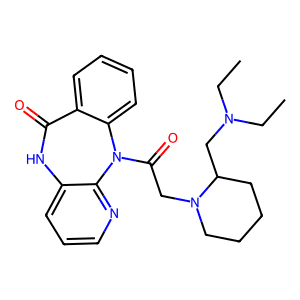
:11-[2-[2-[(Diethylamino)methyl]-1-piperidinyl]acetyl]-5,11-dihydro-6H-pyrido[2,3-b][1,4]benzodiazepin-6-on
- 11-((2-((Diethylamino)methyl)-1-piperidinyl)acetyl)-5,11-dihydro-(6H)-pyrido[2.3-b][1.4]benzodiazepin-6-one
- 11-[2-[2-(Diethylaminomethyl)piperidin-1-yl]acetyl]-5H-pyrido[2,3-b][1,4]benzodiazepin-6-one
- 11-[2-[2-[(Diethylamino)methyl]-1-piperidinyl]acetyl]-5,11-dihydro-6H-pyrido[2,3-b][1,4]benzodiazepin-6-one
- 6H-Pyrido(2,3-B)(1,4)Benzodiazepin-6-One,5,11-Dihydro-11-((2-((Diethylamino)M
- 6H-Pyrido[2,3-b][1,4]benzodiazepin-6-one, 11-[2-[2-[(diethylamino)methyl]-1-piperidinyl]acetyl]-5,11-dihydro-
- 6H-Pyrido[2,3-b][1,4]benzodiazepin-6-one, 11-[[2-[(diethylamino)methyl]-1-piperidinyl]acetyl]-5,11-dihydro-
- Af-Dx 116
- Ethyl)-7-Piperidinyl)Acetyl)-
- Otenzepad
6H-Pyrido[2,3-b][1,4]benzodiazepin-6-one, 11-[2-[2-[(diethylamino)methyl]-1-piperidinyl]acetyl]-5,11-dihydro-
CAS:Formel:C24H31N5O2Reinheit:98%Farbe und Form:SolidMolekulargewicht:421.5352Otenzepad
CAS:Otenzepad (AF-DX 116) is a selective antagonist of M2 mAChR with IC50s of 386 nM and 640 nM for rat heart and rabbit peripheral lung.Formel:C24H31N5O2Reinheit:99.79%Farbe und Form:SolidMolekulargewicht:421.54Ref: TM-T16411
1mg47,00€5mg84,00€10mg120,00€25mg235,00€50mg376,00€100mg603,00€200mg848,00€1mL*10mM (DMSO)92,00€Otenzepad
CAS:Otenzepad is a fluorescent probe that can bind to muscarinic receptors and be used as a research tool. It is an antagonist of the muscarinic receptor, which inhibits the neurotransmitter acetylcholine from binding to the receptor. Otenzepad has low potency and is not selective for any one type of muscarinic receptor, but it does have high affinity for all types. Otenzepad binds to cholinergic neurons by competitive inhibition, preventing acetylcholine from binding to the receptor and inhibiting their function. This results in decreased production of other chemicals that are important for memory and learning processes. Atropine and pirenzepine are muscarinic antagonists that are used in medical practice as anticholinergics or antispasmodics. They block acetylcholine receptors on smooth muscle cells, leading to increased bladder contraction and reduced gastrointestinal motility. Estrogen-benzoate also has antagonistic effects on the muscarinic
Formel:C24H31N5O2Reinheit:Min. 95%Molekulargewicht:421.54 g/molRef: 3D-CEA39431
Ausgelaufenes produkt
![6H-Pyrido[2,3-b][1,4]benzodiazepin-6-one, 11-[2-[2-[(diethylamino)methyl]-1-piperidinyl]acetyl]-5,…](/_next/image/?url=https%3A%2Fstatic.cymitquimica.com%2Fproducts%2FIN%2Fthumb%2FDA0007BO.jpg&w=3840&q=75)