CAS 102601-58-1
:N-cbz-gly-gly-arg 7-amido-4-*methylcoumarin hydro
Beschreibung:
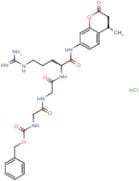
N-Cbz-gly-gly-arg 7-amido-4-methylcoumarin hydro, identifiziert durch die CAS-Nummer 102601-58-1, ist eine synthetische Verbindung, die häufig in der biochemischen Forschung verwendet wird, insbesondere im Studium von proteolytischen Enzymen. Diese Verbindung weist eine Coumarin-Einheit auf, die für ihre fluoreszierenden Eigenschaften bekannt ist, was sie in verschiedenen Tests und Bildgebungstechniken wertvoll macht. Die Anwesenheit der N-Cbz (Carbobenzyloxy)-Gruppe zeigt an, dass es sich um ein geschütztes Aminosäurederivat handelt, das häufig zur Erleichterung der Peptidsynthese verwendet wird. Die Gly-Gly-Arg-Sequenz deutet darauf hin, dass es sich um ein peptidisches Substrat handelt, das potenziell nützlich ist, um die Spezifität und Aktivität von Proteasen zu untersuchen. Die Hydro-Bezeichnung impliziert, dass es in hydratisierter Form existieren oder an hydrolytischen Reaktionen beteiligt sein kann. Insgesamt machen die einzigartigen strukturellen Merkmale und funktionalen Gruppen dieser Verbindung sie zu einem bedeutenden Werkzeug im Bereich der Biochemie, insbesondere für Anwendungen, die Enzymkinetik und Substratspezifität betreffen.
Formel:C28H34ClN7O7
InChl:InChI=1/C28H33N7O7.ClH/c1-17-12-25(38)42-22-13-19(9-10-20(17)22)34-26(39)21(8-5-11-31-27(29)30)35-24(37)15-32-23(36)14-33-28(40)41-16-18-6-3-2-4-7-18;/h2-4,6-7,9-10,12-13,21H,5,8,11,14-16H2,1H3,(H,32,36)(H,33,40)(H,34,39)(H,35,37)(H4,29,30,31);1H
SMILES:Cc1cc(=O)oc2cc(ccc12)N=C(C(CCCNC(=N)N)N=C(CN=C(CN=C(O)OCc1ccccc1)O)O)O.Cl
Synonyme:- Z-Gly-Gly-Arg-AMC . HCl
- N-[(benzyloxy)carbonyl]glycylglycyl-N5-(diaminomethylidene)-N-(4-methyl-2-oxo-2H-chromen-7-yl)ornithinamide hydrochloride
- Z-Gly-Gly-Arg-7-Amino-4-Methylcoumarin
Sortieren nach
Reinheit (%)
0
100
|
0
|
50
|
90
|
95
|
100
6 Produkte.
Z-Gly-Gly-Arg-AMC · HCl
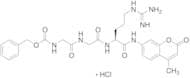
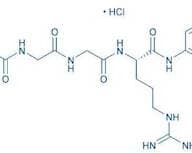
CAS:Z-GGR-AMC has been used as substrate in a direct fluorometric assay of urokinase and tissue-type plasminogen activator as well as for assaying trypsin and thrombin.The substrate is used as thrombin substrate in the calibrated automated thrombogram (CAT), an automated test developed by Hemker et al., for determining hyper- and hypocoagulability. Z-GGR-AMC can also be used for determining the tryptic activity of proteasomes.Formel:C28H33N7O7·HClReinheit:> 99%Farbe und Form:WhiteMolekulargewicht:616.07L-Argininamide, N-[(phenylmethoxy)carbonyl]glycylglycyl-N-(4-methyl-2-oxo-2H-1-benzopyran-7-yl)-, hydrochloride (1:1)
CAS:Formel:C9H10ClNO3Reinheit:98%Farbe und Form:SolidMolekulargewicht:215.6336N-CBZ-Glycyl-glycyl-L-arginine 7-Amido-4-methylcoumarin Hydrochloride
CAS:Applications N-CBZ-Glycyl-glycyl-L-arginine 7-Amido-4-methylcoumarin Hydrochloride is a fluorogenic substrate for uPA (urokinase).
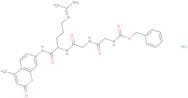
References Zimmerman, M., et al. Proc. Natl. Acad. Sci. USA 75, 750 (1978);Formel:C28H33N7O7·HClFarbe und Form:NeatMolekulargewicht:579.6Z-Gly-Gly-Arg-AMC·HCl
CAS:Z-Gly-Gly-Arg-AMC·HCl is a proteolytic enzyme that cleaves proteins at the carboxyl side of the amino acid arginine. It has been shown to have potential as a drug target and has been found to be active against carcinoma cell lines, but not normal cells. Z-Gly-Gly-Arg-AMC·HCl is activated by light and can be inhibited by natural compounds such as 2-aminoethoxydiphenyl borate. In addition, it specifically cleaves proteins at the carboxyl side of arginine residues, which makes it useful for studying protein degradation mechanisms in living cells and tissues.Formel:C28H33N7O7·HClReinheit:Min. 98%Farbe und Form:White PowderMolekulargewicht:616.07 g/molZ-Glycyl-Glycyl-L-Arginine 7-Amido-4-Methylcoumarin Hydrochloride Salt extrapure, 95%
CAS:Formel:C28H33N7O7·HClMolekulargewicht:616.07

![L-Argininamide, N-[(phenylmethoxy)carbonyl]glycylglycyl-N-(4-methyl-2-oxo-2H-1-benzopyran-7-yl)-, …](/_next/image/?url=https%3A%2Fstatic.cymitquimica.com%2Fproducts%2FIN%2Fthumb%2FDA0007VN.jpg&w=3840&q=75)