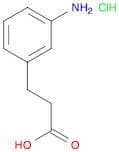
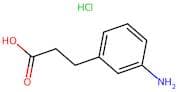
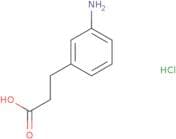
CAS 102879-44-7
:Benzolpropansäure, 3-amino-, Hydrochlorid (1:1)
Beschreibung:
Benzolpropansäure, 3-amino-, Hydrochlorid (1:1), auch bekannt als 3-Amino-Phenylpropansäurehydrochlorid, ist eine organische Verbindung, die durch ihre aromatische Struktur und das Vorhandensein sowohl einer Aminogruppe als auch einer Carbonsäuregruppe gekennzeichnet ist. Diese Verbindung erscheint typischerweise als weißes bis off-white kristallines Feststoff und ist aufgrund der Anwesenheit der Salzform des Hydrochlorids in Wasser löslich, was ihre Löslichkeit im Vergleich zur freien Base erhöht. Die Aminogruppe trägt zu ihrer Basizität bei, während die Carbonsäuregruppe saure Eigenschaften verleiht, was sie unter bestimmten pH-Bedingungen zu einer zwitterionischen Verbindung macht. Sie wird häufig in der biochemischen Forschung und in pharmazeutischen Anwendungen verwendet, insbesondere bei der Synthese verschiedener Derivate und als Baustein in der Arzneimittelentwicklung. Die Eigenschaften der Verbindung, wie Schmelzpunkt und Stabilität, können je nach Umweltbedingungen und dem Vorhandensein anderer Substanzen variieren. Sicherheitsdaten sollten für den Umgang und die Lagerung konsultiert werden, wie bei jeder chemischen Substanz.
Formel:C9H11NO2·ClH
InChl:InChI=1S/C9H11NO2.ClH/c10-8-3-1-2-7(6-8)4-5-9(11)12;/h1-3,6H,4-5,10H2,(H,11,12);1H
InChI Key:InChIKey=QBOBODDISCLHPG-UHFFFAOYSA-N
SMILES:C(CC(O)=O)C1=CC(N)=CC=C1.Cl
Synonyme:- 3-(3-Aminophenyl)propanoic acid hydrochloride (1:1)
- Benzenepropanoic acid, 3-amino-, hydrochloride (1:1)
- Hydrocinnamic acid, m-amino-, hydrochloride
Sortieren nach
Reinheit (%)
0
100
|
0
|
50
|
90
|
95
|
100
4 Produkte.
3-(3-Aminophenyl)propanoic acid hydrochloride
CAS:3-(3-Aminophenyl)propanoic acid hydrochlorideReinheit:97%Molekulargewicht:201.65g/molbeta-(3-Aminophenyl)propionic acid hydrochloride
CAS:Beta- (3-aminophenyl)propionic acid hydrochloride is a drug that belongs to the class of pharmaceuticals and is used as a gastric antacid. It has been shown to be effective in treating acute and chronic gastritis, as well as ulcers in humans. Beta-(3-aminophenyl)propionic acid hydrochloride has been shown to have strong effects on tissues, membranes, and chlorides. The drug binds to hydrogen chloride and chlorine ions in the stomach, thereby preventing the formation of hydrochloric acid (HCL). This prevents the damage caused by HCL on tissues and membranes of the stomach. Beta-(3-aminophenyl)propionic acid hydrochloride also has health effects with high concentrations, such as chloroform or chlorine gas.Formel:C9H12ClNO2Reinheit:Min. 95%Molekulargewicht:201.65 g/mol