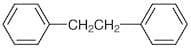
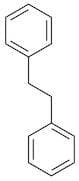
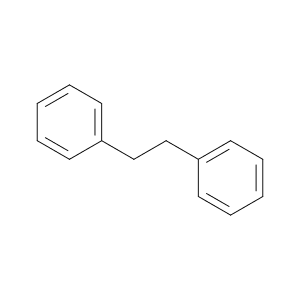
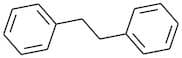
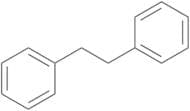
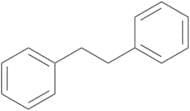
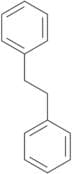
CAS 103-29-7
:Dibenzyl
- (2-Phenylethyl)Benzene
- 1,1'-(1,2-Ethanediyl)Bis[Benzene]
- 1,1'-(1,2-Ethanediyl)bisbenzene
- 1,1'-Ethane-1,2-Diyldibenzene
- 1,2-Difeniletano
- 1,2-Dihydrostilbene
- 1,2-Diphenylethan
- 1,2-Diphenylethane
- 2-Phenylethylbenzene
- Benzene, 1,1'-(1,2-ethanediyl)bis-
- Dibenzil
- Dibenzyl
- Dihydrostilbene
- Ethane, 1,2-diphenyl-
- Ethane, Diphenyl-
- Ethylenebis[benzene]
- Nsc 30686
- Nsc 8789
- sym-Diphenylethane
- Weitere Synonyme anzeigen
Dibenzyl
CAS:Formel:C14H14Reinheit:>99.0%(GC)Farbe und Form:White powder to crystalMolekulargewicht:182.271,2-Diphenylethane, 98+%
CAS:1,2-Diphenylethane is used as solvent for nitro fibre and in synthesis of other organic chemical products. This Thermo Scientific Chemicals brand product was originally part of the Alfa Aesar product portfolio. Some documentation and label information may refer to the legacy brand. The original AlfaFormel:C14H14Reinheit:98+%Farbe und Form:Crystals or powder or crystalline powder or fused solid or chunks, Colorless to white to pale yellowMolekulargewicht:182.271,2-Diphenylethane
CAS:1,2-DiphenylethaneReinheit:98%Farbe und Form:White CrystalsMolekulargewicht:182.26g/mol1,2-Diphenylethane
CAS:Kontrolliertes ProduktApplications 1,2-DIPHENYLETHANE (cas# 103-29-7) is a useful research chemical.
Formel:C14H14Farbe und Form:Off-WhiteMolekulargewicht:182.26Bibenzyl
CAS:Bibenzyl is a trifluoroacetic acid derivative that can be used as a chemical intermediate for the synthesis of other compounds. It has high values, with an ester hydrochloride and hydroxyl group. Bibenzyl has been shown to have antimicrobial properties against bacterial strains, due to its ability to inhibit the mitochondrial membrane potential in these cells. Bibenzyl's inhibition of the mitochondrial membrane potential leads to an increase in reactive oxygen species (ROS) production, which damages the DNA and cellular components of bacteria. Bibenzyl also reacts with copper chloride to form copper bibenzylate complexes, which have been shown to react with nucleophilic groups on DNA or RNA molecules. The reaction mechanism is based on the coordination geometry and conformational properties of bibenzyl and copper chloride complexes.
Formel:C6H5CH2CH2C6H5Reinheit:Min. 95%Molekulargewicht:182.26 g/mol