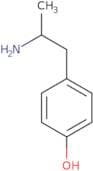
CAS 103-86-6
:Hydroxyamphetamin
Beschreibung:
Hydroxyamphetamin, mit der CAS-Nummer 103-86-6, ist eine chemische Verbindung, die zur Klasse der Phenethylamine gehört. Sie ist strukturell mit Amphetamin verwandt und zeichnet sich durch das Vorhandensein einer Hydroxylgruppe (-OH) aus, die am aromatischen Ring angebracht ist. Diese Modifikation kann ihre pharmakologischen Eigenschaften beeinflussen und macht sie zu einer Verbindung von Interesse in der medizinischen Chemie. Hydroxyamphetamin ist bekannt dafür, stimulierende Effekte zu zeigen und kann als sympathomimetisches Mittel wirken, was potenziell die Freisetzung und Wiederaufnahme von Neurotransmittern im zentralen Nervensystem beeinflusst. Die Verbindung wird häufig auf ihre potenziellen Anwendungen bei der Behandlung von Erkrankungen wie Aufmerksamkeitsdefizit-Hyperaktivitätsstörung (ADHS) und Narkolepsie untersucht. In Bezug auf die physikalischen Eigenschaften ist Hydroxyamphetamin typischerweise ein Feststoff bei Raumtemperatur und kann in polaren Lösungsmitteln löslich sein. Sicherheits- und Handhabungsvorkehrungen sind unerlässlich, wie bei vielen psychoaktiven Substanzen, aufgrund möglicher Nebenwirkungen und regulatorischer Überlegungen. Insgesamt stellt Hydroxyamphetamin eine bedeutende Verbindung in der Studie psychoaktiver Drogen und ihrer therapeutischen Anwendungen dar.
Formel:C9H13NO
InChl:InChI=1S/C9H13NO/c1-7(10)6-8-2-4-9(11)5-3-8/h2-5,7,11H,6,10H2,1H3
InChI Key:InChIKey=GIKNHHRFLCDOEU-UHFFFAOYSA-N
SMILES:C(C(C)N)C1=CC=C(O)C=C1
Synonyme:- 1-p-Hydroxyphenyl-2-propylamine
- 2-Amino-1-(p-hydroxyphenyl)propane
- 4-Hydroxy-alpha-methylphenethylamine
- 4-Hydroxy-α-methylphenethylamine
- 4-Hydroxyamphetamine
- <span class="text-smallcaps">DL</span>-4-Hydroxyamphetamine
- Brn 2413849
- Hydroxyamfetamine
- Hydroxyamphetamine
- Norpholedrine
- Norveritol
- Nov-Pholedrin
- Nsc 170995
- Oksamfetamin
- Oxamfetamin
- Oxamphetamine
- Oxamphetaminium
- Paradrine
- Paredrine
- Paredrinex
- Pedrolon
- Phenol, 4-(2-aminopropyl)-
- Phenol, 4-(2-aminopropyl)- (9CI)
- Phenol, p-(2-aminopropyl)-
- Pulsoton
- Racemic p-hydroxyamphetamine
- Unii-Fqr280Jw2N
- alpha-Methyltyramine
- dl-p-Hydroxyamphetamine
- p-(2-Aminopropyl)phenol
- p-Hydroxy-alpha-methylphenethylamine
- p-Hydroxy-α-methylphenethylamine
- p-Hydroxyamphetamine
- p-Hydroxyphenylisopropylamine
- α-Methyltyramine
- Weitere Synonyme anzeigen
Sortieren nach
Reinheit (%)
0
100
|
0
|
50
|
90
|
95
|
100
1 Produkte.
4-(2-Aminopropyl)phenol
CAS:Kontrolliertes Produkt4-(2-Aminopropyl)phenol is a chemical that is used as a diagnostic and pharmacological agent. It is also known to be a potent inhibitor of dopamine uptake in the brain, and has been shown to affect locomotor activity in a clinical study. 4-(2-Aminopropyl)phenol may be an experimental model for infectious diseases such as malaria, which causes high levels of dopamine release from the central nervous system. It inhibits the oxidation of dopamine by reactive oxygen species (ROS), which prevents the formation of toxic products and protects against oxidative stress. 4-(2-Aminopropyl)phenol has been shown to cause death in liver cells by binding with nitrogen atoms, inhibiting cellular respiration through inhibition of cytochrome P450 enzymes.Formel:C9H13NOReinheit:Min. 95%Molekulargewicht:151.21 g/mol