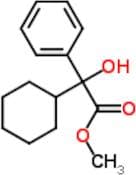
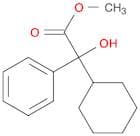
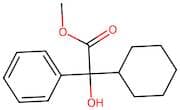
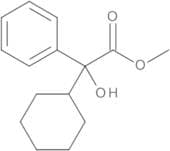
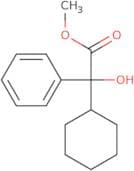
CAS 10399-13-0
:Methyl-α-cyclohexyl-α-hydroxybenzolacetat
Beschreibung:
Methyl-α-cyclohexyl-α-hydroxybenzolacetat, identifiziert durch seine CAS-Nummer 10399-13-0, ist eine organische Verbindung, die durch ihre Esterfunktionalität gekennzeichnet ist. Diese Substanz weist eine Cyclohexylgruppe und ein Hydroxybenzol-Moiety auf, die zu ihren einzigartigen chemischen Eigenschaften beitragen. Typischerweise zeigen Ester wie diese Verbindung eine moderate Polarität aufgrund der Anwesenheit von hydrophoben Kohlenwasserstoffketten und polaren funktionalen Gruppen. Diese Verbindung könnte Anwendungen in der Duft- und Geschmacksindustrie haben, da Ester oft wegen ihrer angenehmen Aromen verwendet werden. Darüber hinaus deutet die Anwesenheit der Hydroxylgruppe auf ein Potenzial für Wasserstoffbrückenbindungen hin, die ihre Löslichkeit in verschiedenen Lösungsmitteln beeinflussen können. Die molekulare Struktur deutet darauf hin, dass sie unter Standardbedingungen eine gewisse Stabilität aufweisen könnte, obwohl die spezifische Reaktivität von Umweltfaktoren wie Temperatur und pH abhängt. Insgesamt ist Methyl-α-cyclohexyl-α-hydroxybenzolacetat eine Verbindung von Interesse in der organischen Chemie, insbesondere in Studien zu Estern und deren Derivaten.
Formel:C15H20O3
InChl:InChI=1S/C15H20O3/c1-18-14(16)15(17,12-8-4-2-5-9-12)13-10-6-3-7-11-13/h2,4-5,8-9,13,17H,3,6-7,10-11H2,1H3
InChI Key:InChIKey=SPTZOODMHSABLY-UHFFFAOYSA-N
SMILES:C(C(OC)=O)(O)(C1CCCCC1)C2=CC=CC=C2
Synonyme:- Benzeneacetic acid, α-cyclohexyl-α-hydroxy-, methyl ester
- Cyclohexaneglycolic acid, α-phenyl-, methyl ester
- Methyl 2-Cyclohenyl-2-hydroxy-2-phenylacetate
- Methyl 2-hydroxy-2-cyclohexyl-2-phenylacetate
- Methyl Cyclohexyl(Hydroxy)Phenylacetate
- Methyl alpha-cyclohexylmandelate
- Methyl cyclohexylphenylglycolate
- Methyl α-cyclohexyl-α-hydroxybenzeneacetate
- Methyl α-cyclohexyl-α-phenylglycolate
- Methylcyclohexylphenylglycolate
Sortieren nach
Reinheit (%)
0
100
|
0
|
50
|
90
|
95
|
100
9 Produkte.
Oxybutynin Related Compound B (Cyclohexyl Mandelic Acid Methyl Ester)
CAS:Carboxylic acids w/ alcohol function but w/o other oxygen function and their derivatives, nesoiFormel:C15H20O3Farbe und Form:White Pale Yellow PowderMolekulargewicht:248.14124methyl 2-(6-cyclohexyl-6-hydroxycyclohexa-2,4-dien-1-yl)acetate
CAS:Formel:C15H20O3Reinheit:98%Farbe und Form:SolidMolekulargewicht:248.3175Oxybutynin EP Impurity F (Oxybutynin USP Related Compound B)
CAS:Formel:C15H20O3Farbe und Form:White To Off-White SolidMolekulargewicht:248.32Oxybutynin Related Compound B
CAS:Oxybutynin Related Compound BReinheit:98%Molekulargewicht:248.32g/molMethyl 2-Cyclohexyl-2-hydroxyphenylacetate
CAS:Applications Methyl 2-Cyclohexyl-2-hydroxyphenylacetate is an impurity of Oxybutynin (O868525).
References Bitar, Y., et al.: J. Pharm. Biomed. Anal., 44, 623 (2007), Wen, T., et al.: Talanta, 71, 854 (2007),Formel:C15H20O3Farbe und Form:WhiteMolekulargewicht:248.32Methyl 2-cyclohexyl-2-hydroxy-2-phenylacetate
CAS:Formel:C15H20O3Reinheit:98%+(GC-MS);RGMolekulargewicht:248.322Methyl 2-cyclohexyl-2-hydroxyphenylacetate
CAS:Methyl 2-cyclohexyl-2-hydroxyphenylacetate is a c6 alkyl and diode. It is an orally active hormone with potential use in catalysis of additives, as well as in the treatment of metabolic disorders. Methyl 2-cyclohexyl-2-hydroxyphenylacetate has been shown to have anticholinergic properties, which may be due to its ability to inhibit acetylcholine release from nerve endings. Lectins are proteins found on the surface of cells that bind to specific sugars and play a role in many biological processes. A lectin that binds to erythrocytes can be used as a marker for damaged red blood cells. Methyl 2-cyclohexyl-2-hydroxyphenylacetate has been shown to react with this lectin in plasma samples from humans, indicating that it is metabolized by enzymes present in red blood cells.Formel:C15H20O3Reinheit:Min. 95%Molekulargewicht:248.32 g/mol