CAS 104-53-0
:Benzolpropanal
Beschreibung:
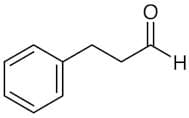
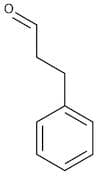
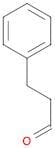
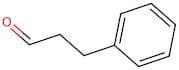
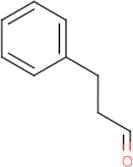
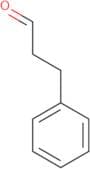
Benzolpropanal, auch bekannt als Phenylpropanal, ist eine organische Verbindung, die durch einen Benzolring gekennzeichnet ist, der an eine Propanalgruppe gebunden ist. Seine chemische Formel ist C9H10O, was darauf hinweist, dass es neun Kohlenstoffatome, zehn Wasserstoffatome und ein Sauerstoffatom enthält. Diese Verbindung ist eine farblose bis blassgelbe Flüssigkeit mit einem süßen, blumigen Aroma, das oft mit bestimmten ätherischen Ölen assoziiert wird. Benzolpropanal ist in organischen Lösungsmitteln löslich, hat jedoch eine begrenzte Löslichkeit in Wasser aufgrund seines hydrophoben Benzolrings. Es wird hauptsächlich in der Parfümindustrie und als Zwischenprodukt in der organischen Synthese verwendet. Die Verbindung zeigt typische Aldehydreaktivität, einschließlich Oxidation zur Bildung von Carbonsäuren und Teilnahme an verschiedenen Kondensationsreaktionen. Sicherheitsüberlegungen sind wichtig, da es gesundheitliche Risiken darstellen kann, wenn es eingeatmet oder eingenommen wird, und geeignete Handhabungsmaßnahmen ergriffen werden sollten, um die Exposition zu minimieren. Insgesamt ist Benzolpropanal eine vielseitige Verbindung mit Anwendungen sowohl in industriellen als auch in Forschungskontexten.
Formel:C9H10O
InChl:InChI=1S/C9H10O/c10-8-4-7-9-5-2-1-3-6-9/h1-3,5-6,8H,4,7H2
InChI Key:InChIKey=YGCZTXZTJXYWCO-UHFFFAOYSA-N
SMILES:C(CC=O)C1=CC=CC=C1
Synonyme:- 3-Fenilpropionaldehido
- 3-Phenyl-1-propanal
- 3-Phenylpropan-1-al
- 3-Phenylpropanal
- 3-Phenylpropanaldehyde
- 3-Phenylpropionaldehyd
- 3-Phenylpropyl aldehyde
- Benzenepropanal
- Benzyl acetaldehyde
- Benzylacetaldehyde
- Dihydrocinnamaldehyde
- Dihydrocinnamic aldehyde
- Hydrocinnamaldehyde
- Hydrocinnamic aldehyde
- Hydrocinnamide
- Nsc 9271
- Phenylpropionaldehyde
- Phenylpropyl aldehyde
- Propanal, 3-Phenyl-
- beta-Phenylpropionaldehyde
- β-Phenylpropionaldehyde
- Weitere Synonyme anzeigen
Sortieren nach
Reinheit (%)
0
100
|
0
|
50
|
90
|
95
|
100
8 Produkte.
3-Phenylpropionaldehyde
CAS:Formel:C9H10OReinheit:>93.0%(GC)Farbe und Form:Colorless to Light yellow clear liquidMolekulargewicht:134.183-Phenylpropionaldehyde, 95%
CAS:3-Phenylpropionaldehyde is used as a flavoring agent. It is also used in the preparation of cinnamaldehyde, 2-chloro hydrocinnamaldehyde by alfa chlorination and mixture of homopropargyl alcohols. It serves as a precursor for the synthesis of mixture of syn- and anti-beta-hydroxyallylsilanes by hydrFormel:C9H10OReinheit:95%Farbe und Form:Clear colorless to pale yellow, LiquidMolekulargewicht:134.183-Phenylpropanal
CAS:3-Phenylpropanal: flavor additive, perfume component, acaricide ingredient, fly attractant, and insecticide.Formel:C9H10OReinheit:99.95%Farbe und Form:Clear Colorless Clear LiquidMolekulargewicht:134.183-Phenylpropionaldehyde
CAS:3-PhenylpropionaldehydeFormel:C9H10OReinheit:95%Farbe und Form: clear. almost colourless liquidMolekulargewicht:134.18g/mol3-Phenylpropanal
CAS:3-Phenylpropanal is a chemical compound that is synthesized from trifluoroacetic acid, activated chitosan polymer, and fatty acids. 3-Phenylpropanal has been shown to have a bioactive phytochemical, which has been identified as allylation. This reaction is catalyzed by the addition of an allylating agent such as propargyl bromide or propargyl chloride. The rate of this reaction is dependent on the concentration of the reactant and kinetic energy (heat). The hydroxyl group on the reactant reacts with hydrogen gas in the presence of a catalyst such as sodium carbonate or zinc oxide to form a hydroxyethyl group. This process can be monitored using kinetic data such as conversion and yield.
Formel:C9H10OReinheit:Min. 95%Farbe und Form:Colourless To Pale Yellow LiquidMolekulargewicht:134.18 g/mol