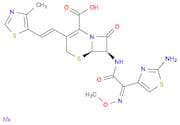
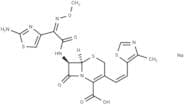
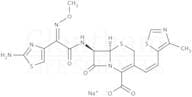
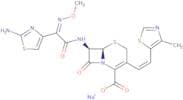
![5-Thia-1-azabicyclo[4.2.0]oct-2-ene-2-carboxylic acid, 7-[[(2Z)-2-(2-amino-4-thiazolyl)-2-(methoxy…](/_next/image/?url=https%3A%2Fstatic.cymitquimica.com%2Fcas-image%2Fthumb-webp%2F313410-5-thia-1-azabicyclo-4-2-0-oct-2-ene-2-carboxylic-acid-7-2z-2-2-amino-4-thiazolyl-2-methoxyimino-acetyl-amino-3-1z-2-4-methyl-5-thiazolyl-ethenyl-8-oxo-sodium-salt-1-1-6r-7r.webp&w=3840&q=75)
CAS 104146-53-4
:5-Thia-1-azabicyclo[4.2.0]oct-2-en-2-carbonsäure, 7-[[(2Z)-2-(2-amino-4-thiazolyl)-2-(methoxyimino)acetyl]amino]-3-[(1Z)-2-(4-methyl-5-thiazolyl)ethenyl]-8-oxo-, Natriumsalz (1:1), (6R,7R)-
Beschreibung:
5-Thia-1-azabicyclo[4.2.0]oct-2-en-2-carbonsäure, 7-[[(2Z)-2-(2-amino-4-thiazolyl)-2-(methoxyimino)acetyl]amino]-3-[(1Z)-2-(4-methyl-5-thiazolyl)ethenyl]-8-oxo-, Natriumsalz (1:1), (6R,7R)- ist eine komplexe chemische Verbindung, die durch ihre bicyclische Struktur gekennzeichnet ist, die sowohl Thiazol- als auch Thiazolidin-Moieties umfasst. Diese Verbindung ist bemerkenswert für ihre potenziellen pharmakologischen Anwendungen, insbesondere als Antibiotikum, aufgrund ihrer strukturellen Ähnlichkeit mit anderen bekannten antimikrobiellen Wirkstoffen. Das Vorhandensein mehrerer funktioneller Gruppen, einschließlich Carbonsäure- und Aminfunktionen, trägt zu ihrer Reaktivität und Löslichkeit in wässrigen Umgebungen bei. Die Natriumsalzform verbessert ihre Stabilität und Bioverfügbarkeit. Ihre Stereochemie, die durch die Konfiguration (6R,7R) angezeigt wird, ist entscheidend für ihre biologische Aktivität und beeinflusst, wie sie mit Zielenzymen oder Rezeptoren interagiert. Insgesamt veranschaulicht diese Verbindung die komplexe Beziehung zwischen molekularer Struktur und biologischer Funktion, was sie zu einem interessanten Thema in der medizinischen Chemie und der Arzneimittelentwicklung macht.
Formel:C19H18N6O5S3·Na
InChl:InChI=1S/C19H18N6O5S3.Na/c1-8-11(33-7-21-8)4-3-9-5-31-17-13(16(27)25(17)14(9)18(28)29)23-15(26)12(24-30-2)10-6-32-19(20)22-10;/h3-4,6-7,13,17H,5H2,1-2H3,(H2,20,22)(H,23,26)(H,28,29);/b4-3-,24-12-;/t13-,17-;/m1./s1
InChI Key:InChIKey=YZHABJAZXAOLGE-WSWQWPGSSA-N
SMILES:C(O)(=O)C=1N2[C@@]([C@H](NC(/C(=N\OC)/C3=CSC(N)=N3)=O)C2=O)(SCC1/C=C\C4=C(C)N=CS4)[H].[Na]
Synonyme:- 5-Thia-1-azabicyclo(4.2.0)oct-2-ene-2-carboxylic acid, 7-(((2-amino-4-thiazolyl)(methoxyimino)acetyl)amino)-3-(2-(4-methyl-5-thiazolyl)ethenyl)-8-oxo-, monosodium salt, (6R-(3(Z),6-alpha,7-beta(Z)))-
- 5-Thia-1-azabicyclo[4.2.0]oct-2-ene-2-carboxylic acid, 7-[[(2-amino-4-thiazolyl)(methoxyimino)acetyl]amino]-3-[2-(4-methyl-5-thiazolyl)ethenyl]-8-oxo-, monosodium salt, [6R-[3(Z),6α,7β(Z)]]-
- 5-Thia-1-azabicyclo[4.2.0]oct-2-ene-2-carboxylic acid, 7-[[(2Z)-(2-amino-4-thiazolyl)(methoxyimino)acetyl]amino]-3-[(1Z)-2-(4-methyl-5-thiazolyl)ethenyl]-8-oxo-, monosodium salt, (6R,7R)-
- 5-Thia-1-azabicyclo[4.2.0]oct-2-ene-2-carboxylic acid, 7-[[(2Z)-2-(2-amino-4-thiazolyl)-2-(methoxyimino)acetyl]amino]-3-[(1Z)-2-(4-methyl-5-thiazolyl)ethenyl]-8-oxo-, sodium salt (1:1), (6R,7R)-
- 5-thia-1-azabicyclo[4.2.0]oct-2-ene-2-carboxylic acid, 7-[[(2E)-2-(2-amino-4-thiazolyl)-2-(methoxyimino)-1-oxoethyl]amino]-3-[(E)-2-(4-methyl-5-thiazolyl)ethenyl]-8-oxo-, sodium salt, (6R,7R)- (1:1)
- Cefditoren sodium
- Me 1206
Sortieren nach
Reinheit (%)
0
100
|
0
|
50
|
90
|
95
|
100
5 Produkte.
Cefditoren Sodium Salt
CAS:Formel:C19H17N6O5S3·NaFarbe und Form:Yellow SolidMolekulargewicht:505.56 22.99Cefditoren sodium
CAS:Cefditoren sodium: cephalosporin antibiotic for bacterial infections; alters Mrp2, Bcrp, Oat2, P-gp, Oct1 mRNA levels.Formel:C19H18N6NaO5S3Farbe und Form:SolidMolekulargewicht:529.57Cefditoren acid sodium
CAS:Cefditoren acid sodium is an antibacterial agent that belongs to the class of third-generation cephalosporins, which is derived from Acremonium fungus and produced through chemical synthesis. This compound acts by inhibiting bacterial cell wall synthesis, leading to cell lysis and death. It achieves this by binding to specific penicillin-binding proteins (PBPs) located inside the bacterial cell wall. The interruption of peptidoglycan synthesis in the cell wall is crucial for maintaining bacterial cell integrity, and its inhibition results in the bactericidal activity of cefditoren acid sodium. It is effective against a range of Gram-positive and Gram-negative bacteria. The key applications of this compound include the treatment of bacterial infections such as respiratory tract infections, skin infections, and other conditions caused by susceptible bacteria. Its spectrum of activity and pharmacokinetic properties make it suitable for situations where third-generation cephalosporins are indicated. Understanding the specific interaction with PBPs and the resistance mechanisms is crucial for optimizing its clinical use and managing antibiotic resistance.Formel:C19H17N6NaO5S3Reinheit:94%MinMolekulargewicht:528.56 g/mol