CAS 104594-70-9
:Kaffeesäurephenethylester
Beschreibung:
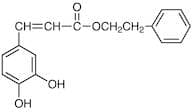
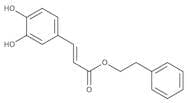
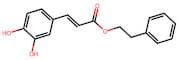
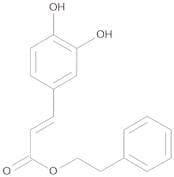
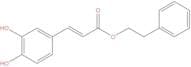
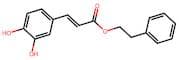
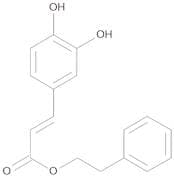
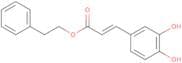
Kaffeesäurephenethylester (CAPE) ist eine phenolische Verbindung, die aus Kaffee-Säure abgeleitet ist und für ihre potenziellen antioxidativen, entzündungshemmenden und krebsbekämpfenden Eigenschaften bekannt ist. Es ist ein gelblich-brauner Feststoff bei Raumtemperatur und in organischen Lösungsmitteln wie Ethanol und Dimethylsulfoxid löslich, hat jedoch eine begrenzte Löslichkeit in Wasser. CAPE weist eine molekulare Formel auf, die seine Struktur widerspiegelt, die eine Phenethylgruppe umfasst, die an das Rückgrat der Kaffee-Säure gebunden ist. Diese Verbindung wird häufig wegen ihrer biologischen Aktivitäten untersucht, einschließlich ihrer Fähigkeit, verschiedene Enzyme zu hemmen und Signalwege zu modulieren, was sie für die pharmakologische Forschung von Interesse macht. CAPE wurde auf seine schützenden Wirkungen gegen oxidativen Stress und seine potenzielle Rolle bei der Prävention chronischer Krankheiten untersucht. Darüber hinaus ist es bekannt für seine Fähigkeit, mit zellulären Komponenten zu interagieren und Prozesse wie Apoptose und Zellproliferation zu beeinflussen. Insgesamt ist Kaffeesäurephenethylester eine bedeutende Verbindung im Bereich der Naturstoffe und der medizinischen Chemie, mit laufenden Forschungen zu seinen therapeutischen Anwendungen.
Formel:C17H16O4
InChl:InChI=1S/C17H16O4/c18-15-8-6-14(12-16(15)19)7-9-17(20)21-11-10-13-4-2-1-3-5-13/h1-9,12,18-19H,10-11H2
InChI Key:InChIKey=SWUARLUWKZWEBQ-UHFFFAOYSA-N
SMILES:C(=CC(OCCC1=CC=CC=C1)=O)C2=CC(O)=C(O)C=C2
Synonyme:- 2-Phenylethyl 3-(3,4-Dihydroxyphenyl)-2-Propenoate
- 2-Phenylethyl 3-(3,4-Dihydroxyphenyl)Prop-2-Enoate
- 2-Phenylethyl caffeate
- 2-Propenoic acid, 3-(3,4-dihydroxyphenyl)-, 2-phenylethyl ester
- 2-phenylethyl (2E)-3-(3,4-dihydroxyphenyl)prop-2-enoate
- Caffeic acid phenethylester
- Phenethyl Caffeate
- β-Phenylethyl caffeate
- Caffeic acid phenethyl ester
- CAPE
Sortieren nach
Reinheit (%)
0
100
|
0
|
50
|
90
|
95
|
100
14 Produkte.
Phenethyl Caffeate
CAS:Formel:C17H16O4Reinheit:>98.0%(HPLC)Farbe und Form:White to Orange to Green powder to crystalMolekulargewicht:284.31Phenylethyl 3,4-dihydroxycinnamate, 98+%
CAS:Inhibitor of protein tyrosine kinase, and is cytotoxic to cancer cell linesFormel:C17H16O4Reinheit:98+%Molekulargewicht:284.31Caffeic acid-phenethyl ester
CAS:CAPE is known to have antimitogenic, anticarcinogenic, antiinflammatory, and immunomodulating properties. The molecular basis for these properties seems to be its ability to specifically and potently inhibit the activation of the nuclear transcription factor NF-kappaB.Formel:C17H16O4Reinheit:99.4%Farbe und Form:White PowderMolekulargewicht:284.312-phenylethyl (2E)-3-(3,4-dihydroxyphenyl)prop-2-enoate
CAS:Formel:C17H16O4Reinheit:97%Farbe und Form:SolidMolekulargewicht:284.3065Caffeic acid phenethyl ester
CAS:Formel:C17H16O4Reinheit:≥ 98.0%Farbe und Form:White to yellow crystalline powderMolekulargewicht:284.31Caffeic Acid Phenethyl Ester
CAS:Caffeic Acid Phenethyl EsterReinheit:≥98%Molekulargewicht:284.31g/molCaffeic Acid Phenethyl Ester
CAS:CAPE, in propolis, blocks NF-kappa B, suppresses p70S6K/Akt pathways, and inhibits PDGF, aiding in cancer protection and immune modulation.Formel:C17H16O4Reinheit:99.18% - 99.35%Farbe und Form:Less Transparent Liquid Colorless Transparent LiquidMolekulargewicht:284.31Caffeic acid phenethyl ester
CAS:Caffeic acid phenethyl esterFormel:C17H16O4Reinheit:98% (nmr) (Typical Value in Batch COA)Farbe und Form: off-white solidMolekulargewicht:284.31g/molCaffeic Acid Phenethyl Ester
CAS:Applications Cytotoxic agent against cancer cell lines. Inhibitor of ornithine decarboxylase and protein tyrosine kinase. Found to be a specific inhibitor of the nuclear transcription factor, NF-kB. It has also been shown to significantly suppress the lipoxygenase pathway of arachidonic acid metabolism during inflammation.
References Grunberger, D., et al.: Experientia, 44, 230 (1988), Fesen, M.R., et al.: Biochem. Pharmacol., 48, 595 (1994), Su, Z.Z., et al.: Cancer Res., 54, 1865 (1994), Zheng, Z.S., et al.: Oncol. Res., 7, 445 (1995), Mirzoeva, O.K. and Calder, P.C.: Essent. Fatty Acids, 55, 441 (1996)Formel:C17H16O4Farbe und Form:NeatMolekulargewicht:284.31Caffeic acid phenethyl ester
CAS:Caffeic acid phenethyl ester (CAPE) is an active phenolic compound found in honeybee propolis that has the potential to downregulate inflammation in mammals. Studies demonstrated that CAPE specifically inhibits the protein complex NF-κB - a key player in inflammation, associated with the pathogenesis of chronic inflammatory diseases. Moreover, CAPE inhibits the activity of the enzyme cyclooxygenase and the production of nitric oxide by macrophages, also responsible for inflammation. By acting on T cells, CAPE can reduce the production of pro-inflammatory cytokines and increase the production of anti-inflammatory ones, leading to a less overwhelming immune response to allergens.Formel:C17H16O4Reinheit:Min. 98.0 Area-%Molekulargewicht:284.31 g/molPhenethyl 3-(3,4-dihydroxyphenyl)acrylate
CAS:Formel:C17H16O4Reinheit:95.0%Farbe und Form:No data available.Molekulargewicht:284.311