CymitQuimica logo

CAS 104691-86-3

:

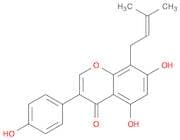
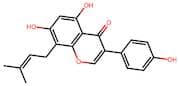
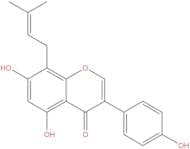
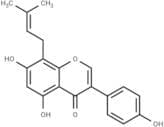
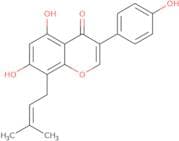
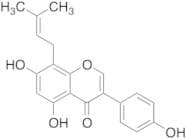
5,7-Dihydroxy-3-(4-hydroxyphenyl)-8-(3-methyl-2-buten-1-yl)-4H-1-benzopyran-4-on

Beschreibung:
5,7-Dihydroxy-3-(4-hydroxyphenyl)-8-(3-methyl-2-buten-1-yl)-4H-1-benzopyran-4-on, auch bekannt unter seiner CAS-Nummer 104691-86-3, ist eine Flavonoidverbindung, die durch ihre komplexe polyphenolische Struktur gekennzeichnet ist. Diese Verbindung weist mehrere Hydroxylgruppen auf, die zu ihren potenziellen antioxidativen Eigenschaften beitragen, was sie in verschiedenen biologischen und pharmakologischen Studien von Interesse macht. Das Vorhandensein eines Benzopyran-Kerns, zusammen mit einer substituierten Phenylgruppe und einer Isoprenylgruppe, deutet darauf hin, dass sie eine Reihe biologischer Aktivitäten aufweisen könnte, einschließlich entzündungshemmender und krebsbekämpfender Wirkungen. Ihre Löslichkeit und Stabilität können je nach Lösungsmittel und Umweltbedingungen variieren, was für ihre Anwendung in der Forschung und potenziellen therapeutischen Anwendungen entscheidend ist. Darüber hinaus können die strukturellen Merkmale der Verbindung ihre Wechselwirkung mit biologischen Zielen beeinflussen, was sie zu einem interessanten Thema in der Entwicklung von auf Naturstoffen basierenden Arzneimitteln macht. Weitere Studien sind erforderlich, um ihre Wirkmechanismen und potenziellen gesundheitlichen Vorteile vollständig zu klären.
Formel:C20H18O5
InChl:InChI=1S/C20H18O5/c1-11(2)3-8-14-16(22)9-17(23)18-19(24)15(10-25-20(14)18)12-4-6-13(21)7-5-12/h3-7,9-10,21-23H,8H2,1-2H3
InChI Key:InChIKey=YGCCASGFIOIXIN-UHFFFAOYSA-N
SMILES:O=C1C=2C(=C(CC=C(C)C)C(O)=CC2O)OC=C1C3=CC=C(O)C=C3
Synonyme:
  • 4H-1-Benzopyran-4-one, 5,7-dihydroxy-3-(4-hydroxyphenyl)-8-(3-methyl-2-butenyl)-
  • 4H-1-benzopyran-4-one, 5,7-dihydroxy-3-(4-hydroxyphenyl)-8-(3-methyl-2-buten-1-yl)-
  • 5,7,4'-Trihydroxy-8-(3,3-dimethylallyl)isoflavone
  • 5,7-Dihydroxy-3-(4-hydroxyphenyl)-8-(3-methyl-2-buten-1-yl)-4H-1-benzopyran-4-one
  • 8-Prenylgenistein
  • Lupiwighteone
Sortieren nach

Reinheit (%)
0
100
|
0
|
50
|
90
|
95
|
100
6 Produkte.
  • 8-PRENYLGENISTEIN

    CAS:
    Formel:C20H18O5
    Reinheit:98%
    Farbe und Form:Solid
    Molekulargewicht:338.3539

    Ref: IN-DA00930L

    1mg
    298,00€
    10mg
    308,00€
  • Lupiwighteone

    CAS:
    Lupiwighteone
    Reinheit:≥98%
    Molekulargewicht:338.35g/mol

    Ref: 54-BUP00550

    1mg
    228,00€
    5mg
    527,00€
    10mg
    783,00€
    25mg
    1.140,00€
    50mg
    1.543,00€
  • Lupiwighteone

    CAS:
    Formel:C20H18O5
    Reinheit:95%~99%
    Molekulargewicht:338.359

    Ref: BP-BPF6146

    5mg
    326,00€
  • Lupiwighteone

    CAS:
    Lupiwighteone has anti-angiogenesis potential, it also has anticancer and cancer preventive effects on SH-SY5Y cells.
    Formel:C20H18O5
    Reinheit:98.92%
    Farbe und Form:Solid
    Molekulargewicht:338.35
  • 8-Prenylgenistein

    CAS:
    <p>8-Prenylgenistein is a prenylated isoflavone, which is a type of naturally occurring polyphenolic compound. It is primarily sourced from plants, particularly legumes, and is a derivative of genistein, an isoflavone commonly found in soy products. The addition of a prenyl group distinguishes 8-prenylgenistein from its parent compound, potentially enhancing its bioactivity and pharmacokinetics.</p>
    Formel:C20H18O5
    Reinheit:Min. 95%
    Farbe und Form:Powder
    Molekulargewicht:338.35 g/mol

    Ref: 3D-FP137754

    1mg
    262,00€
    5mg
    729,00€
    10mg
    863,00€
    25mg
    1.627,00€
  • Lupiwighteone

    CAS:
    <p>Applications Lupiwighteone is a natural product derivative of Genistein (G350000). Genistein exhibits specific inhibitory activity against tyrosine kinases, including autophosphorylation of epidermal growth factor receptor kinase (IC50 - 2.6uM). Also inhibits other protein kinases through competitive inhibition of ATP. Inhibits tumor cell proliferation and induces tumor cell differentiation. Produces cell-cycle arrest and apoptosis in Jurat T-leukemia cells. However, it prevents anti-CD3 monoclonal antibody-induced thymic apoptosis. Genistein also inhibits topoisomerase II activity in vitro. Genistein has also been shown to inhibit the action of GABA on recombinant GABAA receptors 2. uv(max)ethanol: 262.5 nm (e= 138). moderately sol. in hot alcohol.<br>References Akiyama, T., et al.: J. Biol. Chem., 262, 5592 (1987); O'Dell, T.J., et al.: Nature, 353, 588 (1991); Aharonovits, O., et al.: Biochim Biophys. Acta, 1112, 181 (1992); Platanias, L.C., et al.: J. Biol. Chem., 267, 24053 (1992); Yoshida, H., et al.: Biochim. Biophys. Acta, 1137, 321 (1992); Uckun, F.M., et al.: Science, 267, 886 (1995); Merck Index 12th ed. 4395, Huang, R.Q.; Fang, M.J.; Dillon, G.H., Mol. Brain Res. 67: 177-183 (1999)<br></p>
    Formel:C20H18O5
    Farbe und Form:Neat
    Molekulargewicht:338.354

    Ref: TR-L478020

    1mg
    197,00€
    5mg
    696,00€
    10mg
    1.152,00€