CAS 104777-68-6
:Plantamajosid
Beschreibung:
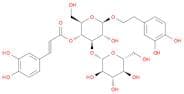
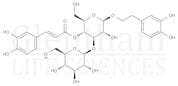
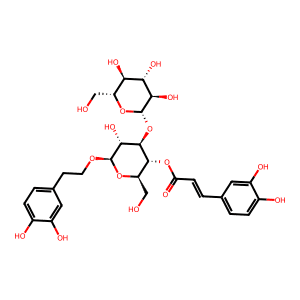
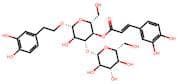
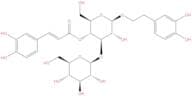
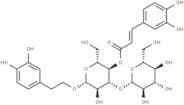
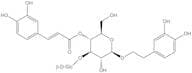
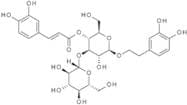
Plantamajosid ist ein natürlich vorkommendes Phenylethanoid-Glycosid, das hauptsächlich aus verschiedenen Pflanzenarten, einschließlich solcher der Gattung Plantago, gewonnen wird. Es ist durch seine strukturelle Zusammensetzung gekennzeichnet, die ein Phenylethanoid-Rückgrat umfasst, das mit einer Zuckerkomponente, typischerweise Rhamnose oder Glukose, verbunden ist. Diese Verbindung zeigt eine Reihe biologischer Aktivitäten, einschließlich entzündungshemmender, antioxidativer und antimikrobieller Eigenschaften, was sie für die pharmakologische Forschung von Interesse macht. Plantamajosid wird oft auf seine potenziellen therapeutischen Anwendungen untersucht, insbesondere in der traditionellen Medizin. Seine Löslichkeit in Wasser und organischen Lösungsmitteln variiert, was seine Bioverfügbarkeit und Wirksamkeit in verschiedenen Formulierungen beeinflussen kann. Darüber hinaus wurde das Sicherheitsprofil von Plantamajosid bewertet, was auf niedrige Toxizitätsniveaus hinweist und seine Verwendung in pflanzlichen Heilmitteln und Nahrungsergänzungsmitteln unterstützt. Insgesamt stellt diese Verbindung ein bedeutendes Interessengebiet in der Chemie natürlicher Produkte und der Pharmakognosie dar, was die Bedeutung pflanzenbasierter Substanzen in der modernen Medizin hervorhebt.
Formel:C29H36O16
InChl:InChI=1S/C29H36O16/c30-11-19-22(37)23(38)24(39)29(42-19)45-27-25(40)28(41-8-7-14-2-5-16(33)18(35)10-14)43-20(12-31)26(27)44-21(36)6-3-13-1-4-15(32)17(34)9-13/h1-6,9-10,19-20,22-35,37-40H,7-8,11-12H2/b6-3+/t19-,20-,22-,23+,24-,25-,26-,27-,28-,29+/m1/s1
InChI Key:InChIKey=KFEFLPDKISUVNR-QJEHNBJNSA-N
SMILES:O([C@H]1[C@H](OC(/C=C/C2=CC(O)=C(O)C=C2)=O)[C@@H](CO)O[C@@H](OCCC3=CC(O)=C(O)C=C3)[C@@H]1O)[C@@H]4O[C@H](CO)[C@@H](O)[C@H](O)[C@H]4O
Synonyme:- 2-(3,4-dihydroxyphenyl)ethyl 4-O-[(2E)-3-(3,4-dihydroxyphenyl)prop-2-enoyl]-3-O-beta-D-glucopyranosyl-beta-D-glucopyranoside
- Plantamoside
- Purpureaside A
- β-<span class="text-smallcaps">D</smallcap>-Glucopyranoside, 2-(3,4-dihydroxyphenyl)ethyl 3-O-β-<smallcap>D</span>-glucopyranosyl-, 4-[(2E)-3-(3,4-dihydroxyphenyl)-2-propenoate]
- β-<span class="text-smallcaps">D</smallcap>-Glucopyranoside, 2-(3,4-dihydroxyphenyl)ethyl 3-O-β-<smallcap>D</span>-glucopyranosyl-, 4-[3-(3,4-dihydroxyphenyl)-2-propenoate], (E)-
- Plantamajoside
- β-D-Glucopyranoside, 2-(3,4-dihydroxyphenyl)ethyl 3-O-β-D-glucopyranosyl-, 4-[(2E)-3-(3,4-dihydroxyphenyl)-2-propenoate]
- β-D-Glucopyranoside, 2-(3,4-dihydroxyphenyl)ethyl 3-O-β-D-glucopyranosyl-, 4-[3-(3,4-dihydroxyphenyl)-2-propenoate], (E)-
- C10485
- (E)-6-(3,4-Dihydroxyphenethoxy)-5-hydroxy-2-(hydroxymethyl)-4-((3,4,5-trihydroxy-6-(hydroxymet
- 2-(3,4-Dihydroxyphenyl)ethyl 4-O-(3,4-dihydroxycinnamoyl)-3-O-(β-D-glucopyranosyl)-β-D-glucopyranoside
- dihoside A
- 2-(3,4-Dihydroxyphenyl)ethyl 3-O-beta-D-glucopyranosyl-beta-D-glucopyranoside 4-[(2E)-3-(3,4-dihydroxyphenyl)-2-propenoate]
- (2R,3R,4R,5R,6R)-6-(3,4-dihydroxyphenethoxy)-5-hydroxy-2-(hydroxymethyl)-4-(((2S,3R,4S,5S,6R)-3,4,5-trihydroxy-6-(hydroxymethyl)tetrahydro-2H-pyran-2-yl)oxy)tetrahydro-2H-pyran-3-yl (E)-3-(3,4-dihydroxyphenyl)acrylate
- Plantamajoside, 98%, from Plantago major L.
- Weitere Synonyme anzeigen
Sortieren nach
Reinheit (%)
0
100
|
0
|
50
|
90
|
95
|
100
8 Produkte.
Plantamajoside
CAS:Plantamajoside has antibacterial activity, and has inhibition activity against cAMP phosphodiesterase and 5-lipoxygenase and antioxidant activity.Formel:C29H36O16Reinheit:95%~99%Farbe und Form:White powderMolekulargewicht:640.591Plantamajoside
CAS:Plantamajoside (Y0160) has anti-hepatotoxic, anti-inflammatory, antinociceptive activities, improving sexual function and antioxidant activity.Formel:C29H36O16Reinheit:99.82% - ≥95%Farbe und Form:SolidMolekulargewicht:640.59Ref: TM-T3409
2mg39,00€5mg55,00€10mg77,00€25mg111,00€50mg160,00€100mg227,00€200mg339,00€1mL*10mM (DMSO)79,00€Plantamajoside
CAS:Natural glycosideFormel:C29H36O16Reinheit:≥ 95.0 % (HPLC)Farbe und Form:PowderMolekulargewicht:640.6Plantamajoside
CAS:Plantamajoside is a phenylethanoid glycoside isolated primarily from Plantago asiatica, which is a perennial herb known for its pharmacological benefits. This compound functions through its anti-inflammatory and antioxidant properties, effectively modulating pathways such as the NF-κB signaling and scavenging reactive oxygen species (ROS). These mechanisms contribute to its potential therapeutic effects in managing inflammation and oxidative stress-related conditions.Formel:C29H36O16Reinheit:Min. 95%Farbe und Form:PowderMolekulargewicht:640.59 g/mol