CAS 104809-30-5
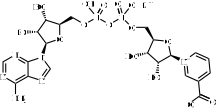
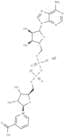
:Adenosin 5′-(Trihydrogendiphosphat), P′→5′-Ester mit 3-Carboxy-1-β-D-ribofuranosylpyridinium-Innersalz, Mononatriumsalz
Beschreibung:
Adenosin 5′-(Trihydrogendiphosphat), P′→5′-Ester mit 3-Carboxy-1-β-D-ribofuranosylpyridinium-Innersalz, Mononatriumsalz ist eine komplexe organische Verbindung, die eine bedeutende Rolle in biochemischen Prozessen spielt. Diese Substanz zeichnet sich durch ihre Struktur aus, die eine Adenosin-Gruppe enthält, die an eine Diphosphat-Gruppe gebunden ist, und weist ein Pyridinium-Innensalz auf, das ihre Löslichkeit und Stabilität in wässrigen Umgebungen verbessert. Das Vorhandensein der Carboxylgruppe trägt zu ihren sauren Eigenschaften bei, während die Ribofuranosyl-Komponente auf ihre Nukleosid-Natur hinweist. Diese Verbindung ist häufig an der Energieübertragung und Signalwegen innerhalb von Zellen beteiligt, ähnlich wie andere Nukleotide. Ihre Form als Mononatriumsalz deutet darauf hin, dass sie in einem stabilen ionischen Zustand existieren kann, was für ihre biologische Aktivität entscheidend ist. Insgesamt ist diese Verbindung in verschiedenen biochemischen Anwendungen wichtig, einschließlich Studien, die sich mit dem Stoffwechsel und enzymatischen Reaktionen befassen, aufgrund ihrer Fähigkeit, an der Phosphatübertragung und energiebezogenen Prozessen teilzunehmen.
Formel:C21H26N6O15P2·Na
InChl:InChI=1S/C21H26N6O15P2.Na/c22-17-12-18(24-7-23-17)27(8-25-12)20-16(31)14(29)11(41-20)6-39-44(36,37)42-43(34,35)38-5-10-13(28)15(30)19(40-10)26-3-1-2-9(4-26)21(32)33;/h1-4,7-8,10-11,13-16,19-20,28-31H,5-6H2,(H4-,22,23,24,32,33,34,35,36,37);/t10-,11-,13-,14-,15-,16-,19-,20-;/m1./s1
InChI Key:InChIKey=SSMFFDBXAUKIMZ-RHANTIMGSA-N
SMILES:O[C@H]1[C@H](N2C=3C(N=C2)=C(N)N=CN3)O[C@H](COP(OP(OC[C@H]4O[C@H]([C@H](O)[C@@H]4O)[N+]=5C=C(C([O-])=O)C=CC5)(=O)O)(=O)O)[C@H]1O.[Na]
Synonyme:- 1-[5-[[[[5-(6-Aminopurin-9-Yl)-3,4-Dihydroxy-Tetrahydrofuran-2-Yl]Methoxy-Hydroxy-Phosphoryl]Oxy-Hydroxy-Phosphoryl]Oxymethyl]-3,4-Dihydroxy-Tetrahydrofuran-2-Yl]Pyridine-3-Carboxylic Acid
- Adenosine 5′-(trihydrogen diphosphate), P′→5′-ester with 3-carboxy-1-β-<span class="text-smallcaps">D</span>-ribofuranosylpyridinium inner salt, monosodium salt
- Sodium
- Adenosine 5′-(trihydrogen diphosphate), P′→5′-ester with 3-carboxy-1-β-D-ribofuranosylpyridinium inner salt, monosodium salt
Sortieren nach
Reinheit (%)
0
100
|
0
|
50
|
90
|
95
|
100
3 Produkte.
Nicotinic acid adenine dinucleotide sodium
CAS:Nicotinic acid adenine dinucleotide sodium (NAAD) is a novel anticancer and antiviral agent. NAAD is an analog of nicotinamide adenine dinucleotide (NAD) that has been modified to include a sodium ion. This modification inhibits the synthesis of DNA and RNA, which are required for cell division and replication. It has been shown to inhibit the growth of cancer cells in vitro and in vivo. In addition, NAAD suppresses viral replication by inhibiting protein synthesis in cells infected with HIV-1 or influenza virus. NAAD has also been shown to be a potent inhibitor of ribonucleoside reductase, which converts ribonucleosides into deoxyribonucleosides. This inhibition prevents the conversion of diphosphate nucleotides into monophosphate nucleotides, which are necessary for DNA synthesis.Formel:C21H26N6O15P2•NaReinheit:Min. 95%Molekulargewicht:687.4 g/molNAAD sodium salt
CAS:NAAD sodium salt (NAAD Na salt) is a substrate of nicotinamide adenine dinucleotide synthase and can be used in studies about the specificity and kinetics ofFormel:C21H25N6NaO15P2Reinheit:98.6% - 99.87%Farbe und Form:SolidMolekulargewicht:686.4