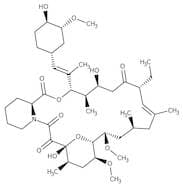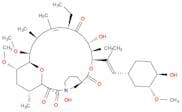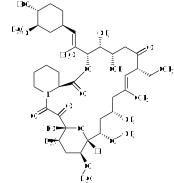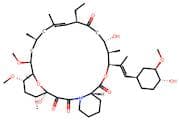
CAS 104987-12-4
:Ascomycin
Beschreibung:
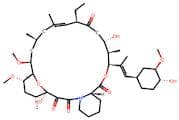
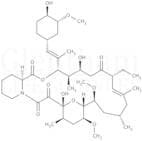
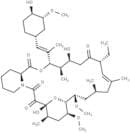
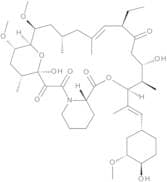
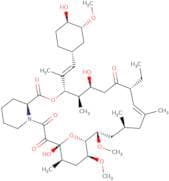
Ascomycin, mit der CAS-Nummer 104987-12-4, ist ein Makrolid-Antibiotikum, das aus der Fermentation bestimmter Pilzarten, insbesondere der Gattung *Aspergillus*, gewonnen wird. Es zeigt ein breites Spektrum an antifungaler Aktivität, das hauptsächlich auf verschiedene Pilzstämme abzielt, einschließlich *Candida* und *Aspergillus*. Ascomycin wirkt, indem es die Synthese der Pilzzellwände hemmt und so das Wachstum und die Replikation verhindert. Neben seinen antifungalen Eigenschaften hat es immunosuppressive Effekte gezeigt, was es im Kontext von Organtransplantationen und Autoimmunerkrankungen von Interesse macht. Die Verbindung zeichnet sich durch ihre komplexe Makrolidstruktur aus, die einen großen Laktonring und mehrere funktionelle Gruppen umfasst, die zu ihrer biologischen Aktivität beitragen. Ascomycin wird typischerweise in einem klinischen Umfeld unter strenger medizinischer Aufsicht verabreicht, aufgrund seiner starken Wirkungen und potenziellen Nebenwirkungen. Seine Löslichkeit und Stabilität können je nach Formulierung variieren, was seine Pharmakokinetik und therapeutische Wirksamkeit beeinflusst.
Formel:C43H69NO12
InChl:InChI=1S/C43H69NO12/c1-10-30-18-24(2)17-25(3)19-36(53-8)39-37(54-9)21-27(5)43(51,56-39)40(48)41(49)44-16-12-11-13-31(44)42(50)55-38(28(6)33(46)23-34(30)47)26(4)20-29-14-15-32(45)35(22-29)52-7/h18,20,25,27-33,35-39,45-46,51H,10-17,19,21-23H2,1-9H3/b24-18+,26-20+/t25-,27+,28+,29-,30+,31-,32+,33-,35+,36-,37-,38+,39+,43+/m0/s1
InChI Key:InChIKey=ZDQSOHOQTUFQEM-NURRSENYSA-N
SMILES:O(C)[C@@H]1[C@@]2(O[C@](O)([C@H](C)C1)C(=O)C(=O)N3[C@](C(=O)O[C@H](\C(=C\[C@H]4C[C@@H](OC)[C@H](O)CC4)\C)[C@H](C)[C@@H](O)CC(=O)[C@H](CC)/C=C(\C)/C[C@H](C)C[C@@H]2OC)(CCCC3)[H])[H]
Synonyme:- (3S,4R,5S,8R,12S,14R,15R,16S,18R,19R,26aS)-8-ethyl-5,19-dihydroxy-3-{(E)-2-[(1S,3R,4S)-4-hydroxy-3-methoxycyclohexyl]-1-methylethenyl}-14,16-dimethoxy-4,10,12,18-tetramethyl-5,6,8,11,12,13,14,15,16,17,18,19,24,25,26,26a-hexadecahydro-3H-15,19-epoxypyrido[2,1-c][1,4]oxazacyclotricosine-1,7,20,21(4H,23H)-tetrone
- (3S,4R,5S,8R,12S,14S,15R,16S,18R,19R,26aS)-8-ethyl-5,19-dihydroxy-3-{(E)-2-[(1R,3R,4R)-4-hydroxy-3-methoxycyclohexyl]-1-methylethenyl}-14,16-dimethoxy-4,10,12,18-tetramethyl-5,6,8,11,12,13,14,15,16,17,18,19,24,25,26,26a-hexadecahydro-3H-15,19-epoxypyrido[2,1-c][1,4]oxazacyclotricosine-1,7,20,21(4H,23H)-tetrone
- (3S,4R,5S,8R,9E,12S,14S,15R,16S,18R,19R,26aS)-8-Ethyl-5,6,8,11,12,13,14,15,16,17,18,19,24,25,26,26a-hexadecahydro-5,19-dihydroxy-3-[(1E)-2-[(1R,3R,4R)-4-hydroxy-3-methoxycyclohexyl]-1-methylethenyl]-14,16-dimethoxy-4,10,12,18-tetramethyl-15,19-epoxy-3H-pyrido[2,1-c][1,4]oxaazacyclotricosine-1,7,20,21(4H,23H)-tetrone
- (3S,4S,5S,8R,12S,14S,15R,16S,18R,19R,26aS)-8-ethyl-5,19-dihydroxy-3-{(E)-2-[(1R,3R,4R)-4-hydroxy-3-methoxycyclohexyl]-1-methylethenyl}-14,16-dimethoxy-4,10,12,18-tetramethyl-5,6,8,11,12,13,14,15,16,17,18,19,24,25,26,26a-hexadecahydro-3H-15,19-epoxypyrido[2,1-c][1,4]oxazacyclotricosine-1,7,20,21(4H,23H)-tetrone
- 12,18-Tetramethyl-,(3S-(3R*(E(1S*,3S*,4S*)),4S*,19S*,26Ar*))--10
- 15,19-Epoxy-3H-pyrido[2,1-c][1,4]oxaazacyclotricosine-1,7,20,21(4H,23H)-tetrone, 8-ethyl-5,6,8,11,12,13,14,15,16,17,18,19,24,25,26,26a-hexadecahydro-5,19-dihydroxy-3-[(1E)-2-[(1R,3R,4R)-4-hydroxy-3-methoxycyclohexyl]-1-methylethenyl]-14,16-dimethoxy-4,10,12,18-tetramethyl-, (3S,4R,5S,8R,9E,12S,14S,15R,16S,18R,19R,26aS)-
- 15,19-Epoxy-3H-pyrido[2,1-c][1,4]oxaazacyclotricosine-1,7,20,21(4H,23H)-tetrone, 8-ethyl-5,6,8,11,12,13,14,15,16,17,18,19,24,25,26,26a-hexadecahydro-5,19-dihydroxy-3-[2-(4-hydroxy-3-methoxycyclohexyl)-1-methylethenyl]-14,16-dimethoxy-4,10,12,18-tetramethyl-, [3S-[3R*[E(1S*,3S*,4S*)],4S*,5R*,8S*,9E,12R*,14R*,15S*,16R*,18S*,19S*,26aR*]]-
- 8-Ethyl-3-(2-(4-Hydroxy-3-Methoxycyclohexyl)-1-Methylethenyl)-14,16-Dimethoxy
- AAG
- Ascomycin, Streptomyces Hygroscopicus
- Ascomycin, Streptomyces Hygroscopicus Var Ascomyceticus
- Changchuanmycin
- Fk-520
- Fr 520
- Fr-900520
- Immunomycin
- Weitere Synonyme anzeigen
Sortieren nach
Reinheit (%)
0
100
|
0
|
50
|
90
|
95
|
100
13 Produkte.
Ascomycin, 95%
CAS:Ascomycin, 95%; Internal standard for LC-MS/MS testing of the immunosuppressants tacrolimus, sirolimus, and everolimus.Formel:C43H69NO12Reinheit:95%Farbe und Form:Powder, White to pale yellowMolekulargewicht:792.02Ascomycin (Tacrolimus EP Impurity A)
CAS:Formel:C43H69NO12Farbe und Form:White To Off-White SolidMolekulargewicht:792.02Ascomycin
CAS:AscomycinFormel:C43H69NO12Reinheit:By hplc: 100% (Typical Value in Batch COA)Farbe und Form: white powderMolekulargewicht:792.01g/molAscomycin
CAS:Formel:C43H69NO12Reinheit:≥ 95%Farbe und Form:White to yellow powder or solidMolekulargewicht:792.01Ascomycin
CAS:Ascomycin (Immunomycin)(Immunomycin, FR-900520, FK520) is an ethyl analog of tacrolimus (FK506) with strong immunosuppressant properties.Formel:C43H69NO12Reinheit:99.64% - 99.94%Farbe und Form:White SolidMolekulargewicht:792.01Ascomycin
CAS:Impurity Tacrolimus Related Compound A USP
Applications A potent immunosuppressive agent and could be used as a potential therapeutic agent for autoimmune diseases.
References Matuszewski, B., et al.: Anal. Chem., 75, 3019 (2003), Taylor, P., et al.: Clin. Chem., 51, 1890(2005);Formel:C43H69NO12Farbe und Form:White To Off-WhiteMolekulargewicht:792.01Ascomycin
CAS:Ascomycin is an immunosuppressive macrolide, which is a product derived from the fermentation of the bacterium *Streptomyces hygroscopicus*. Its mode of action involves binding to the intracellular protein FK506-binding protein (FKBP), inhibiting the calcium-dependent signal transduction pathway that is crucial for T-cell activation. This interference with the immune response is achieved through the inhibition of calcineurin, thus preventing the dephosphorylation and nuclear translocation of nuclear factor of activated T-cells (NF-AT), a necessary step in the activation of genes required for T-cell proliferation.Formel:C43H69NO12Reinheit:Min. 95%Molekulargewicht:792.01 g/molAscomycin
CAS:Ascomycin is an immunosuppressant macrolide lactone, which is derived from the soil bacterium *Streptomyces hygroscopicus*. It functions primarily by inhibiting the T-cell activation pathway. The mechanism involves binding to the immunophilin FKBP-12, forming a complex that inhibits the calcium-dependent phosphatase, calcineurin. This inhibition prevents the dephosphorylation and subsequent translocation of nuclear factor of activated T cells (NFAT), which is crucial for the transcription of interleukin-2 and other cytokines. Consequently, this suppresses the activation and proliferation of T-cells, which are essential components of the adaptive immune response.Formel:C43H69NO12Reinheit:Min. 95%Molekulargewicht:792.01 g/mol