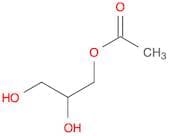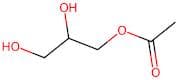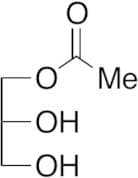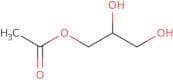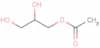
CAS 106-61-6
:Monoacetin
Beschreibung:
Monoacetin, auch bekannt als Glycerolmonoacetat, ist eine organische Verbindung, die durch ihre Struktur als Glycerolderivat mit einer Acetylgruppe gekennzeichnet ist. Es ist eine farblose, viskose Flüssigkeit, die hygroskopisch ist und einen leicht süßen Geschmack hat. Die Verbindung ist in Wasser und organischen Lösungsmitteln löslich, was sie in verschiedenen Anwendungen vielseitig macht. Monoacetin wird hauptsächlich als Emulgator, Stabilisator und Feuchthaltemittel in Lebensmittel-, Kosmetik- und pharmazeutischen Formulierungen verwendet. Ihre Fähigkeit, stabile Emulsionen zu bilden, macht sie wertvoll bei der Herstellung von Cremes und Lotionen. Darüber hinaus kann sie als Lösungsmittel und Weichmacher in verschiedenen industriellen Anwendungen dienen. Die Verbindung wird allgemein als sicher für den Verzehr und die Verwendung in Körperpflegeprodukten angesehen, sollte jedoch in industriellen Umgebungen aufgrund möglicher reizender Eigenschaften mit Vorsicht behandelt werden. Insgesamt ist Monoacetin eine wichtige Verbindung in der Lebensmittel- und Kosmetikindustrie, die zur Stabilität und Textur von Produkten beiträgt.
Formel:C5H10O4
InChl:InChI=1S/C5H10O4/c1-4(7)9-3-5(8)2-6/h5-6,8H,2-3H2,1H3
InChI Key:InChIKey=KMZHZAAOEWVPSE-UHFFFAOYSA-N
SMILES:C(COC(C)=O)(CO)O
Synonyme:- 1,2,3,-Propanetriol monoacetate
- 1,2,3-Propanetriol, 1-acetate
- 1,2,3-Propanetriol, 1-acetate (9CI)
- 1-Monoacetin
- Acetic acid, monoglyceride
- Acetin, 1-mono-
- Glycerine 1-acetate
- Glycerol 1-monoacetate
- Glycerol α-monoacetate
- Glyceryl 1-monoacetate
- Nsc 35010
- Weitere Synonyme anzeigen
Sortieren nach
Reinheit (%)
0
100
|
0
|
50
|
90
|
95
|
100
5 Produkte.
Glycerol 1-Acetate (Technical grade)
CAS:Formel:C5H10O4Farbe und Form:ColourlessMolekulargewicht:134.132,3-Dihydroxypropyl acetate
CAS:2,3-Dihydroxypropyl acetate (2,3-DHPA) is a glycerol derivative that has been used as an antimicrobial agent for the treatment of infectious diseases. It inhibits bacterial growth by binding to the cell wall and interfering with cell membrane permeability. 2,3-DHPA has an antibacterial efficacy of up to 1% and is active against both Gram-positive and Gram-negative bacteria. The compound is also effective at inhibiting the growth of fungi such as Candida albicans. 2,3-DHPA has been shown to act on various strains of staphylococci, which are often resistant to other types of antibiotics. This compound binds to the chitosan quaternary ammonium ion exchange resin and metal chelate resins in a concentration-dependent manner, which may be due to its hydroxyl group. 2,3-DHPA can be thermodynamically stabilized by adding CO2 gasFormel:C5H10O4Reinheit:Min. 95%Farbe und Form:Clear LiquidMolekulargewicht:134.13 g/mol