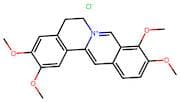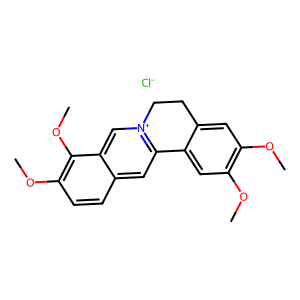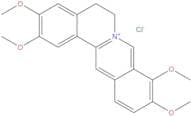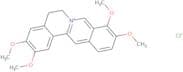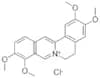
CAS 10605-02-4
:Palmatinchlorid
- 2,3,9,10-Tetramethoxyprotoberberinchloride
- Berbericine Chloride
- Palmatine Hydrochloride
- Palmatine HCL
- 2,3,9,10-Tetramethoxy-5,6-dihydroisoquinolino[2,1-b]isoquinolin-7-ium chloride
- 2,3,9,10-Tetramethoxy-5,6-Dihydroisoquino[3,2-A]Isoquinolinium Chloride
- 2,3,9,10-tetramethoxy-5,13a-dihydro-6H-isoquino[3,2-a]isoquinoline
Palmatine Chloride
CAS:Formel:C21H22ClNO4Reinheit:>97.0%(HPLC)Farbe und Form:Light yellow to Brown powder to crystalMolekulargewicht:387.86Palmatine chloride
CAS:Palmatine chloride analytical standard provided with chromatographic purity, to be used as reference material for qualitative determination.Formel:C21H22NO4ClReinheit:(HPLC) ≥95%Farbe und Form:PowderMolekulargewicht:387.84Palmatine chloride
CAS:Palmatine chlorideFormel:C21H22ClNO4Reinheit:83.7%Farbe und Form:YellowMolekulargewicht:387.12374Palmatine Chloride
CAS:Vegetable alkaloids, natural or reproduced by synthesis, their salts and other derivatives, nesoiFormel:C21H22ClNO4Farbe und Form:Orange PowderMolekulargewicht:387.12374Dibenzo[a,g]quinolizinium, 5,6-dihydro-2,3,9,10-tetramethoxy-, chloride
CAS:Formel:C21H22ClNO4Reinheit:97%Farbe und Form:SolidMolekulargewicht:387.8567Palmatine Chloride
CAS:Palmatine hydrochloride (PaH), a naturally occurring photosensitizer isolated from traditional Chinese medicine (TCM), can induce remarkable cell apoptosis ,significantly increase intracellular ROS level and significantly kill breast cancer MCF-7 cells; it also has potential in photodynamic therapy on colon adenocarcinoma.[1,2]Formel:C21H22ClNO4Reinheit:95%~99%Farbe und Form:White powderMolekulargewicht:387.86Palmatine chloride
CAS:Palmatine chloride an isoquinoline alkaloid, is an important medicinal herbal extract with diverse pharmacological and biological properties.Formel:C21H22ClNO4Reinheit:97.9% - 99.47%Farbe und Form:SolidMolekulargewicht:387.86Palmatine chloride
CAS:Natural alkaloidFormel:C21H22NO4ClReinheit:≥ 95.0 % (HPLC)Farbe und Form:PowderMolekulargewicht:387.86Palmatine Chloride
CAS:Kontrolliertes ProduktApplications Palmatine Chloride is a protoberberine alkaloid, as a potential anti-inflammatory and anti-hypertensive agent.
References Bhadra, K. et al.: Med. Res. Rev., 31, 821 (2011)Formel:C21H22NO4·ClFarbe und Form:NeatMolekulargewicht:387.86Palmatine chloride
CAS:Palmatine chloride is an alkaloid that has been isolated from the roots of Corydalis yanhusuo. Palmatine chloride inhibits the activity of toll-like receptor 4, which is a key molecule in inflammation and autoimmunity. This compound also inhibits the synthesis of proinflammatory cytokines such as IL-1β, IL-6, and TNF-α. Palmatine chloride has also been shown to inhibit the production of inflammatory mediators such as nitric oxide (NO) and prostaglandin E2 (PGE2). Furthermore, palmatine chloride has been found to have anti-cancer properties through its inhibition of squamous cell carcinoma cells.
Formel:C21H22NO4ClReinheit:Min. 98 Area-%Farbe und Form:PowderMolekulargewicht:387.86 g/mol
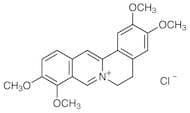

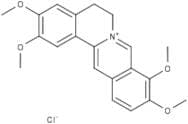


![Dibenzo[a,g]quinolizinium, 5,6-dihydro-2,3,9,10-tetramethoxy-, chloride](/_next/image/?url=https%3A%2Fstatic.cymitquimica.com%2Fproducts%2FIN%2Fthumb%2FDA00HAQQ.jpg&w=3840&q=75)