CAS 1060805-95-9
:4-Chlor-6-methylnicotinsäure
Beschreibung:
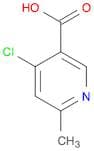
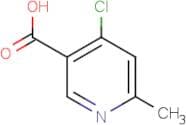
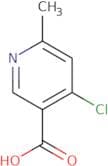
4-Chlor-6-methylnicotinsäure ist eine chemische Verbindung, die zur Klasse der Pyridincarboxylsäuren gehört. Sie weist einen chlorierten Pyridinring mit einer Methylgruppe und einer Carbonsäurefunktionalgruppe auf. Die Anwesenheit des Chloratoms an der Position 4 und der Methylgruppe an der Position 6 trägt zu ihren einzigartigen chemischen Eigenschaften bei, die ihre Reaktivität und potenziellen Anwendungen beeinflussen. Diese Verbindung wird typischerweise durch ihren festen Zustand bei Raumtemperatur charakterisiert und zeigt aufgrund der Carbonsäuregruppe eine moderate Löslichkeit in polaren Lösungsmitteln. Sie kann an verschiedenen chemischen Reaktionen teilnehmen, einschließlich nucleophiler Substitutionen und Kupplungsreaktionen, was sie für die organische Synthese und die medizinische Chemie von Interesse macht. Darüber hinaus werden Derivate der Nikotinsäure häufig auf ihre biologischen Aktivitäten untersucht, einschließlich potenzieller Rollen in der Pharmakologie. Sicherheitsdatenblätter sollten für Handhabungs- und Lagerungsrichtlinien konsultiert werden, wie bei jeder chemischen Substanz, um sicherzustellen, dass angemessene Sicherheitsmaßnahmen getroffen werden.
Sortieren nach
Reinheit (%)
0
100
|
0
|
50
|
90
|
95
|
100
4 Produkte.
4-Chloro-6-Methylnicotinic acid
CAS:Formel:C7H6ClNO2Reinheit:98%Farbe und Form:SolidMolekulargewicht:171.58104-Chloro-6-methylnicotinic acid
CAS:4-Chloro-6-methylnicotinic acidReinheit:98%Molekulargewicht:171.58g/mol4-Chloro-6-methylnicotinic acid
CAS:Formel:C7H6ClNO2Reinheit:98%Farbe und Form:SolidMolekulargewicht:171.584-Chloro-6-methylnicotinic acid
CAS:4-Chloro-6-methylnicotinic acid (4C6MNA) is a chemical substance that is used in the study of plant leaves and their permeability. This substance has been found to be an excellent indicator of chlorophyll content, as it stains leaf cells with a green color. 4C6MNA is taken up by healthy plant cells and mitochondria, where it binds to the chromophore molecule in the mitochondria. The binding of 4C6MNA to the chromophore molecule leads to the production of fluorescence, which can be detected via microscopy. This substance has been used for laser microbeam studies on natural leaves and tobacco plants.Formel:C7H6CINO2Reinheit:Min. 95%Molekulargewicht:275.04 g/mol