CAS 106700-29-2
:Pethoxamid
Beschreibung:
Pethoxamid ist ein selektives Herbizid, das hauptsächlich zur Bekämpfung von einjährigen Gräsern und bestimmten breitblättrigen Unkräutern in verschiedenen Kulturen eingesetzt wird. Es gehört zur Klasse der chemischen Verbindungen, die als Acetamide bekannt sind, und wirkt, indem es das Wachstum der Zielpflanzen hemmt. Der Wirkungsmechanismus umfasst die Störung der Zellteilung und -elastizität, was letztendlich zum Tod des Unkrauts führt. Pethoxamid zeichnet sich durch seine relativ geringe Toxizität für Säugetiere und seine Wirksamkeit bei niedrigen Anwendungsraten aus, was es zu einer attraktiven Option für integrierte Unkrautmanagementstrategien macht. Es wird typischerweise vor der Keimung oder früh nach der Keimung angewendet, um eine effektive Unkrautbekämpfung zu ermöglichen und gleichzeitig die Auswirkungen auf erwünschte Kulturen zu minimieren. Darüber hinaus hat Pethoxamid eine moderate Umweltpersistenz, was eine sorgfältige Handhabung erfordert, um potenziellen Abfluss und Kontamination von Wasserquellen zu verhindern. Seine Formulierung enthält oft verschiedene Hilfsstoffe, um seine Wirksamkeit und Stabilität im Feld zu verbessern. Insgesamt stellt Pethoxamid ein wertvolles Werkzeug in modernen landwirtschaftlichen Praktiken dar, das zur nachhaltigen Pflanzenproduktion beiträgt.
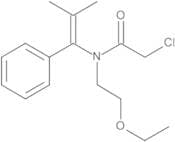
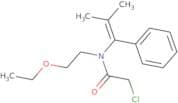
Formel:C16H22ClNO2
InChl:InChI=1/C16H22ClNO2/c1-4-20-11-10-18(15(19)12-17)16(13(2)3)14-8-6-5-7-9-14/h5-9H,4,10-12H2,1-3H3
InChI Key:InChIKey=CSWIKHNSBZVWNQ-UHFFFAOYSA-N
SMILES:C(N(CCOCC)C(CCl)=O)(=C(C)C)C1=CC=CC=C1
Synonyme:- 2-Chloro-N-(2-ethoxyethyl)-N-(2-methyl-1-phenyl-1-propen-1-yl)acetamide
- 2-Chloro-N-(2-ethoxyethyl)-N-(2-methyl-1-phenyl-1-propenyl)acetamide
- 2-chloro-N-(2-ethoxyethyl)-N-(2-methyl-1-phenylprop-1-en-1-yl)acetamide
- 2-chloro-N-(2-ethoxyethyl)-N-(2-methyl-1-phenylprop-1-enyl)acetamide
- Acetamide, 2-chloro-N-(2-ethoxyethyl)-N-(2-methyl-1-phenyl-1-propen-1-yl)-
- Acetamide, 2-chloro-N-(2-ethoxyethyl)-N-(2-methyl-1-phenyl-1-propenyl)-
- Pethoxamide
- Successor 600
- Pethoxamid
- NSK-68
- N-[1-(Phenyl)-2-methyl-1-propenyl]-N-[2-ethoxyethyl]-2-chloroacetamide
- N-(2-Ethoxyethyl)-N-(2-methyl-1-phenyl-1-propenyl)-2-chloroacetamide
- Pethoxamid@100 μg/mL in Methanol
- N-[α-(1-Methylethylidene)benzyl]-N-(2-ethoxyethyl)-2-chloroacetamide
- pethoxamid (bsi,pa iso)
- Weitere Synonyme anzeigen
Sortieren nach
Reinheit (%)
0
100
|
0
|
50
|
90
|
95
|
100
3 Produkte.
LC PestiMix 5 10 µg/mL in Acetonitrile
CAS:- 100986-85-4
- 101-27-9
- 1014-69-3
- 104030-54-8
- 106700-29-2
- 112143-82-5
- 1134-23-2
- 115-26-4
- 117718-60-2
- 127-79-7
- 131341-86-1
- 14086-35-2
- 1491-41-4
- 15310-01-7
- 153197-14-9
- 1593-77-7
- 1596-84-5
- 183675-82-3
- 18854-01-8
- 1918-11-2
- 1929-77-7
- 210880-92-5
- 219714-96-2
- 22936-86-3
- 2307-68-8
- 23564-06-9
- 25366-23-8
- 2588-03-6
- 2588-04-7
- 2588-05-8
- 2588-06-9
- 26087-47-8
- 2686-99-9
- 299-86-5
- 30043-49-3
- 31120-85-1
- 314-40-9
- 3244-90-4
- 3813-05-6
- 3983-45-7
- 470-90-6
- 4726-14-1
- 51218-45-2
- 535-89-7
- 53780-34-0
- 59756-60-4
- 61676-87-7
- 62850-32-2
- 64249-01-0
- 644-64-4
- 6552-12-1
- 6552-13-2
- 67018-59-1
- 672-99-1
- 673-04-1
- 70217-36-6
- 70630-17-0
- 741-58-2
- 759-94-4
- 7700-17-6
- 78-30-8
- 79540-50-4
- 80214-83-1
- 81335-37-7
- 83657-22-1
- 85785-20-2
- 86763-47-5
- 88283-41-4
- 89784-60-1
- 947-02-4
- 95-06-7
- 96491-05-3
- 99485-76-4
- 99675-03-3
Farbe und Form:MixturePethoxamid
CAS:Pethoxamid is a kinase inhibitor that has been used in traditional Chinese medicine for its medicinal properties. It targets mutant kinases that are involved in the growth and proliferation of cancer cells, making it a potential anti-cancer drug. Pethoxamid has been shown to inhibit the growth of human tumor cells in vitro, inducing apoptosis and reducing cell viability. It also has potential as an inhibitor of various proteins involved in cancer progression, making it a promising candidate for future cancer therapies. Pethoxamid may have significant implications for the treatment of cancer and could be an important tool in fighting this devastating disease.Formel:C16H22ClNO2Reinheit:Min. 95%Molekulargewicht:295.8 g/mol