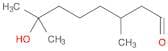
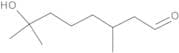
CAS 107-75-5
:Hydroxycitronellal
Beschreibung:
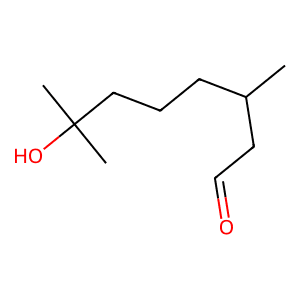
Hydroxycitronellal, mit der CAS-Nummer 107-75-5, ist eine organische Verbindung, die als Monoterpenoid und Aldehyd klassifiziert ist. Es handelt sich um eine farblose bis blassgelbe Flüssigkeit mit einem blumigen, zitrusartigen Geruch, was es zu einer beliebten Zutat in Parfums und Kosmetika macht. Hydroxycitronellal ist in Alkohol und Ölen löslich, hat jedoch eine begrenzte Löslichkeit in Wasser. Seine molekulare Formel ist C10H18O, und es weist eine Hydroxylgruppe (-OH) und eine Aldehydgruppe (-CHO) auf, die zu seiner Reaktivität und Duftnote beitragen. Diese Verbindung wird häufig als Duftverstärker verwendet und ist auch für ihre potenziellen allergenen Eigenschaften bekannt, was zu regulatorischen Prüfungen in kosmetischen Formulierungen geführt hat. Darüber hinaus kann Hydroxycitronellal aus Citronellal synthetisiert werden, einem natürlichen Bestandteil, der aus ätherischen Ölen gewonnen wird. Seine Anwendungen gehen über die Parfümerie hinaus und umfassen die Verwendung in Aromastoffen und als potenzielles Zwischenprodukt in der organischen Synthese. Sicherheitsdaten zeigen, dass es mit Vorsicht behandelt werden sollte, da es bei empfindlichen Personen Hautreizungen verursachen kann.
Formel:C10H20O2
InChl:InChI=1S/C10H20O2/c1-9(6-8-11)5-4-7-10(2,3)12/h8-9,12H,4-7H2,1-3H3
InChI Key:InChIKey=WPFVBOQKRVRMJB-UHFFFAOYSA-N
SMILES:C(C(C)(C)O)CCC(CC=O)C
Synonyme:- (±)-Hydroxycitronellal
- 3,7-Dimethyl-7-Hydroxyoctanal
- 3,7-Dimethyl-7-hydroxyoctan-1-al
- 7-Hydroxy-3,7-dimethyloctanal
- Citronellal hydrate
- Citronellal, hydroxy-
- Cyclalia
- Cyclosia
- Cyclosia base
- Fixol
- Laurine
- Lilyl aldehyde
- Muguet synthetic
- Muguettine principle
- NSC 406740
- Octanal, 7-hydroxy-3,7-dimethyl-
- Weitere Synonyme anzeigen
Sortieren nach
Reinheit (%)
0
100
|
0
|
50
|
90
|
95
|
100
7 Produkte.
7-Hydroxy-3,7-dimethyloctanal
CAS:Formel:C10H20O2Reinheit:95%Farbe und Form:LiquidMolekulargewicht:172.26467-Hydroxycitronellal
CAS:7-HydroxycitronellalFormel:C10H20O2Reinheit:95%Farbe und Form: clear. colourless liquidMolekulargewicht:172.26g/mol7-Hydroxy-3,7-dimethyloctanal
CAS:7-Hydroxy-3,7-dimethyloctanal has extremely weak agonist activity against TRPM8 (EC50 = 1960 µM) and can be used in related research in the field of life sciences.
Formel:C10H20O2Farbe und Form:SolidMolekulargewicht:172.267-Hydroxycitronellal
CAS:Kontrolliertes ProduktStability Air Sensitive
Applications 7-Hydroxycitronellal shows fungicide activity the strains of Candida tropicalis.
References Filho, O., et al.: Bioscience Journal, 33, 204 (2017)Formel:C10H20O2Farbe und Form:NeatMolekulargewicht:172.267-Hydroxy-3,7-dimethyloctanal
CAS:Formel:C10H20O2Reinheit:95%Farbe und Form:Liquid, No data available.Molekulargewicht:172.268Citronellal hydrate
CAS:Citronellal hydrate is a chemical substance that is found in many essential oils, such as citronella, lemon grass, and citronella. It has been shown to have significant effects on the human metabolism and urine samples. Citronellal hydrate can be used as a preservative due to its ability to inhibit bacterial growth, including bacteria that are resistant to benzalkonium chloride. Citronellal hydrate also has been shown to have an effect on cell maturation, which may be predictive for the development of cancer cells. Citronellal hydrate is present in many natural products that are used in cosmetics and personal care products. It is a good analytical method for identifying the presence of other chemicals in a sample because it has been shown to react with molecules such as alcohols, amines, ketones, esters, and ethers. Citronellal hydrate reacts with these molecules by altering their mass through an electron-transfer process called triple-Formel:C10H20O2Reinheit:Min. 95%Molekulargewicht:172.26 g/mol