CAS 107257-28-3
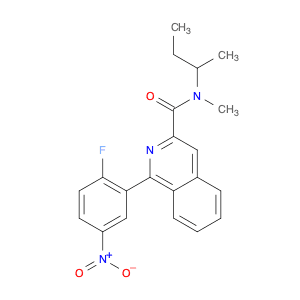
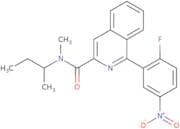
:N-(butan-2-yl)-1-(2-fluor-5-nitrophenyl)-N-methylisochinolin-3-carboxamid
Beschreibung:
N-(butan-2-yl)-1-(2-fluor-5-nitrophenyl)-N-methylisochinolin-3-carboxamid ist eine synthetische organische Verbindung, die durch ihre komplexe Struktur gekennzeichnet ist, die einen Isoquinolinkern, eine Carboxamidfunktion und eine Nitrobenzolgruppe umfasst. Die Anwesenheit einer Butan-2-yl-Gruppe und einer Methylgruppe an den Stickstoffatomen trägt zu ihrer Lipophilie bei, was potenziell ihre Löslichkeit und Permeabilität in biologischen Systemen beeinflussen kann. Die Fluor- und Nitrosubstituenten am Phenylring können einzigartige elektronische Eigenschaften verleihen, die die Reaktivität der Verbindung und ihre Wechselwirkung mit biologischen Zielen beeinflussen. Diese Verbindung wird wahrscheinlich spezifische pharmakologische Aktivitäten aufweisen, was sie in der medizinischen Chemie von Interesse macht. Ihre molekulare Struktur deutet auf potenzielle Anwendungen in der Arzneimittelentwicklung hin, insbesondere bei der gezielten Ansprache bestimmter biologischer Wege. Detaillierte Studien zu ihrer biologischen Aktivität, Toxizität und Pharmakokinetik wären jedoch notwendig, um ihre Eigenschaften und potenziellen Anwendungen vollständig zu verstehen.
Formel:C21H20FN3O3
InChl:InChI=1/C21H20FN3O3/c1-4-13(2)24(3)21(26)19-11-14-7-5-6-8-16(14)20(23-19)17-12-15(25(27)28)9-10-18(17)22/h5-13H,4H2,1-3H3
SMILES:CCC(C)N(C)C(=O)c1cc2ccccc2c(c2cc(ccc2F)N(=O)=O)n1
Synonyme:- 1-(2-Fluoro-5-nitrophenyl)-N-methyl-N-(1-methylpropyl)-3-isoquinolinecarboxamide
- 3-Isoquinolinecarboxamide, 1-(2-fluoro-5-nitrophenyl)-N-methyl-N-(1-methylpropyl)-
Sortieren nach
Reinheit (%)
0
100
|
0
|
50
|
90
|
95
|
100
3 Produkte.
PK14105
CAS:PK14105 is a benzodiazepine that has been shown to bind with high affinity to the benzodiazepine binding site on the gamma-aminobutyric acid receptor. It has been used in experimental models of conditions such as Parkinson's disease and schizophrenia, as well as for the treatment of cardiac arrhythmia. PK14105 also binds to the dopamine D2 receptor, which may be responsible for its anti-psychotic properties. The localization of PK14105 in mitochondria is thought to be responsible for its ability to inhibit mitochondrial functions and prevent cell death.Formel:C21H20FN3O3Reinheit:Min. 95%Molekulargewicht:381.4 g/molPK14105
CAS:PK14105: potential PET radioligand, crosses blood-brain barrier, retained in lesioned striatum, inhibits various neural ligands.Formel:C21H20FN3O3Reinheit:98%Farbe und Form:SolidMolekulargewicht:381.4