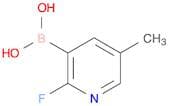
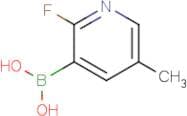
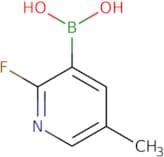
CAS 1072952-45-4
:2-Fluor-5-methylpyridin-3-borsäure
Beschreibung:
2-Fluor-5-methylpyridin-3-borsäure ist eine Organoborverbindung, die durch das Vorhandensein einer boronsäurefunktionellen Gruppe, die an einen Pyridinring gebunden ist, gekennzeichnet ist. Die molekulare Struktur weist ein Fluoratoms und eine Methylgruppe an bestimmten Positionen des Pyridinrings auf, was seine Reaktivität und Eigenschaften beeinflusst. Diese Verbindung ist typischerweise ein weißer bis off-white fester Stoff und ist in polaren Lösungsmitteln wie Wasser und Alkoholen löslich, was auf die boronsäuregruppe zurückzuführen ist. Sie ist bekannt für ihre Nützlichkeit in der organischen Synthese, insbesondere in Suzuki-Miyaura-Kreuzkupplungsreaktionen, wo sie als vielseitiger Baustein für die Bildung von Kohlenstoff-Kohlenstoff-Bindungen dient. Das Vorhandensein des Fluoratoms kann die elektronischen Eigenschaften des Moleküls verbessern, was es zu einem wertvollen Zwischenprodukt in der Entwicklung von Arzneimitteln und Agrochemikalien macht. Darüber hinaus sind Boronsäuren bekannt für ihre Fähigkeit, reversible Komplexe mit Diolen zu bilden, die in verschiedenen Anwendungen, einschließlich Sensortechnologie und Arzneimittelabgabesystemen, genutzt werden können.
Sortieren nach
Reinheit (%)
0
100
|
0
|
50
|
90
|
95
|
100
4 Produkte.
(2-Fluoro-5-methylpyridin-3-yl)boronic acid
CAS:Formel:C6H7BFNO2Reinheit:97%Farbe und Form:SolidMolekulargewicht:154.93472-Fluoro-5-methylpyridine-3-boronic acid
CAS:2-Fluoro-5-methylpyridine-3-boronic acidReinheit:≥95%Molekulargewicht:154.93g/mol(2-Fluoro-5-methylpyridin-3-yl)boronic acid
CAS:Formel:C6H7BFNO2Reinheit:98%Farbe und Form:Liquid, No data available.Molekulargewicht:154.942-Fluoro-5-methylpyridine-3-boronic acid
CAS:2-Fluoro-5-methylpyridine-3-boronic acid is a high quality chemical with CAS No. 1072952-45-4 that is a useful building block for the synthesis of complex compounds and speciality chemicals. 2-Fluoro-5-methylpyridine-3-boronic acid is also a versatile building block that can be used in organic reactions as a reaction component for the synthesis of speciality chemicals and other reagents. It can also be used to make fluoroquinolones and related pharmaceuticals, which are used to treat bacterial infections. This compound has many uses in research, including being a valuable scaffold for the synthesis of new drugs.Formel:C6H7BFNO2Reinheit:Min. 95%Farbe und Form:White PowderMolekulargewicht:154.93 g/mol