CAS 1073-67-2
:4-Chlorstyrol
Beschreibung:
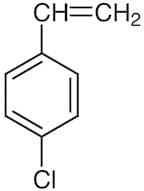
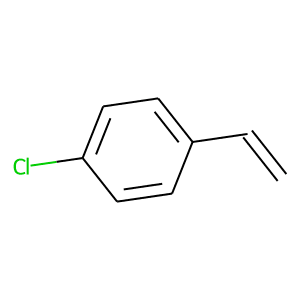
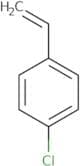
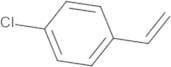
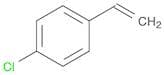
4-Chlorstyrol ist eine organische Verbindung, die durch das Vorhandensein einer chlorierten Phenylgruppe, die an eine Vinylgruppe gebunden ist, gekennzeichnet ist. Es handelt sich um eine farblose bis blassgelbe Flüssigkeit mit einem ausgeprägten aromatischen Geruch. Die Verbindung weist eine Vinylgruppe (–CH=CH2) auf, die direkt an einen Chlorbenzolring gebunden ist, und zwar speziell an der Para-Position, was ihre Reaktivität und Eigenschaften beeinflusst. 4-Chlorstyrol ist bekannt für seine Fähigkeit zur Polymerisation, was es nützlich für die Herstellung verschiedener Polymere und Copolymere macht. Es ist mäßig in organischen Lösungsmitteln löslich, hat jedoch eine begrenzte Löslichkeit in Wasser. Die Verbindung wird auch für ihre potenziellen Anwendungen in der Synthese von Arzneimitteln, Agrochemikalien und Spezialchemikalien anerkannt. Sie sollte jedoch mit Vorsicht behandelt werden, da sie potenzielle Gesundheitsrisiken birgt, einschließlich Haut- und Atemwegsreizungen. Angemessene Sicherheitsmaßnahmen, einschließlich der Verwendung persönlicher Schutzausrüstung, sind unerlässlich, wenn mit dieser Substanz in einem Labor oder industriellen Umfeld gearbeitet wird.
Formel:C8H7Cl
InChl:InChI=1/C8H7Cl/c1-2-7-3-5-8(9)6-4-7/h2-6H,1H2
InChI Key:InChIKey=KTZVZZJJVJQZHV-UHFFFAOYSA-N
SMILES:C(=C)C1=CC=C(Cl)C=C1
Synonyme:- (4-Chlorophenyl)ethene
- 1-Chloro-4-ethenylbenzene
- 1-Chloro-4-vinylbenzene
- 4-Chloro-1-ethenylbenzene
- Benzene, 1-Chloro-4-Ethenyl-
- Nsc 18603
- P-Chlorostyrene
- P-Cloroestireno
- Styrene, 4-Chloro-
- Styrene, p-chloro-
- p-Chlorovinylbenzene
- p-Chlorstyrol
- p-Vinylphenyl chloride
- 4-Chlorostyrene
- CHLOROSTYRENE-4
- 4-chloro-styren
- 4-CHLOROSTYRENE , STABILIZED WITH 0.1% 4-TERT-BUTYLCATECHOL
- Benzene, 4-chloro-1-ethenyl-
- 4-Chlorostyrene, stabilized, 99%
- p-chloro-styren
- Parachlorostyrene
- 4-CHLOROSTYRENE Stabilised with 0.1% 4-tert-butylcatechol
- 4-Chlorostyrene (stabilized with TBC)
- 4-VINYLCHLOROBENZENE
- 4-CHLOROSTYRENE, 99%, STAB.
- para-chlorostyrene
- Weitere Synonyme anzeigen
Sortieren nach
Reinheit (%)
0
100
|
0
|
50
|
90
|
95
|
100
9 Produkte.
4-Chlorostyrene (stabilized with TBC)
CAS:Formel:C8H7ClReinheit:>98.0%(GC)Farbe und Form:Colorless to Light yellow clear liquidMolekulargewicht:138.594-Chlorostyrene, 98+%, stab
CAS:4-Chlorostyrene is used in the preparation of new bis(pyrazolyl)borato olefin complexes of copper(I). It is also employed in the investigation of regioselectivity in the cationic Heck reaction of 4-substituted styrenes. Further, it plays an important role in the preparation of 4-[(4-chloro-phenyl)-tFormel:C8H7ClReinheit:98+%Farbe und Form:Clear colorless to yellow to orange, LiquidMolekulargewicht:138.594-Chlorostyrene
CAS:4-ChlorostyreneFormel:C8H7ClReinheit:≥95%Farbe und Form: clear. yellow liquidMolekulargewicht:138.59g/mol4-Chlorostyrene (stabilised with TBC)
CAS:Formel:C8H7ClReinheit:95% (stabilized with TBC)Farbe und Form:Liquid, ClearMolekulargewicht:138.594-Chlorostyrene - stabilised with 4-tert-butylcatechol
CAS:4-Chlorostyrene is a chlorinated organic compound. This chemical has been shown to bind to the hydroxyl group of polyhydroxy compounds, such as poly(vinyl alcohol), with a frequency shift of 1.0 cm-1 in the infrared spectrum. The ph optimum for this reaction is between 4 and 5. When exposed to cationic polymerization, chlorine atoms are incorporated into the polymer chain and the resultant product is a cationic polymer that has an isolated yield of 82%. In order for this reaction to be successful, both 4-chlorostyrene and 4-tert-butylcatechol must be present. The reaction mechanism is believed to involve diazonium salt formation followed by activation energies of 20 kcal/mol and 25 kcal/mol.Formel:C8H7ClReinheit:Min. 95%Farbe und Form:Colorless Clear LiquidMolekulargewicht:138.59 g/mol4-Chlorostyrene
CAS:Kontrolliertes ProduktApplications 4-Chlorostyrene is a reagent primarily used in epoxidation reactions of olefins. Also used in the synthesis of 9-deazaxanthine derivatives as dual A2A antagonists/MAO-B inhibitors.
References Srinivasan, K. et al.: J. Am. Chem. Soc., 108, 2309 (1986); Samsel, E. et al.: J. Am. Chem. Soc., 107, 7606 (1985); Rivara, S. et al.: J. Med. Chem., 56, 1247 (2013);Formel:C8H7ClFarbe und Form:NeatMolekulargewicht:138.594