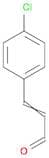
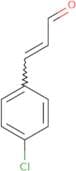
CAS 1075-77-0
:p-Chlorocinnamaldehyd
Beschreibung:
p-Chlorocinnamaldehyd, mit der CAS-Nummer 1075-77-0, ist eine organische Verbindung, die durch ihre aromatische Struktur und funktionelle Gruppen gekennzeichnet ist. Sie weist eine chlorierte Phenylgruppe auf, die an eine trans-Alkenkette gebunden ist, die in einer Aldehydfunktion endet. Diese Verbindung erscheint typischerweise als gelbliche bis bräunliche Flüssigkeit oder Feststoff, abhängig von ihrer Reinheit und Temperatur. Sie ist bekannt für ihren charakteristischen aromatischen Geruch, der an Zimt erinnert, und wird häufig in der Synthese verschiedener organischer Verbindungen und als Aromastoff in der Lebensmittelindustrie verwendet. p-Chlorocinnamaldehyd zeigt eine moderate Löslichkeit in organischen Lösungsmitteln wie Ethanol und Ether, ist jedoch aufgrund ihrer hydrophoben Natur weniger löslich in Wasser. Darüber hinaus weist sie eine gewisse biologische Aktivität auf, was sie in der medizinischen Chemie für potenzielle Anwendungen in der Pharmazie von Interesse macht. Sicherheitsvorkehrungen sind beim Umgang mit dieser Verbindung erforderlich, da sie Haut- und Augenreizungen verursachen kann. Insgesamt ist p-Chlorocinnamaldehyd eine vielseitige Verbindung mit Anwendungen sowohl in industriellen als auch in Forschungsumgebungen.
Formel:C9H7ClO
InChl:InChI=1/C9H7ClO/c10-9-5-3-8(4-6-9)2-1-7-11/h1-7H/b2-1+
Synonyme:- (E)-3-(4-Chlorophenyl)-2-propenal
- (2E)-3-(4-Chlorophenyl)prop-2-enal
- (2E)-3-(4-Chlorophenyl)acrylaldehyde
- (2E)-3-(4-Chlorphenyl)prop-2-enal
- 2-propenal, 3-(4-chlorophenyl)-, (2E)-
- 4-Chlorocinnamaldehyde
Sortieren nach
Reinheit (%)
0
100
|
0
|
50
|
90
|
95
|
100
2 Produkte.
3-(4-Chlorophenyl)acrylaldehyde
CAS:Acrylaldehyde is a reactive compound that can bind to the enzyme tyrosinase, inhibiting its activity. 3-(4-Chlorophenyl)acrylaldehyde (3-CA) is a small molecule that has shown an inhibitory effect on the proliferation of leukemia cells in vitro and in vivo. It also has broad-spectrum antimicrobial activity against Gram-positive and Gram-negative bacteria, including methicillin-resistant Staphylococcus aureus (MRSA). Tyrosine kinases are enzymes that catalyze the transfer of phosphate groups from ATP to tyrosine residues in proteins, leading to cellular signaling and cell division. 3-(4-Chlorophenyl)acrylaldehyde binds to tyrosine kinases and inhibits their function, which may be responsible for its cytotoxic effects.
Formel:C9H7ClOReinheit:Min. 95%Molekulargewicht:166.6 g/mol