CAS 107761-42-2
:beta-Amyloid (1-42) menschlich
- Beta-Amyloid Peptide (1-42), Human
- Daefrhdsgyevhhqklvffaedvgsnkgaiiglmvggvvia
- Amyloid Beta-Peptide (1-42) (Human)
- Amyloid B-Protein Fragment 1-42
- Amyloidb-Peptide(1-42)(human)
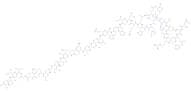
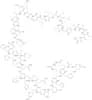
- H-Asp-Ala-Glu-Phe-Arg-His-Asp--Ser-Gly-Tyr-Glu-Val-His-His-Gln-Lys-Leu-Val-Phe-Phe-Ala-Glu-Asp-Val-Gly-Ser-Asn-Lys-Gly-Ala-Ile-Ile-Gly-Leu-Met-Val-Gly-Gly-Val-OH
- H-asp-Ala-Glu-Phe-Gly-His-Asp-Ser-Gly-Phe-Glu-Val-Arg-His-Gln-Lys-Leu-Val-Gly-Phe-Phe-Ala-Glu-Asp-Val-Gly-Ser-Asn-Lys-Gly-Ala-Ile-Ile-Gly-Leu-Met-Val-Gly-Gly-Val-Ile-Ala-OH
- Abeta 1-42
- β-Amyloid(1-42)Human
- Soy peptide
- Beta-Amyloid 1-42,human
Amyloid β (1-42), Human
CAS:For cellular and molecular biology applicationsFarbe und Form:Lyophilized powder, WhiteAmyloid β-Protein (1-42) (HFIP-treated)
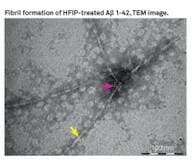
CAS:The peptide was obtained by dissolving Amyloid β-Protein (1-42) in HFIP, aliquoting, and removing the solvent as described in the literature. The morphology of the resulting peptide was studied by transmission electron microscopy (TEM). The magenta arrow points to the nucleation centers where aggregation starts. The yellow arrow indicates the fibrils which are formed as long thin helical structures with regular twists. See in the technical note.Formel:C203H311N55O60SReinheit:95.3%Farbe und Form:WhiteMolekulargewicht:4514.1Amyloid β-Protein (1-42)
CAS:Aβ 1-42, 42-residue fragment of amyloid precursor protein, has been found to be a major constituent of the senile plaques formed in the brains of patients with Alzheimer’s disease and late Down’s syndrome. Aβ 1-42 readily forms neurotoxic oligomers at physiological pH. On the other hand, the peptide shows antimicrobial activity. The sequence of this peptide corresponds to the sequence of human, bovine, canine, feline, ovine, guinea pig, and rabbit Aβ42. The peptide has been used to detect amyloid β-protein multimers in the cerebrospinal fluid of Alzheimer’s disease patients through fluorescence correlation spectroscopy. For detailed descriptions of the preparation of Aβ 1-42 monomers and protofibrils please see the papers of Jan, Hartley, and Lashuel, Stine et al. (2011), and of Broersen and colleagues. For the preparation of Aβ for experimental use, Fezoui et al. (2000) found that solvation of synthetic peptide with sodium hydroxide (Aβ·NaOH) followed by lyophilization, produced stocks with superior solubility and fibrillogenesis characteristics. Solubilization of the pretreated material with neutral buffers resulted in a pH transition from ≈10.5 to neutral, avoiding the isoelectric point of Aβ (pI≈5.5), at which Aβ precipitation and aggregation propensity are maximal.Formel:C203H311N55O60SReinheit:92.1%Farbe und Form:WhiteMolekulargewicht:4514.1Amyloid β-Protein (1-42)
CAS:Compared to the inner salt of Aβ42, the HCl salt of Aβ42 aggregates more readily at pH 7.4.Formel:C203H311N55O60SReinheit:> 80%Farbe und Form:WhitishMolekulargewicht:4514.1Amyloid β-Protein (1-42)
CAS:Bachem ID: 4061966.
Formel:C203H311N55O60SReinheit:97.2%Farbe und Form:White LyophilisateMolekulargewicht:4514.1Amyloid β-Protein (1-42)
CAS:Aβ 1-42, 42-residue fragment of amyloid precursor protein, has been found to be a major constituent of the senile plaques formed in the brains of patients with Alzheimer’s disease and late Down’s syndrome. Aβ 1-42 readily forms neurotoxic oligomers at physiological pH. On the other hand, the peptide shows antimicrobial activity. The sequence of this peptide corresponds to the sequence of human, bovine, canine, feline, ovine, guinea pig, and rabbit Aβ42. The peptide has been used to detect amyloid β-protein multimers in the cerebrospinal fluid of Alzheimer’s disease patients through fluorescence correlation spectroscopy. For detailed descriptions of the preparation of Aβ 1-42 monomers and protofibrils please see the papers of Jan, Hartley, and Lashuel, Stine et al. (2011), and of Broersen and colleagues. The findings of Ryan et al. indicate that 10% ammonia disaggregates Aβ42 more efficiently than HFIP.Formel:C203H311N55O60SReinheit:97.3%Farbe und Form:White LyophilisateMolekulargewicht:4514.1ë?-Amyloid Peptide
CAS:ë?-Amyloid PeptideReinheit:99%,from soybean peptideMolekulargewicht:4514.04g/molβ-Amyloid (1-42), human
CAS:β-Amyloid (1-42), human is a 42-amino acid peptide which plays a key role in the pathogenesis of Alzheimer disease.Formel:C203H311N55O60SReinheit:99.52%Farbe und Form:SolidMolekulargewicht:4514.04Amyloid β Protein fragment 1-42 HCl Salt
CAS:Amyloid β Protein fragment 1-42 HCl SaltReinheit:99%,from soybean peptideMolekulargewicht:0.00g/molAmyloid β Protein fragment 1-42
CAS:Amyloid β Protein fragment 1-42Reinheit:(hplc): 90.9% (nh3) (Typical Value in Batch COA)Farbe und Form: white lyophilisatebeta-Amyloid (1-42) Human
CAS:Amyloid β-peptide (Aβ) has been identified as the key subunit of the extracellular plaques found in the brains of patients with Alzheimer's disease (AD) and Down's syndrome (DS). Aβ has therefore been extensively studied as a potential target for treatment of AD.Aβ is formed from the cleavage of the large, transmembrane protein- APP (amyloid precursor protein). Cleavage of APP by β- and then γ-secretases results in the formation of Aβ. Aβ can aggregate to produce amyloid-β oligomers, which are thought to be highly neurotoxic. Over time Aβ can further aggregate to produce the characteristic senile plaques present in AD and DS.Aβ can be degraded by enzymes such as neprilysin, insulin degrading enzyme or endothelin converting enzyme. At physiological levels Aβ may be involved in controlling synaptic activity and neuronal survival.Supplied as the TFA saltMolekulargewicht:4,514.04 g/molAmyloid beta-Protein (1-42) sodium salt
CAS:Amyloid β-Protein (1-42) is a fragment of the amyloid beta protein that is thought to be a major contributor to the development of Alzheimer's disease. Amyloid β-Protein (1-42) has been shown to have neuroprotective effects, as it reduces cell death in the brain and preserves memory. It binds to the β-catenin protein in neurons and protects against oxidative stress by reducing production of reactive oxygen species. This molecule also reduces microglia activation and tnf-α levels, which may reduce inflammation. Amyloid β-Protein (1-42) is found in plants such as pueraria lobata, and has been used for centuries in traditional Chinese medicine for its anti-inflammatory properties.Formel:C203H311N55O60SReinheit:Min. 95%Farbe und Form:White PowderMolekulargewicht:4,514.04 g/molAmyloid beta-Protein (Human, 1-42)
CAS:Amyloid beta-protein (Aβ) is a peptide that is found in the human brain. It is one of the major components of amyloid plaque, which are deposits of a protein fragment in the brain that form as a result of aging and Alzheimer’s disease. It is produced by cleavage of the amyloid precursor protein (APP). Aβ has been shown to be toxic to cells, causing them to die. This toxicity may be due to its ability to inhibit ATP production and increase oxidative stress. Aβ can also induce apoptosis by binding to receptors on cell surfaces and activating intracellular signaling pathways. These events lead to activation of caspases, which are proteolytic enzymes that contribute to programmed cell death.Formel:C203H311N55O60SReinheit:Min. 95%Molekulargewicht:4,514 g/mol...Amyloid Beta-Protein (Human, 1-42)
CAS:Amino acids 1-42 of the Amyloid beta-protein (Aβ), a major plaque component in Alzheimer's Disease, a neurodegenerative disorder that affects memory and cognitive function. It is thought that these Aβ peptides can aggregate to form insoluble fibrils that are a hallmark of Alzheimer's disease and may contribute to neurodegeneration and cognitive decline.
Research is ongoing to better understand the mechanisms underlying Aβ-induced neurodegeneration and to develop therapies that target Aβ to prevent or treat Alzheimer's disease. Aβ peptides, particularly Aβ(1-42), are commonly used in research as a model for Alzheimer's disease to investigate the pathogenesis and potential therapeutic approaches.
This product is available in the trifluoroacetate salt form and as a 0.5mg vial.Formel:C203H311N55O60SReinheit:Min. 95%Molekulargewicht:4,514 g/molAmyloid beta-Protein (1-42) hydrochloride salt
CAS:Key subunit of extracellular plaques found in the brains of patients with Alzheimer's disease; Hydrochloride saltFormel:C203H311N55O60SReinheit:Min. 95%Molekulargewicht:4,514.04 g/molAmyloid β Protein Fragment 1-42
CAS:Formel:C203H311N55O60SReinheit:99%Farbe und Form:SolidMolekulargewicht:4514.038939999975Amyloid β-Protein (1-42) TFA salt
CAS:Key subunit of extracellular plaques found in the brains of patients with Alzheimer's disease. TFA salt; 95%.
Formel:C203H311N55O60SMolekulargewicht:4,514.1 g/mol