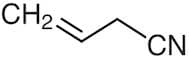
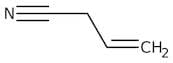
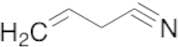
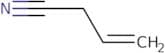
CAS 109-75-1
:3-Butennitril
- -Butenonitrile
- 1-Butene-3-nitrile
- 1-Butene-4-nitrile
- 1-Propene-3-nitrile
- 2-Propenyl cyanide
- 2-Propenylcyanide
- 3-Butenenitrile
- 3-Butennitril
- 3-Butenonitrile
- 3-Butenylnitrile
- 3-Cyano-1-propene
- 3-Cyanopropene
- Acetonitrile, vinyl-
- Allylcyanid
- Allylkyanid
- Allylnitrile
- But-3-Enenitrile
- But-3-Enonitrilo
- But-3-ennitril
- Ch2=Chch2Cn
- Nsc 2583
- Propene-3-nitrile
- TL 350 tl350
- Vinyl-Acetonitril
- VinylacetonitriIe
- Vinylacetonitril
- Vinylacetonitrile
- beta-Butenonitrile
- β-Butenonitrile
- Weitere Synonyme anzeigen
Allyl Cyanide
CAS:Formel:C4H5NReinheit:>92.0%(GC)Farbe und Form:Colorless to Light yellow to Light orange clear liquidMolekulargewicht:67.09Allyl cyanide, 97%
CAS:Allyl cyanide is used as an anti-microbial. It is also used as pharmaceutical intermediates. This Thermo Scientific Chemicals brand product was originally part of the Alfa Aesar product portfolio. Some documentation and label information may refer to the legacy brand. The original Alfa Aesar product
Formel:C4H5NReinheit:97%Molekulargewicht:67.09but-3-enenitrile
CAS:Formel:C4H5NReinheit:92.0%Farbe und Form:Liquid, Clear or yellow to brown liquidMolekulargewicht:67.0913-Butenenitrile
CAS:3-ButenenitrileFormel:C4H5NReinheit:97%Farbe und Form: colourless liquidMolekulargewicht:67.09g/molAllyl Cyanide
CAS:Applications Allyl cyanide is a substance whose toxicity originates through cyanide liberation. Allyl cyanide is also a degradation product of allyl isothiocyanate, a natural compound found in plants that have been shown to exhibit strong antimicrobial activity.
Not a dangerous good if item is equal to or less than 1g/ml and there is less than 100g/ml in the package
References Ahmed, A. & Farooqui, M.: Toxicol. Lett., 12, 157 (1982); Lin, C. & Preston, J.: J. Food Protect., 63, 727 (2000)Formel:C4H5NFarbe und Form:NeatMolekulargewicht:67.093-Butenenitrile
CAS:3-Butenenitrile is an organic compound that belongs to the group of nitriles. It can be found in plants, such as garlic and horseradish, and is also used as a solvent. 3-Butenenitrile has been shown to have both vestibular and behavioral effects in animals, which may be due to its ability to inhibit the production of p-hydroxybenzoic acid. This inhibition prevents the formation of allyl mercaptan, which is responsible for many of these effects. The structural analysis of 3-butenenitrile has shown that it contains a reactive methoxy group that forms a covalent bond with hydrogen cyanide in alkanoic acid. The resulting product is hydrocyanic acid, which causes acute toxicity in humans.Formel:C4H5NReinheit:Min. 95%Molekulargewicht:67.09 g/mol