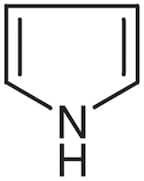
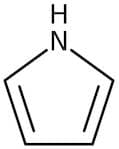
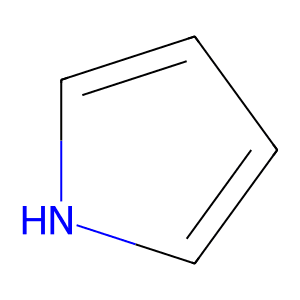
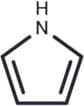
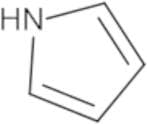
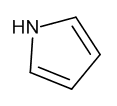
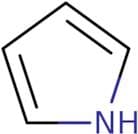
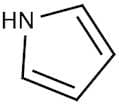
CAS 109-97-7
:1H-Pyrrol
- 1-Aza-2,4-cyclopentadiene
- 1H-Pyrrol
- 1H-Pyrrole
- Ai3-18817
- Azole
- Ccris 2933
- Divinyleneimine
- Divinylenimine
- FEMA No. 3386
- Hsdb 119
- Imidole
- Monopyrrole
- Nsc 62777
- Pirrol
- Pyrrol
- Unii-86S1Zd6L2C
- Weitere Synonyme anzeigen
Pyrrole
CAS:Formel:C4H5NReinheit:>99.0%(GC)Farbe und Form:Colorless to Light orange to Yellow clear liquidMolekulargewicht:67.09Pyrrole, 98+%
CAS:This Thermo Scientific Chemicals brand product was originally part of the Alfa Aesar product portfolio. Some documentation and label information may refer to the legacy brand. The original Alfa Aesar product / item code or SKU reference has not changed as a part of the brand transition to Thermo SciFormel:C4H5NReinheit:98+%Farbe und Form:Clear colorless to yellow to brown, LiquidMolekulargewicht:67.091H-Pyrrole
CAS:1H-PyrroleFormel:C4H5NReinheit:98+%Farbe und Form: clear. pale yellow liquidMolekulargewicht:67.09g/molPyrrole
CAS:Formel:C4H5NReinheit:≥ 99.0%Farbe und Form:Colourless to light yellow liquidMolekulargewicht:67.09Pyrrole
CAS:Pyrrole (1H-pyrrole) is a fungicides.Formel:C4H5NReinheit:>99.99%Farbe und Form:Dark Brown Liquid ClearMolekulargewicht:67.091H-Pyrrole
CAS:Kontrolliertes ProduktApplications 1H-Pyrrole is a five membered heteroaromatic ring that is used as a synthetic intermediate to create products for the pharmaceutical, chemical, food and cosmetic industries. 1H-Pyrrole has the ability to undergo electrochemical polymerization, producing a durable, conductive film that can be used to coat biosensors.
Not a dangerous good if item is equal to or less than 1g/ml and there is less than 100g/ml in the package
References Diaz, A., et al.: J. Chem. Soc. Chem. Comm., 14, 635 (1979); Kaneto, K.: Curr. Appl. Phys., 5, 178 (2005); Lipshutz, B.: Chem. Rev., 86, 795 (1986)Formel:C4H5NFarbe und Form:NeatMolekulargewicht:67.09Pyrrole
CAS:Pyrrole is a small molecule that inhibits the growth of bacteria by binding to the 50S ribosomal subunit. The drug has been shown to be effective in inhibiting the growth of resistant mutants, which may be due to its ability to bind to sephadex g-100. Pyrrole binds to bacterial 16S ribosomal RNA and inhibits protein synthesis, leading to cell death by inhibiting the production of proteins vital for cell division. It also inhibits ATP binding cassette transporter and transfer reactions in bacterial cells. Pyrrole has been shown to have anti-inflammatory properties, which may be due to its inhibition of prostaglandin synthesis.
Formel:C4H5NReinheit:Min. 95%Farbe und Form:Clear LiquidMolekulargewicht:67.09 g/molPyrrole extrapure, 99%
CAS:Formel:C4H5NReinheit:min. 99%Farbe und Form:Clear, Pale yellow to brown, LiquidMolekulargewicht:67.09