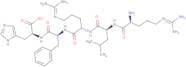
CAS 109024-47-7
:b-Bag-Zellpeptid (Aplysia californica)
Beschreibung:
Das b-Bag Cell Peptid, abgeleitet von dem marinen Mollusken Aplysia californica, ist ein Neuropeptid, das eine bedeutende Rolle bei der Modulation der neuronalen Aktivität und des Verhaltens spielt. Dieses Peptid ist Teil einer größeren Familie von Neuropeptiden, die an verschiedenen physiologischen Prozessen beteiligt sind, einschließlich der Stressreaktion und reproduktiven Verhaltensweisen. Charakteristisch für das b-Bag Cell Peptid ist seine relativ kleine molekulare Größe, und es besteht aus einer spezifischen Sequenz von Aminosäuren, die zu seiner biologischen Aktivität beitragen. Es fungiert hauptsächlich als Signalmolekül, das die neuronale Erregbarkeit und die synaptische Übertragung beeinflusst. Das Peptid ist bekannt für seine Rolle bei der Aktivierung von Bag-Zellen, die Cluster von neurosekretorischen Zellen sind, die Hormone freisetzen, die die reproduktiven Funktionen beeinflussen. Seine Struktur und Funktion sind von Interesse in der Neurobiologie und Pharmakologie, da das Verständnis seiner Mechanismen Einblicke in ähnliche Prozesse bei anderen Organismen geben kann. Die Forschung zum b-Bag Cell Peptid untersucht weiterhin seine potenziellen Anwendungen in der Neurowissenschaft und therapeutischen Interventionen.
Formel:C33H53N13O6
Synonyme:- Beta-Bag Cell Peptide (Aplysia californica) trifluoroacetate salt
- β-Bag Cell Peptide (Aplysia californica) trifluoroacetate salt
- b-Bag Cell Peptide (Aplysia californica)
- L-Histidine, L-arginyl-L-leucyl-L-arginyl-L-phenylalanyl-
- β-Bag Cell Peptide (Aplysia californica)
Sortieren nach
Reinheit (%)
0
100
|
0
|
50
|
90
|
95
|
100
1 Produkte.
Beta-Bag Cell Peptide (Aplysia californica) trifluoroacetate salt
CAS:Aplysia californica is a species of sea slug that produces a peptide, beta-Bag Cell Peptide (BACP), which has been shown to have depolarizing effects on neurons. BACP can be synthesized from the amino acid sequence of the Aplysia californica cell membrane protein, and this synthetic peptide has been shown to have maximal depolarizing effects at high concentrations. The depolarizing effect of BACP can be seen in populations of neurons as well as individual neurons. This peptide also desensitizes autoreceptors for acetylcholine and serotonin, which may play a role in its electrophysiological effects.Formel:C33H53N13O6Reinheit:Min. 95%Molekulargewicht:727.86 g/mol