CAS 110-60-1
:Putrescin
Beschreibung:
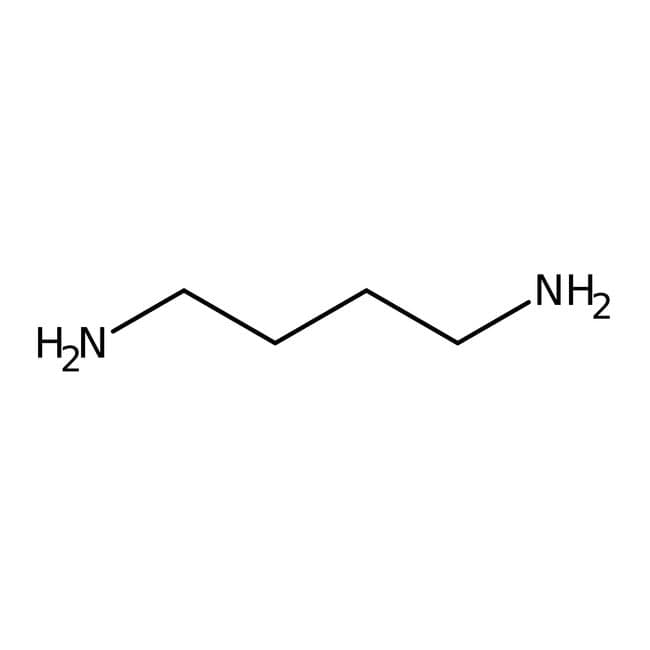
Putrescin, mit der CAS-Nummer 110-60-1, ist eine biogene Amine, die durch ihre einfache Struktur als lineare aliphatische Diamin, speziell 1,4-Butandiamin, gekennzeichnet ist. Sie ist farblos und hat einen starken, unangenehmen Geruch, der an verrottendes Fleisch erinnert, was ihren Einfluss auf biologische Prozesse im Zusammenhang mit Zersetzung und Fäulnis widerspiegelt. Putrescin wird natürlich in lebenden Organismen durch die Decarboxylierung der Aminosäure Ornithin produziert und ist an verschiedenen physiologischen Funktionen beteiligt, einschließlich Zellwachstum und -differenzierung. Sie ist in Wasser und polaren organischen Lösungsmitteln löslich, was sie für biochemische Reaktionen leicht verfügbar macht. Neben ihrer biologischen Bedeutung wird Putrescin in verschiedenen industriellen Anwendungen eingesetzt, einschließlich der Synthese von Kunststoffen, Harzen und Arzneimitteln. Sie kann jedoch in hohen Konzentrationen toxisch sein, und ihr Vorhandensein in Lebensmitteln oder biologischen Proben wird oft mit Verderbnis in Verbindung gebracht. Insgesamt dient Putrescin als eine wichtige Verbindung sowohl in biologischen als auch in industriellen Kontexten und hebt ihre doppelte Natur als natürlicher Metabolit und potenzielle Gefahr hervor.
Formel:C4H12N2
InChl:InChI=1S/C4H12N2/c5-3-1-2-4-6/h1-6H2
InChI Key:InChIKey=KIDHWZJUCRJVML-UHFFFAOYSA-N
SMILES:C(CCN)CN
Synonyme:- 1,4-Butanediamine
- 1,4-Butylenediamine
- 1,4-Diamimobutane
- 1,4-Diamino-n-butane
- 1,4-Tetramethylenediamine
- Butane, 1,4-Diamino-
- Butane-1,4-Diamine
- Nsc 60545
- Putramine
- Putrascine
- Putrescin
- Putrescine
- Putrescine Free Base
- Tetramethylendiamin
- Tetramethylenediamine
- Tetrametilendiamina
- α,ω-Butanediamine
- Weitere Synonyme anzeigen
Sortieren nach
Reinheit (%)
0
100
|
0
|
50
|
90
|
95
|
100
11 Produkte.
1,4-Diaminobutane
CAS:Formel:C4H12N2Reinheit:>98.0%(GC)(T)Farbe und Form:White or Colorless to Almost white or Almost colorless powder to lump to clear liquidMolekulargewicht:88.151,4-Diaminobutane, 98+%
CAS:1,4-Diaminobutane is used as a precursor in many biological systems and synthon for amido-ureas. It is involved in the synthesis of nylon 46 by reacting with adipic acid. This Thermo Scientific Chemicals brand product was originally part of the Alfa Aesar product portfolio. Some documentation and laFormel:C4H12N2Reinheit:98+%Farbe und Form:Clear colorless to pale yellow, Liquid as meltMolekulargewicht:88.151,4-Diaminobutane
CAS:Formel:C4H12N2Reinheit:(GC) ≥ 99.0%Farbe und Form:Colourless to white, solid, powder or liquidMolekulargewicht:88.151,4-Butanediamine
CAS:1, 4-butanediamine is an aliphatic diamine compound that can be used as an analytical reagent to assist in precise detection experiments and also as a dye intermediate to facilitate the synthesis of various functional dyes.Formel:C4H12N2Farbe und Form:SolidMolekulargewicht:88.15151,4-Diaminobutane
CAS:Formel:C4H12N2Reinheit:98.0%Farbe und Form:Low Melting SolidMolekulargewicht:88.154Putrescine, free base
CAS:Putrescine, free baseFormel:C4H12N2Reinheit:By gc: 99.7% (Typical Value in Batch COA)Farbe und Form: colourless low melting solidMolekulargewicht:88.15148g/molPutrescine, free base
CAS:Discovered in 1885, Putrescine is a colorless solid with a melting point close to room temperature, specifically at 26°C. This diamine is ubiquitous across all organisms and stands out as the most prevalent polyamine within plant tissues. Its organic composition is pivotal in stress responses, and its absence is frequently linked to increased susceptibility to parasites and fungi in plants. Beyond its biological role, Putrescine finds utility in industrial applications. One noteworthy application is its involvement in the synthesis of polyamide nylon through a reaction with adipic acid.Formel:C4H12N2Reinheit:Min. 99.0 Area-%Molekulargewicht:88.15 g/mol1,4-Diaminobutane
CAS:Kontrolliertes ProduktApplications 1,4-Diaminobutane is an amino acid degradation product. Used in the preparation of hexahydropyrimidines as novel hepatitis C virus inhibitors. Also a reagent in the synthesis of antibacterial castor oil-based polyurethane membranes.
Not a dangerous good if item is equal to or less than 1g/ml and there is less than 100g/ml in the package
References Hwang, J. et al.: Eur. J. Med. Chem., 70, 315 (2013); Yari, A. et al.: J. Biomed. Mat. Res., 102A, 84 (2014);Formel:C4H12N2Farbe und Form:Colourless To Off-WhiteMolekulargewicht:88.15Putrescine free base extrapure, 99%
CAS:Formel:C4H12N2Reinheit:min. 99%Farbe und Form:Clear, Colorless, Liquid / SemisolidMolekulargewicht:88.15