CAS 110042-95-0
:Acemannan
Beschreibung:
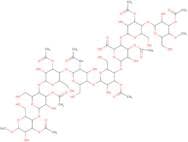
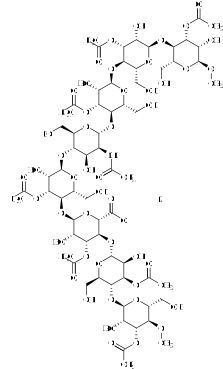
Acemannan ist ein Polysaccharid, das aus dem Gel des inneren Blattes der Aloe-Vera-Pflanze gewonnen wird und für seine verschiedenen biologischen Eigenschaften bekannt ist. Es besteht hauptsächlich aus Mannose und hat eine komplexe Struktur, die ein Rückgrat aus β-(1→4)-verknüpften Mannoseeinheiten mit verschiedenen Acetylgruppen und Seitenketten umfasst. Acemannan zeigt immunmodulatorische, entzündungshemmende und wundheilende Eigenschaften, was es zu einer beliebten Zutat in kosmetischen und pharmazeutischen Formulierungen macht. Seine Fähigkeit, die Hautfeuchtigkeit zu verbessern und die Gewebereparatur zu fördern, wird seiner Fähigkeit zugeschrieben, die Aktivität von Fibroblasten und die Kollagensynthese zu stimulieren. Darüber hinaus wurde Acemannan auf seine potenziellen antiviralen und antibakteriellen Wirkungen untersucht, was zu seiner Verwendung in der alternativen Medizin beiträgt. Die Substanz wird allgemein als sicher für die topische Anwendung anerkannt, obwohl ihre Wirksamkeit je nach Formulierung und Konzentration variieren kann. Insgesamt wird Acemannan für sein therapeutisches Potenzial geschätzt und wird häufig in Gesundheits- und Wellnessprodukten verwendet.
Formel:C64H97NO49
InChl:InChI=1/C66H101NO49/c1-18(75)67-33-34(83)42(26(11-68)102-59(33)110-44-29(14-71)106-63(38(87)51(44)97-21(4)78)113-46-30(15-72)107-64(39(88)53(46)99-23(6)80)111-45-28(13-70)103-60(94-10)35(84)50(45)96-20(3)77)109-61-37(86)52(98-22(5)79)48(32(17-74)105-61)114-66-41(90)55(101-25(8)82)56(57(116-66)58(91)92)115-65-40(89)54(100-24(7)81)47(31(16-73)108-65)112-62-36(85)49(95-19(2)76)43(93-9)27(12-69)104-62/h26-57,59-66,68-74,83-90H,11-17H2,1-10H3,(H,67,75)(H,91,92)/p-1/t26-,27-,28-,29-,30-,31-,32-,33+,34-,35+,36+,37+,38+,39+,40+,41+,42-,43-,44-,45-,46-,47-,48-,49-,50-,51-,52-,53-,54-,55-,56+,57+,59-,60+,61-,62-,63-,64-,65-,66+/m1/s1
Synonyme:- (2S,3S,4R,5S,6S)-6-{[(2R,3R,4R,5S,6R)-6-{[(2R,3S,4R,5S,6R)-5-(acetylamino)-6-{[(2R,3R,4R,5S,6R)-4-(acetyloxy)-6-{[(2R,3R,4R,5S,6R)-4-(acetyloxy)-6-{[(2R,3R,4R,5S,6S)-4-(acetyloxy)-5-hydroxy-2-(hydroxymethyl)-6-methoxytetrahydro-2H-pyran-3-yl]oxy}-5-hydroxy-2-(hydroxymethyl)tetrahydro-2H-pyran-3-yl]oxy}-5-hydroxy-2-(hydroxymethyl)tetrahydro-2H-pyran-3-yl]oxy}-4-hydroxy-2-(hydroxymethyl)tetrahydro-2H-pyran-3-yl]oxy}-4-(acetyloxy)-5-hydroxy-2-(hydroxymethyl)tetrahydro-2H-pyran-3-yl]oxy}-4-(acetyloxy)-3-{[(2R,3S,4R,5R,6R)-4-(acetyloxy)-5-{[(2R,3S,4R,5R,6R)-4-(acetyloxy)-3-hydroxy-6-(hydroxymethyl)-5-methoxytetrahydro-2H-pyran-2-yl]oxy}-3-hydroxy-6-(hydroxymethyl)tetrahydro-2H-pyran-2-yl]oxy}-5-hydroxytetrahydro-2H-pyran-2-carboxylate (non-preferred name)
- Acemananan
- Acemananan [INN-Spanish]
- Acemannan [USAN:INN]
- Acemannan hydrogel
- Acemannan is a highly acetylated, polydispersed, linear mannan obtained from the mucilage of Aloe barbadensis, Miller (aloe vera)
- Acemannan is a highly acetylated, polydispersed, linear mannan obtained from the mucilage of Aloe barbadensis, Miller (aloe vera). Molecular weight is 1-2 million daltons
- Acemannanan
- Acemannanum
- Acemannanum [INN-Latin]
- Aloe Vera Mucilage
- Carraklenz Wound & Skin Cleanser
- Carrisyn
- Snow & Sun Sports Gel
- alpha-D-Galacto-beta-D-mannan, (1-4),(1-6)-, acetate
- α-<span class="text-smallcaps">D</smallcap>-Galacto-β-<smallcap>D</span>-mannan, (1→4),(1→6)-, acetate
- α-D-Galacto-β-D-mannan, (1→4),(1→6)-, acetate
- Acemannan
- Ace-m
- Acemannan Q: What is the storage condition of
- Polymannoacetate
- Aids-000120
- Acemannan (Technical Grade)
- Acemannan Q: What is the CAS Number of
- Aids000120
- Weitere Synonyme anzeigen
Sortieren nach
Reinheit (%)
0
100
|
0
|
50
|
90
|
95
|
100
3 Produkte.
Acemannan
CAS:Acemannan is a natural compound found in the Aloe vera plant and has been used in traditional Chinese medicine for its various health benefits. It has been shown to have anticancer properties by inhibiting cancer cell growth and inducing apoptosis. Acemannan works by targeting various kinases and proteins involved in tumor development, making it an effective inhibitor of cancer progression. This compound has also been found to have angiotensin-converting enzyme (ACE) inhibitory activity, which can help regulate blood pressure. Acemannan analogs have been developed and tested for their potential as anticancer agents, showing promising results in human urine cancer cell lines. Overall, acemannan is a powerful natural compound with many potential health benefits.Formel:C66H101NO49Reinheit:Min. 95%Molekulargewicht:1,692.5 g/molRef: 4Z-A-166001
Ausgelaufenes produkt